
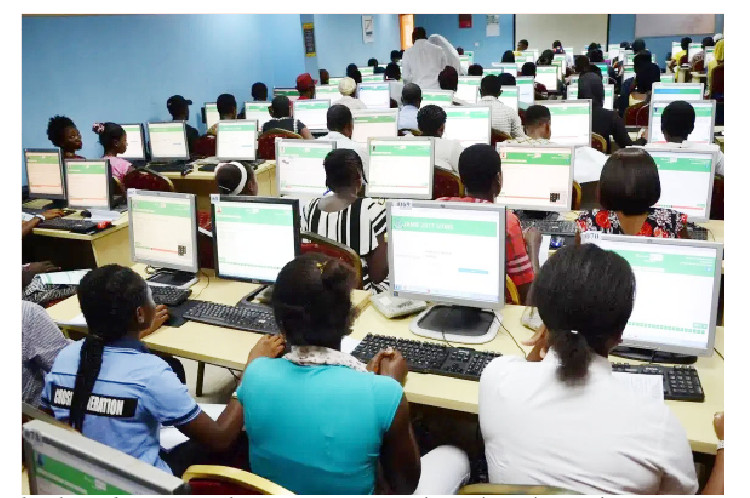
As candidates sit for this year’s Unified Tertiary Matriculation Examination (UTME), computer literacy continues to pose anxiety for many.
Despite years of transition to Computer-Based Testing (CBT), anxiety over basic digital skills continues to shape performance, exposing a persistent gap in Nigeria’s education system.
UTME, organised by the Joint Admissions and Matriculation Board (JAMB), is conducted entirely as a Computer-Based Test. The system was introduced to modernise assessment, reduce malpractice, speed up result processing, and align Nigeria with global examination standards.
Over time, it has succeeded in improving efficiency and transparency in many respects. However, it has also revealed deep inequalities in access to digital literacy.
Despite the technical structure of the CBT system, many candidates continue to struggle with its practical demands.
Across examination centres, candidates often arrive early, clutching their printouts and revising possible questions. However, once seated in front of a computer, confidence frequently gives way to confusion for some candidates.
Some candidates struggle with basic tasks such as moving between questions, using the mouse effectively, or interpreting on-screen instructions.
For first-time users, the presence of a ticking timer increases pressure and heightens anxiety.
In an interview with LEADERSHIP, candidates shared real-time accounts of their experiences. Many admitted that unfamiliarity with the system cost them valuable time, while others said fear of pressing the wrong button disrupted their concentration.
A recurring concern is that academic preparation alone is no longer sufficient; digital competence has become an unspoken requirement.
Stakeholders have attributed this challenge to systemic gaps in access to ICT training. While private schools and well-funded institutions often introduce students to computers early, many public schools still lack functional ICT laboratories.
In several cases, students only encounter computers for the first time during UTME registration or practice sessions.
Even where ICT facilities exist, irregular power supply and limited access mean that hands-on experience remains minimal. This creates an uneven playing field between candidates who are digitally comfortable and those who are not.
Parents of UTME 2026 candidates also said disparity affects performance in subtle but significant ways. According to them, while some candidates focus entirely on answering questions, others must divide attention between understanding the system and solving academic problems.
This imbalance, they said can influence overall outcomes, even when subject knowledge is adequate.
For many candidates, the CBT environment itself becomes a source of pressure rather than a neutral testing platform.
Some candidates who participated in the 2026 examination described their experiences as overwhelming, especially in rural areas. One candidate, Mercy Christopher, who wrote the UTME on a Monday, said she was touching a computer for the first time during the examination.
According to her, while JAMB has made efforts to simplify the process, it remains challenging for candidates without prior experience.
“When I sat on the computer, I first had anxiety. I was even scared to touch it. Calculating Mathematics questions within the short time frame was also difficult for me. One of my friends pressed the submit button even before finishing the exam by mistake,” she said.
Christopher who confirmed to LEADERSHIP on Tuesday that she scored 177, said she will enroll for computer programme to prepare well for next year as she intend to study nursing.
A parent, identified as Anable, whose son sat for the examination at Good Success Computer-Based Test Centre in Utako, Abuja, said she took proactive steps to prepare her child by enrolling him in a computer training centre for three months before the examination
She emphasised the importance of early digital education.
“Parents should do well to equip their children with computer skills. It is very important. Most of these children will not tell you, but the anxiety of sitting in front of a computer alone can make them fail exams,” she said.
LEADERSHIP report that examination process usually begins long before candidates enter the hall. After registration, candidates print their examination slips, which contain essential details such as examination date, time, and assigned CBT centre.
These sessions are usually divided into morning and afternoon batches depending on scheduling.
On the day of the examination, candidates are expected to arrive at their designated centres at least one to two hours early.
At the entrance, strict security checks are conducted. Personal belongings such as mobile phones, calculators, bags, and other electronic devices are prohibited within the examination premises.
Following security checks, candidates undergo identity verification. This includes confirmation of registration details, examination slips, and biometric fingerprint scanning to ensure each candidate matches JAMB’s database.
Once verification is complete, candidates are directed to their assigned computer terminals. They are logged into a secure CBT interface, where instructions appear on the screen before the examination begins. A countdown timer is then activated immediately the test starts, and candidates must manage their time carefully.
The examination comprises multiple-choice questions covering Use of English, which is compulsory for all candidates, and three other subjects based on each candidate’s chosen course of study. Candidates select answers using a mouse or keyboard.
They may skip questions, return to them later, and navigate between sections within the allocated time.
The test typically lasts about two hours. When time expires, the system automatically submits responses, whether or not the candidate has completed all questions.
Candidates may also submit manually if they finish early. After submission, responses are instantly recorded on JAMB’s central servers for processing.
Results are later released in batches via the official JAMB portal or through SMS using registered phone numbers.
As of Tuesday, JAMB had released results for candidates who sat for the examination on Friday, 17 April; Saturday, 18 April; and Monday, 20 April 2026.
Candidates who participated on these dates were advised to check their results using the established process.
Earlier, JAMB had also released results for candidates who sat on Thursday, 16 April 2026. A total of 632,752 results were made available for that day alone.
Subsequently, results for candidates who sat on Friday, 17 April and Saturday, 18 April were released, totalling 1,264,940 candidates across both days.
With the inclusion of the latest batch, the total number of results released so far has risen to over 1,897,692 candidates.
JAMB advised candidates to check their results by sending “UTMERESULT” to either 55019 or 66019 using the same phone number used during registration.
We’ve got the edge. Get real-time reports, breaking scoops, and exclusive angles delivered straight to your phone. Don’t settle for stale news. Join LEADERSHIP NEWS on WhatsApp for 24/7 updates →
Join Our WhatsApp Channel