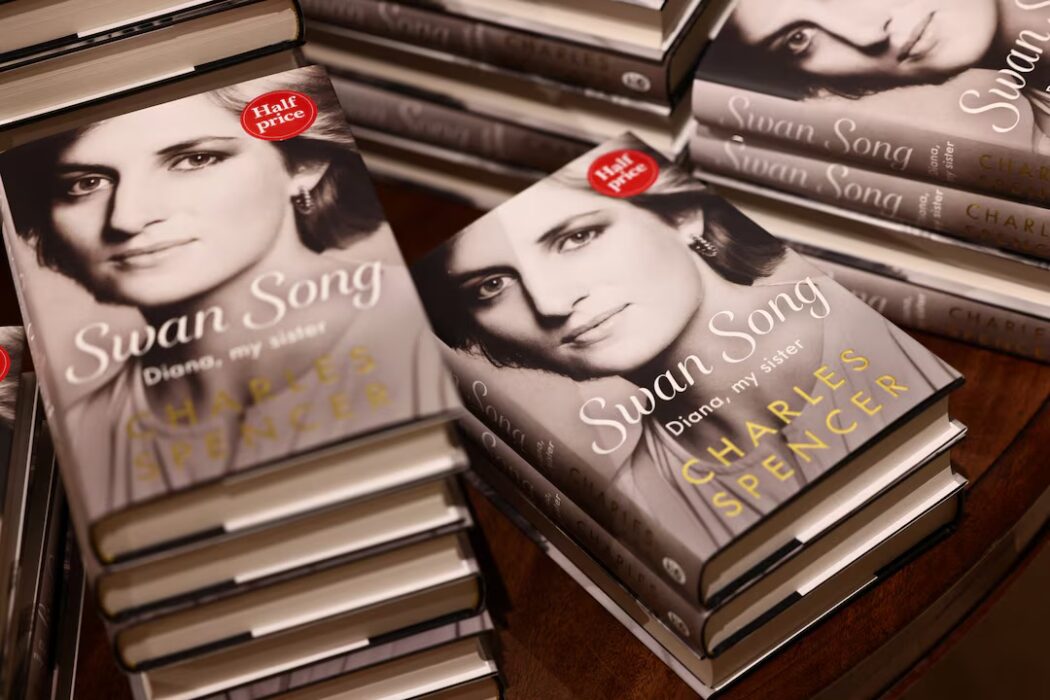
Charles Spencer’s memoir about his late sister, Diana, Princess of Wales, has gone on sale nearly three decades after her death, bringing renewed attention to the troubled relationship between Diana and the British Royal Family.
Swan Song: Diana, My Sister, published on Tuesday, September 22, offers Spencer’s personal account of Diana’s life, their childhood together and the events surrounding her death in Paris in 1997.
The 384-page memoir was published by Penguin and released in the UK and other English-speaking markets, with editions translated into 12 languages for international readers.
Spencer, the 9th Earl Spencer, has described the book as his attempt to tell Diana’s story from the perspective of her younger brother. He said the approaching 30th anniversary of her death prompted him to put his memories on record rather than continue reading accounts of his sister that he believes contain inaccuracies.
The book has attracted particular attention for Spencer’s recollections of his relationship with Diana and his accounts of the period immediately following her death, including his dealings with her former husband, King Charles III.
One of the most contentious passages concerns a telephone conversation Spencer says he had with Charles in the days after Diana died.
According to Spencer, the conversation followed a disagreement over plans for Princes William and Harry, then aged 15 and 12, to walk behind their mother’s coffin during her funeral procession.
Spencer says he objected because he believed Diana would not have wanted her sons to endure the ordeal. He claims Charles responded angrily before telling him: “Rest assured, we’ll forget her soon enough.”
Spencer has continued to stand by the account, telling the BBC that those were “precisely the words” Charles used.
Buckingham Palace, however, issued an unusual response to the claim. While stating that it does not normally comment on books, a Palace spokesperson said the King was mindful that grief could affect reason, judgement and memory, including many years after a traumatic loss.
Spencer also describes Charles as sounding “giddily elated” when they spoke after Diana’s death. He suggests the then-Prince of Wales may have viewed her death as freeing him to marry Camilla, although he acknowledges that he could not know what Charles was thinking.
The memoir also revisits Diana’s position within the Royal Family following her divorce from Charles in 1996.
Spencer recounts that Queen Elizabeth II offered to restore Diana’s HRH styling after her death. He says he rejected the idea because he believed the gesture would have meant little to Diana by that point.
Beyond the controversy surrounding Charles, Spencer uses the memoir to challenge some long-held perceptions of Diana’s early life.
He has described their childhood at the Spencer family estate, Althorp, as a happy one and disputes portrayals of Diana as having experienced an unhappy upbringing. At the same time, he acknowledges that there may have been aspects of her private life and emotional experiences that were unknown to him.
The memoir follows Diana’s journey from her childhood within the aristocratic Spencer family to her marriage to Charles in 1981 and her emergence as one of the world’s most recognisable public figures.
Her marriage to Charles deteriorated over the following years, with the couple separating in 1992 before their divorce was finalised in 1996.
Diana died on August 31, 1997, after the car in which she was travelling crashed in the Pont de l’Alma tunnel in Paris. She was 36.
Her death triggered an unprecedented public outpouring of grief and placed the Royal Family under intense scrutiny over its response to the tragedy. Spencer delivered the eulogy at her funeral at Westminster Abbey on September 6, 1997.
The memoir has also become embroiled in a separate dispute involving broadcaster Piers Morgan.
Spencer acknowledged on Tuesday that he had made a factual error in the book concerning Morgan’s employment at the time photographs of Diana exercising at a gym were published by the Mirror Group in 1993.
The book incorrectly suggested Morgan was editor of the Daily Mirror at the time. Morgan was actually working for The Sun and did not join the Daily Mirror until 1995.
Spencer has apologised for the error and said a corrected version will address it. He nevertheless maintains his recollection that Morgan was “surly and annoyed” during a later telephone conversation in which Spencer told him he was not welcome at Diana’s funeral.
Morgan has said he intends to pursue legal action over the claims, despite Spencer’s apology.
The dispute has added another layer of scrutiny to Swan Song, particularly because Spencer presents himself in the memoir as an eyewitness seeking to preserve his personal memories of Diana.
For Spencer, the book is ultimately intended as a portrait of his sister from someone who knew her before she became Princess of Wales and one of the most photographed women in the world.
But its publication has also renewed public discussion around Diana’s marriage, her relationship with the Royal Family and the events that followed her death, subjects that continue to attract intense interest almost 30 years later.
We’ve got the edge. Get real-time reports, breaking scoops, and exclusive angles delivered straight to your phone. Don’t settle for stale news. Join LEADERSHIP NEWS on WhatsApp for 24/7 updates →
Join Our WhatsApp Channel