
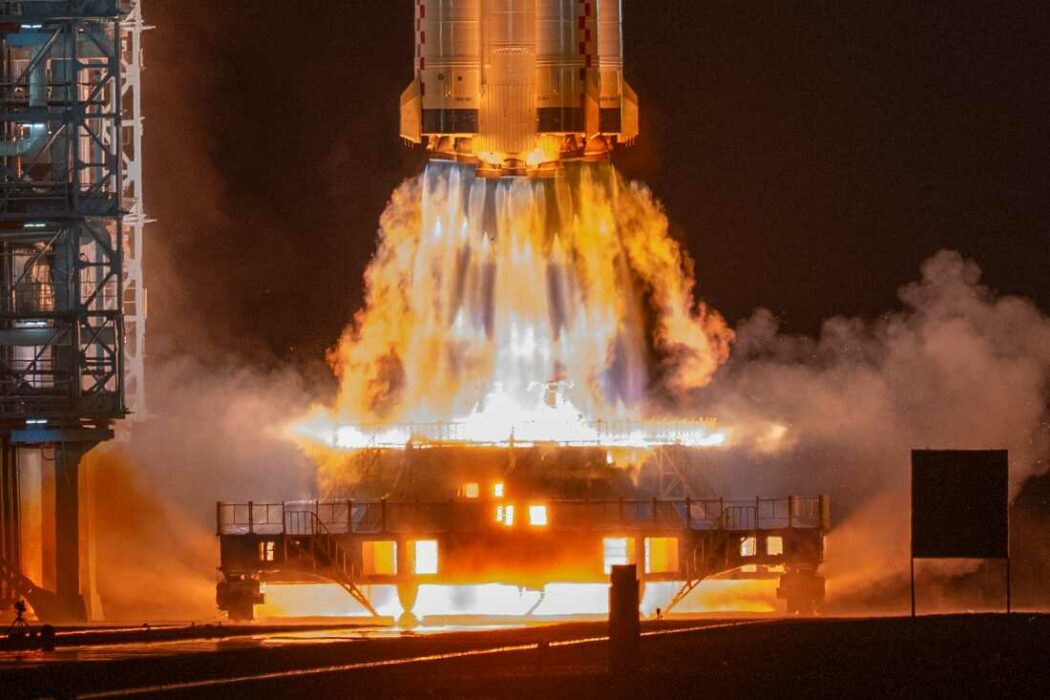
China has launched its Shenzhou-23 mission, marking a major milestone in its space programme as it prepares for a historic first year-long astronaut stay in orbit and advances plans for a crewed Moon mission by 2030.
The mission lifted off on Sunday aboard a Long March 2-F rocket, which blasted off at 11:08 pm (1508 GMT) from the Jiuquan launch centre in the Gobi Desert, according to state broadcaster CCTV.
The China Manned Space Agency confirmed that the spacecraft successfully separated from the rocket about 10 minutes after launch and entered orbit, describing the mission as fully successful.
“The astronauts are in good condition, and the launch has been a complete success,” the agency said on social media.
The mission includes three astronauts, including 43-year-old Li Jiaying, who becomes the first person from Hong Kong to travel to space. The crew also includes space engineer Zhu Yangzhu and former air force pilot Zhang Zhiyuan, both 39.
The astronauts were seen saluting during a farewell ceremony before launch, as crowds waved Chinese flags and a military band performed.
The crew will conduct a range of scientific experiments in life sciences, materials science, fluid physics, and medicine aboard the Tiangong space station.
A key objective of the mission is to test the effects of long-duration spaceflight, with one astronaut expected to remain in orbit for a full year—the longest Chinese crewed mission to date.
Experts say the experiment will provide critical data on bone density loss, muscle wasting, radiation exposure, and psychological effects associated with extended stays in microgravity.
The mission is part of China’s broader plan to strengthen its long-term human presence in space and prepare for future lunar and Mars exploration.
China is also developing next-generation spacecraft under its Mengzhou programme, expected to support future Moon missions and replace the current Shenzhou series.
Beijing aims to establish a crewed lunar research base by 2035 under the International Lunar Research Station initiative, while also expanding cooperation with select international partners.
The country’s space programme has grown rapidly in recent decades, with milestones including the Chang’e-4 landing on the Moon’s far side in 2019 and the Tianwen-1 Mars rover mission in 2021.
We’ve got the edge. Get real-time reports, breaking scoops, and exclusive angles delivered straight to your phone. Don’t settle for stale news. Join LEADERSHIP NEWS on WhatsApp for 24/7 updates →
Join Our WhatsApp Channel