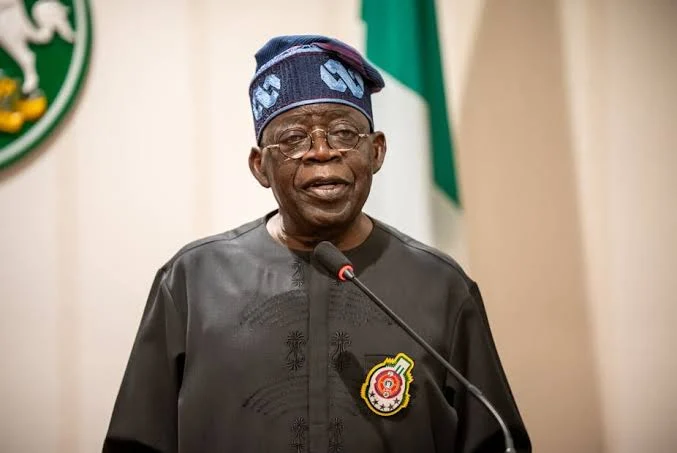
President Bola Ahmed Tinubu on Tuesday declared climate change a matter of national security, warning that its growing impact on food production, livelihoods and economic stability demands urgent and coordinated action across all tiers of government.
The President spoke at the launch of the Renewed Hope Climate Change Awareness Tour (REHCCAT) at the State House, Abuja, where he called on governors, the private sector, and development partners to take the lead in driving Nigeria’s transition to a climate-resilient, low-carbon economy.
Represented by the Minister of Environment, Balarabe Abbas Lawal, Tinubu said climate change is no longer a distant environmental concern but a present danger affecting farmers in the North facing desert encroachment, coastal communities in the South battling erosion and flooding, and businesses grappling with rising energy costs and supply chain disruptions.
“Climate resilience is not optional; it is national security,” the President stated. “Climate change is here. It affects our farmers, our coastal communities, our businesses and the future of our young people. The choices we make today will determine the Nigeria of tomorrow.”
Tinubu described the nationwide awareness tour as more than a series of events, calling it a “national call to action” aimed at moving climate engagement beyond conference halls and into communities, farms, markets and classrooms.
According to him, Nigeria stands at a defining moment as the global transition to low-carbon development accelerates, with capital shifting, markets evolving and technology transforming industries. He stressed that the countries that position themselves wisely would lead the future global economy.
“Climate change is not only about risk; it is also about opportunity,” he said. “The global transition is accelerating, and we intend to be among the nations that lead.”
The President said the tour would engage governors, traditional rulers, students, innovators, entrepreneurs, farmers and financial institutions to identify bankable climate projects, unlock local solutions and strengthen Nigeria’s capacity to mobilise climate finance at scale.
He emphasised that Nigeria’s Nationally Determined Contributions (NDCs) under the Paris Agreement are not mere documents but commitments to reduce emissions, enhance resilience and safeguard communities. However, he added that commitments must be matched with action and backed by investment.
“This tour will help bridge the gap between ambition and implementation. We will catalyse project pipelines at the subnational level, deepen our understanding of carbon markets and green finance, and mobilise partnerships between the public and private sectors,” Tinubu said.
The President urged state governments to serve as engines of climate resilience and green growth, while challenging the private sector to innovate boldly and invest responsibly in the emerging green economy.
“To our young people, this transition belongs to you. Your ideas, your technology and your entrepreneurship will shape Nigeria’s future,” he added, noting that climate finance should be viewed not as charity but as strategic investment.
In his remarks, the Minister of Environment, represented by the Director of Forestry, Halima Bawa, said the Federal Government is working to consolidate climate governance at the state level through performance rankings, institutional reforms and inter-state collaboration frameworks.
He noted that the effects of climate change are already evident across the country, from desert encroachment in the North and flooding in riverine communities to coastal erosion in the South and erratic rainfall patterns affecting farmers nationwide.
The minister highlighted the Climate Change Act 2021 as a landmark legal framework that established coordinated climate governance, carbon budgeting and a pathway to net-zero emissions by 2060, stressing that climate governance must be domesticated at subnational and grassroots levels.
Chairman of the REHCCAT Committee and Special Assistant to the President on Climate Change Matters, Comrade Yussuf Olatunji Kelani, described the initiative as a whole-of-government and whole-of-society approach to tackling climate challenges.
He said the tour would move across Nigeria’s six geopolitical zones, beginning with two states per zone in the first phase, and would feature high-level policy dialogues, town hall meetings, technical roundtables and innovation showcases focused on clean energy, waste-to-value initiatives, climate-smart agriculture and green enterprise solutions.
Kelani stressed that climate change has evolved into a development, economic, and social justice concern, with visible impacts including flooding, desertification, and rising food prices.
Guest speaker, Professor Babajide Alo, who delivered a lecture titled Securing Our Climate Future: Empowering Communities for a Resilient Nigeria, urged governments at all levels to move beyond top-down technocratic approaches and empower local communities to drive adaptation using indigenous knowledge and inclusive decision-making.
He called for strengthened subnational capacities, improved climate education and clearer funding mechanisms to enable states and local governments to implement effective climate action.
With the launch of the Renewed Hope Climate Change Awareness Tour, the administration signalled a shift in framing climate change not only as an environmental challenge but as a strategic priority linked to national security, economic growth and long-term development.
We’ve got the edge. Get real-time reports, breaking scoops, and exclusive angles delivered straight to your phone. Don’t settle for stale news. Join LEADERSHIP NEWS on WhatsApp for 24/7 updates →
Join Our WhatsApp Channel