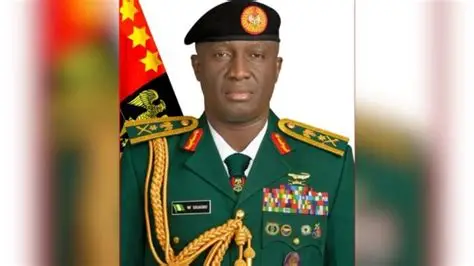
The Chief of Army Staff (COAS), Lieutenant General Waidi Shuibu, has reaffirmed the Nigerian Army’s commitment to sustaining its Civil-Military Cooperation (CIMIC) projects, aimed at improving community welfare and strengthening ties with civilians.
Lieutenant General Shuibu made the pledge during the commissioning of intervention projects, Modification of Atoshi Recreational Center in Wukari Local Government Area of Taraba State on Saturday.
The COAS said, the initiative was designed to foster public support, enhance cooperation and promote community development.
According to him, the projects also provide an avenue for the military to build trust with host communities, saying the role of civilians as critical in achieving national security objectives in an increasingly complex security environment.
“The Chief of Army Staff Special Intervention Civil-Military Cooperation Project remains the cornerstone of our efforts in this regard,” he said.
According to him, the Nigerian Army has so far executed over 250 intervention projects across the six geopolitical zones of the country.
“These include the construction and rehabilitation of hospitals, schools, community town halls, laboratories, roads, solar-powered facilities, boreholes and information and communication technology centres.”
He explained that, the projects are meant to complement existing government infrastructure, particularly in communities of senior Army officers who have risen to the rank of Major General through distinguished service.
The COAS commended Governor Agbu Kefas for his infrastructural strides and provision of basic social amenities in Taraba State.
He urged residents to take ownership of the facilities and support the Army’s efforts to tackle all forms of insecurity in the country.
Lieutenant General Shuibu, then described Major General Maxwell Wunukhe Dangana as a dedicated and worthy officer, whose exemplary service with emulating.
He encouraged Major General Dangana to continue the good works in representing the interests of the people of Wukari.
In his remarks, the Chief of Civil-Military Affairs, represented by the Deputy Chief, Maj. Gen. MA Estu Ndagi, said the newly renovated recreational centre in Wukari was part of efforts to strengthen civil-military relations and support community development.
Represented by Maj. Gen. Aminu Umar, said the project reflects the Army’s commitment to non-kinetic strategies aimed at fostering collaboration with civilian populations.
“Today’s event forms part of the Nigerian Army’s effort to entrench a whole society approach to achieving national security objectives, as public cooperation remains critical to the success of our operations,” he said.
Maj. Gen. Ndagi explained that the Special Intervention have led to the execution of several quick-impact initiatives across communities nationwide, designed to deliver lasting benefits and encourage local ownership.
He commended residents of Taraba State for their continued support to the Nigerian Army, and urged them to sustain the collaboration in tackling insecurity, including banditry and other criminal activities in the North-East.
“Our contemporary security environment requires the active collaboration of all well-meaning Nigerians with the military and other security agencies in defeating our common adversaries,” he added.
He praised Maj. Gen. Dangana, currently Commander, Army Headquarters Garrison, for the exemplary execution of the project.
According to Ndagi, Dangana went beyond expectations in delivering the facility, which is expected to promote youth development, particularly in sports, and to enhance social cohesion within the community.
Earlier, Maj. Gen. Dangana said the renovation of the Atoshi Aguma II Recreational Centre in Wukari was part of the Army’s enduring commitment to promoting civil-military relations and addressing the socio-economic needs of host communities.
He noted that the project reflects the Nigerian Army’s resolve not only to secure the nation but also to support developmental initiatives that directly impact the lives of the people.
Giving brief historical context of the center, Maj. Gen. Dangana explained that the recreational centre was originally constructed in 1990 by the then administrator of Wukari Local Government Area, late Alhaji Nuhu Muhammed, as a hub for social interaction.
He added that the facility, designed by Bala Skaway, was later named after the late Aku-Uka of Wukari, Atoshi Aguma II, who reigned from 1945 to 1960.
According to him, the centre had not undergone any major renovation for over three decades until the recent intervention by the COAS special intervention project.
“The renovation was carefully carried out in consultation with the people of Wukari to ensure it meets their needs and aspirations,” he said.
He listed the upgraded features to include a modern gate, improved conveniences, sporting facilities such as lawn tennis and basketball courts, a pavilion, hall, solar-powered lighting, borehole and enhanced environmental aesthetics.
The event drew government officials, traditional rulers, community leaders and residents, who lauded the initiative as a significant boost to social infrastructural development in the area.
The project, executed under the COAS Special Intervention CIMIC initiative, is expected to boost social activities and community engagement in the area while strengthening the bond between the military and the civilian population.
We’ve got the edge. Get real-time reports, breaking scoops, and exclusive angles delivered straight to your phone. Don’t settle for stale news. Join LEADERSHIP NEWS on WhatsApp for 24/7 updates →
Join Our WhatsApp Channel