The Teachers Registration Council of Nigeria (TRCN), in conjunction with Plan International Nigeria, has trained teachers from different fields of learning, ahead of its reformed Professional Qualifying Examination (PQE) and digital literacy Model Design.
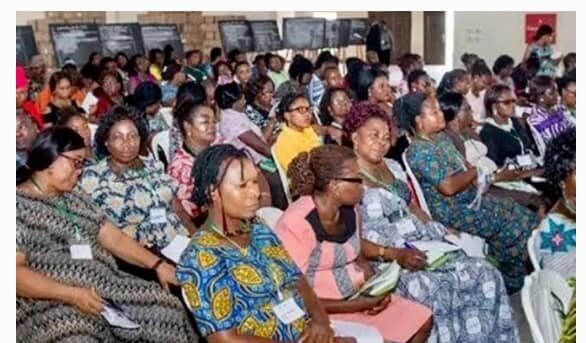
The five-day technical workshop on the “Reformed Professional Qualifying Examination and Digital Literacy Model Design” in Abuja at the weekend
This historical five-day technical workshop aim to finalise the reformed Professional Qualifying Examination (PQE), build a validated question bank, and design a digital literacy training model that prepares teachers for the new standards.
This landmark workshop brough stakeholder, TRCN management, Federal Ministry of Education, selected universities and colleges of education, curriculum/assessment experts, Plan International Nigeria, QEDA and development partners/CSOs amongst others.
The registrar TRCN, Dr. Ronke Soyombo emphasize that the new PQE streamlined 23 subjects into five, as follow competency domains: literacy, numeracy, digital literacy, pedagogy and safeguarding, that enhance improved learner outcomes.
Noted thar just last four months ago, 26,000 teachers had registered for the forthcoming PQE, saying by 2027 every practicing teacher must be registered as a TRCN professional teacher.
She explain that we are focusing on foundation literacy, mathematics, digital literacy, pedagogy and safeguarding, she said.”
“For Safeguarding, we are very particular about it, because every child in Nigeria needs to feel safe in our schools. So, teachers must be able to know what is expected of them, she said.”
She further stressing that when a child makes a disclosure to them, teachers must be able to know that there are supports for them also, if they are being abused as well.”
“Because we are not just looking at how students are being abused, we are also looking at how teachers can be abused in some cases,” she added.
She highlighted that the participants were selected from the basic education background, from tertiary education, maths specialists, literacy specialists, IT specialists and also safeguard specialist.
“So, what we are doing is to ensure that everybody is selected from different areas so that places are properly covered and professionally covered as well,” she said.
Meanwhile, Project Coordinator, Plan International Nigeria Mr Tanimudari Zakari, noted that Nigeria’s teacher certification is being modernised to better align with real classroom needs, especially in crisis contexts such as Adamawa and Sokoto.
Zakari explained that simplified, competency-based PQE: TRCN’s reform moves from 23 subjects to five core domains, Literacy, Numeracy, Digital Literacy, Pedagogy, and Safeguarding, aligned with global standards and classroom realities.
He stressing that teacher wellbeing and retention, professional development, psychosocial support and community integration will keep teachers in hard-to-serve locations.
Zakari underscored TRCN and Plan International Nigeria’s partnership as a catalyst for education reforms that translate into better learning for every child as well as advancing teacher professionalisation and classroom results across Nigeria.
He concluded that our goal is to empower 20 million girls to take action and drive change by 2028 and increase advocacy momentum for strategic education reviews.
In his remarks, Researcher with the University of Ibadan, Prof. Gbenga Adewole, underscored the need to design a digital literacy training model for improved learning outcomes.
We’ve got the edge. Get real-time reports, breaking scoops, and exclusive angles delivered straight to your phone. Don’t settle for stale news. Join LEADERSHIP NEWS on WhatsApp for 24/7 updates →
Join Our WhatsApp Channel