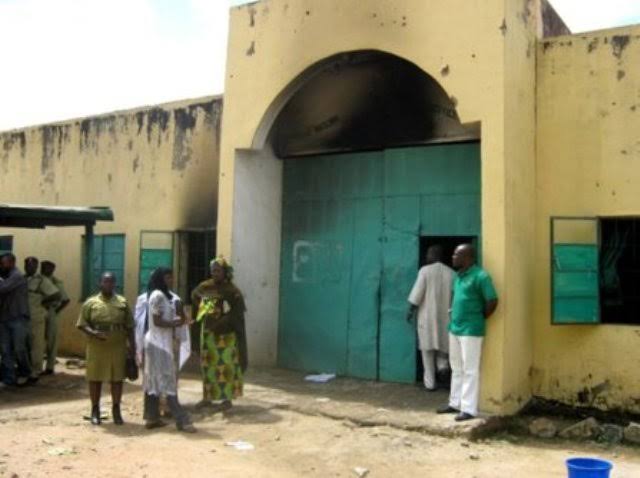
Recently, the Nigerian Correctional Service (NCoS) destroyed 1,167 mobile phones and other prohibited items recovered from custodial facilities across the country.
The Controller-General of Corrections (CG), Sylvester Ndidi Nwakuche, disclosed that the items were seized over the past eight months and included smartphones, SIM cards, chargers and other unauthorised materials.
According to him, the presence of such items within correctional facilities undermines security and enables inmates to sustain criminal activities from behind bars.
He further revealed that the sum of N2.569 million confiscated during the operations had been paid into the Federal Government treasury in line with financial regulations.
The CG also stated that 147 personnel had been sanctioned for various acts of misconduct, including complicity in the smuggling of contraband items pinto custodial centres.
Closely following this development was the arrest of two women allegedly attempting to smuggle illicit drugs into a custodial facility in Kano.
The Controller-General rightly observed that the smuggling of contraband into prisons fuels violence, sustains criminal networks and, in some cases, facilitates escape attempts.
These disturbing incidents once again expose the deep-rooted problems plaguing Nigeria’s correctional system.
As of February this year, Nigeria reportedly had more than 80,000 inmates spread across 241 custodial centres, in addition to several satellite and farm centres.
Many of these facilities remain severely overcrowded, poorly funded and inadequately staffed.
Reports also indicate that over 145 inmates escaped from correctional facilities in 2025 alone, with major incidents recorded in March and August.
Ordinarily, correctional centres are expected to serve as places of lawful custody, rehabilitation and reformation. They exist not merely to punish offenders but also to prepare them for eventual reintegration into society as responsible citizens.
Unfortunately, the persistent inflow of mobile phones, drugs and other prohibited items into custodial centres — often with the connivance of officials — is gradually turning some prisons into operational headquarters for criminal enterprises.
This newspaper recognises that the destruction of over 1,100 confiscated phones is not necessarily a sign of victory, but rather an indication of the scale of the challenge confronting the Nigerian Correctional Service.
The sheer number of recovered items points to an entrenched system of compromise that has continued to thrive despite repeated assurances of reform.
Mobile phones in prison are not merely contraband; they symbolise deeper institutional failings. They reflect chronic underfunding, weak oversight mechanisms, corruption, poor welfare conditions for personnel and a correctional philosophy that has largely failed to prioritise genuine rehabilitation.
It is difficult to explain how inmates repeatedly gain access to sophisticated communication devices without internal collaboration. In many cases, these gadgets are reportedly used to coordinate kidnappings, internet fraud, armed robbery and other crimes from within prison walls.
Even more troubling is the perception that Nigeria’s correctional facilities often operate a discriminatory system in which wealthy or influential inmates enjoy privileges unavailable to ordinary prisoners.
Such perceptions continue to damage public confidence in the justice system.
This newspaper recalls the controversy that erupted in September 2024 following allegations involving popular social media personality, Martins Otse, popularly known as VeryDarkMan, and crossdresser Idris Okuneye, widely known as Bobrisky.
In a leaked audio recording, Bobrisky allegedly claimed that he did not spend his prison term within the custodial facility as officially stated, but instead stayed in a private apartment allegedly arranged through influential connections
Although the subsequent investigative panel reportedly found no evidence that he slept outside the correctional facility, it nevertheless confirmed that he enjoyed certain privileges during his incarceration.
Predictably, the episode generated widespread outrage and intensified concerns about corruption, preferential treatment and abuse of office within the correctional system.
The issue, therefore, goes far beyond confiscated phones and smuggled drugs. It raises fundamental questions about accountability, transparency and the integrity of Nigeria’s justice institutions.
A correctional system that permits inmates to maintain criminal networks, purchase privileges or evade the realities of imprisonment cannot effectively fulfil its constitutional responsibilities.
The authorities must understand that public confidence in the criminal justice system depends not only on the arrest and conviction of offenders but also on the credibility of custodial institutions. Where prisons become centres of organised crime or symbols of inequality, the moral authority of the state is weakened.
The Nigerian Correctional Service deserves commendation for sanctioning erring officials and destroying confiscated items.
However, isolated enforcement actions will not solve a systemic problem. What is required is sustained institutional reform. There must be stricter surveillance within custodial facilities, improved screening procedures for visitors and personnel, regular auditing of prison operations and stronger internal disciplinary mechanisms.
Equally important is the welfare of correctional officers. Poor remuneration and difficult working conditions often create fertile ground for corruption.
Government must therefore invest more substantially ,’ in the training, motivation and monitoring of prison personnel. Technology-driven monitoring systems, including electronic scanners, CCTV surveillance and communication-jamming equipment, should also be prioritised across custodial centres.
Beyond security measures, authorities must not lose sight of the rehabilitative purpose of incarceration. Overcrowded facilities with inadequate healthcare, poor sanitation and limited vocational opportunities only breed frustration and criminal sophistication among inmates. Meaningful correctional reform must include educational programmes, skills acquisition initiatives and psychological support aimed at reducing recidivism.
We agree with the position of the Controller-General that any custodial environment compromised by contraband and corruption ceases to serve its lawful purpose and instead becomes an extension of the very crimes it was established to prevent.
Nigeria cannot afford a correctional system where criminality flourishes behind locked gates while the public bears the consequences outside them.
The time has come for the Federal Government to move beyond symbolic gestures and pursue comprehensive reforms capable of restoring discipline, credibility and true correctional values within Nigeria’s prisons.
Until that happens, the nation’s custodial centres may continue to function less as institutions of rehabilitation and more as breeding grounds for insecurity and impunity.
We’ve got the edge. Get real-time reports, breaking scoops, and exclusive angles delivered straight to your phone. Don’t settle for stale news. Join LEADERSHIP NEWS on WhatsApp for 24/7 updates →
Join Our WhatsApp Channel