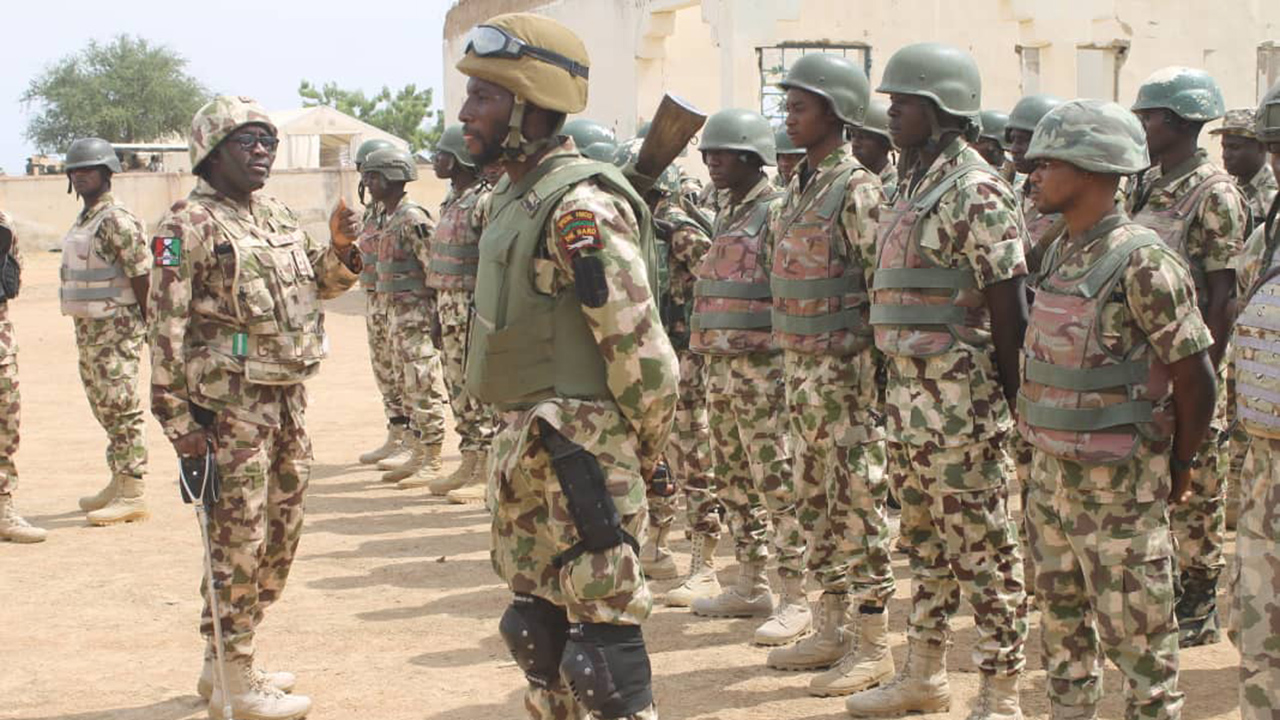
The Nigerian government has deployed ground forces to the Benin Republic following a failed coup in the country.
Military sources said the troops are already in the country, providing support to the President and his cabinet.
Recall that some military officers on Sunday, 7 December 2025, attempted to overthrow the democratically elected President of the Benin Republic, Patrice Talon.
President Bola Ahmed Tinubu initially deployed a Nigerian Air Force fighter jet and subsequently deployed ground troops.
A statement by the Special Adviser to the President, Mr Bayo Onanuga, said the Government of the Republic of Benin had requested President Tinubu to help save its 35-year-old democracy from coup plotters.
According to the statement, Tinubu, acting on two separate requests from the Government of Benin, first ordered Nigerian Air Force fighter jets to enter the country and take over the airspace to help dislodge the coup plotters from the National TV and a military camp where they had regrouped.
“The Republic of Benin, through its Ministry of Foreign Affairs, in a Note Verbal, requested immediate Nigerian air support in view of the urgency and seriousness of the situation and to safeguard the constitutional order, protect national institutions and ensure the security of the population.”
He said in the second request, the authorities in Benin requested the deployment of Nigerian Air Force assets within Beninese airspace for surveillance and rapid intervention operations under Beninese-led coordination.
“The Benin government also requested Nigerian ground forces, “strictly for missions approved by the Beninese Command authority in support of the protection of constitutional institutions and the containment of armed Groups.”
He quoted Nigeria’s Chief of Defence Staff, General Olufemi Oluyede, as saying all the requests have been fulfilled, with Nigerian ground forces now in Benin.
“Ours is to comply with the order of the Commander-in-Chief of our armed forces, President Tinubu,” he said.
Governors Commend Tinubu’s Strategic Rollback Of Benin Coup
The Nigeria Governors’ Forum (NGF) has described President Bola Tinubu’s deployment of Nigeria’s military assets to swiftly contain and reverse the coup attempt in the Benin Republic as an exercise in the best interest of Nigeria.
In a statement yesterday, the NGF chairman and Kwara State governor, AbdulRahman AbdulRazaq, stated that a successful coup in Benin would have far-reaching consequences for Nigeria, as militants and hostile non-state actors in the Sahel region would take advantage to destabilise the Benin Republic further.
“Apart from admirably acting in support of democracy in the subregion, the President acted in the best interest of our country and West Africa with the intervention. With the Sahel in disarray and dire security conditions, and a significant portion of Benin, especially the W-forest, already infested by the militants, a successful coup would have had devastating effects on our own country due to our proximity to the Benin Republic, which shares a border with many of our states,” it said.
The Forum, therefore, commended the President and the Nigerian Armed Forces for the timely interventions that have helped to restore stability and constitutional order to Benin.
“It is our position that democracy, whatever its challenges, remains the best form of government for regional peace, stability, and development. F
“Subsidising the coup on the invitation of the Benin Republic is a big plus for the collective security efforts by ECOWAS in the region and for Nigeria in particular. For instance, security threats on Porto Novo, Cotonou, or Parakou constitute a grave security risk to Nigeria, and the President’s firm action is an effective check to this,” NGF said.
Search Intensifies For Soldiers Behind Foiled Benin Coup
After managing to release all hostages, including high-ranking officers, Benin was searching for fugitive soldiers behind a foiled coup attempt as other West African countries mobilised to offer military support.
The economic capital, Cotonou, was calm, and traffic had returned to normal by Monday afternoon, after a group of soldiers had announced on national television the previous day that they had ousted the president.
President Patrice Talon made his TV appearance late Sunday, assuring the country that the situation was “completely under control”.
Talon, 67, is due to hand over the reins of power in April after two terms leading Benin, which in recent years has been hit by jihadist violence in the north.
The coup attempt follows a spate of military takeovers in the region, including in Benin’s northern neighbours Niger and Burkina Faso, as well as Mali, Guinea and, last month, Guinea-Bissau.
Benin called on the swift help of its neighbouring country, Nigeria, which said late Sunday that it had carried out military strikes on Cotonou and deployed troops.
The West African regional bloc ECOWAS has also announced military support for Benin, but a meeting scheduled for Monday in Abidjan was cancelled. The bloc had threatened intervention during Niger’s 2023 coup but ultimately did not act.
AFP quoted a military source as saying that they were “not in a position to say how many” people were implicated in the coup attempt, “nor how many are currently on the run”, but it was “presumed that many of them have fled” to the countryside.
“The search continues,” the source said, adding that “there have been arrests”.
Other sources said there had been around a dozen arrests, and that coup leader Lieutenant Colonel Pascal Tigri is on the run.
All hostages have meanwhile been “released”, according to the military source.
Two senior Beninese officers, Chief of Army Staff Abou Issa and army chief Colonel Faizou Gomina, had been taken hostage but were released near the National Guard in Cotonou overnight.
In his address late Sunday, Talon said the country had “stood firm” and “cleared the last pockets of resistance”.
In Cotonou, the road to the presidential residence was closed Monday afternoon, and military tanks were seen elsewhere in the city.
The Economic Community of West African States said troops from Ghana, Ivory Coast, Nigeria and Sierra Leone were being deployed to Benin to help the government “preserve constitutional order”.
The regional bloc, along with the United Nations, former colonial power France and the African Union, has condemned the coup attempt.
Under Benin’s constitution, Talon is not permitted to run for a third term, but his designated successor, Finance Minister Romuald Wadagni, is considered a favourite for the April presidential election.
The main opposition Democrats party has been excluded from the ballot because its candidate did not have sufficient sponsors.
In a statement, the party said it “rejects any seizure of power by force and strongly condemns these acts that do not honour our country”.
“This heinous and tragic event once again highlights the need for all political actors in our country to prioritise dialogue,” it stated.
Although hailed for spurring economic growth, Talon is accused of authoritarianism in a country once praised for its democratic dynamism.
Benin’s political history has been marked by several coups and attempted coups since its independence from France in 1960.
We’ve got the edge. Get real-time reports, breaking scoops, and exclusive angles delivered straight to your phone. Don’t settle for stale news. Join LEADERSHIP NEWS on WhatsApp for 24/7 updates →
Join Our WhatsApp Channel