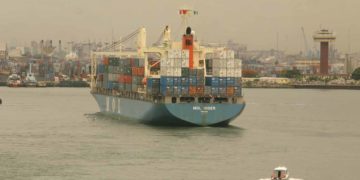
Dangote Refinery’s offshore terminal has handled about 1,100 tanker calls since it began operations and currently sees roughly 75 tanker visits each month, the company said.
The head of Port Infrastructure and Marine Operations at Dangote Petroleum Refinery and Petrochemicals, Captain Satendra Singh Rana, told participants on a tour of the refinery’s marine facilities that tanker traffic is expected to rise to between 900 and 1,000 calls a year as the refinery reaches full capacity.
Rana said the figure reflected the expanding scale of marine operations that support the refinery. He described the facility’s Landfall Point, also known as the Trestle, as the gateway linking onshore processing to the offshore marine infrastructure. “We are now clocking about 75 tanker calls a month. We are looking to scale to 900 to 1,000 tanker calls per year as the refinery is ramped up to full capacity already,” he said. “Today we have clocked approximately 1,100 tanker calls already, changing the energy landscape and maritime economy, bringing Nigeria to the forefront, not only by the refinery but for the maritime trade as well.”
Rana explained that crude oil arriving aboard very large tankers is discharged at offshore Single Point Mooring (SPM) terminals and conveyed via subsea pipelines to onshore storage tanks. From there, crude is processed through the refinery’s distillation and secondary and tertiary units. Finished products, he said, are pumped back through separate pipelines to the offshore terminals for export or domestic distribution.
He told the visiting members of the Global CEO Africa Programme from Lagos Business School (Pan-Atlantic University) that the refinery operates five offshore SPMs — two dedicated to crude imports and three used for loading refined products. He said the offshore configuration was chosen because it allows very large crude carriers to berth in natural deep water of around 21 to 22 metres, removing the need for costly dredging at conventional ports.
Rana said one of the largest vessels to call at the terminal delivered three million barrels of crude, while Very Large Crude Carriers (VLCCs) carrying around two million barrels make routine calls. He added that the terminal frequently receives one-million-barrel loads aboard Suezmax tankers from local and international sources.
He also argued that the offshore location provides operational advantages: he said the site is largely free from cyclones, typhoons and other severe weather, enabling year-round marine operations. Ships, he noted, berth directly at the SPMs and connect to fixed pipelines via floating hoses, eliminating the need for ship-to-ship transfers. “This proven deepwater operating model supports efficient crude imports and refined product exports,” he said.
Academic director of the Global CEO Africa Programme at Lagos Business School, Enase Akinwuntan, said the Dangote refinery illustrates the scale of industrial projects Africa can deliver.
She described the facility as “a practical example of how local investment can support economic transformation.” Akinwuntan added that the refinery, led by Aliko Dangote and funded largely with local resources, shows how private-sector investment can strengthen regional trade and industrialisation under the African Continental Free Trade Area. She said refining crude domestically and exporting finished products demonstrates value addition that can improve trade balances, reduce import dependence and generate foreign exchange.
Participants on the tour were shown the gantry, processing area, laboratory, main control room and crude storage tanks, followed by a conference session where company officials discussed operations and logistics.
Separately, the refinery confirmed it had raised $2.5 billion through a private placement as part of preparations for a planned initial public offering (IPO) later this year.
The refinery’s group executive director, Devakumar Edwin, told Reuters that the capital would support the refinery’s next phase of expansion. Recall that the refinery’s valuation was put at about $39.1 billion. Regulators have already issued a temporary waiver allowing Pension Fund Administrators to invest pension assets in the anticipated IPO once final approvals are in place, making the listing one of the most watched events in Nigeria’s capital market.
We’ve got the edge. Get real-time reports, breaking scoops, and exclusive angles delivered straight to your phone. Don’t settle for stale news. Join LEADERSHIP NEWS on WhatsApp for 24/7 updates →
Join Our WhatsApp Channel