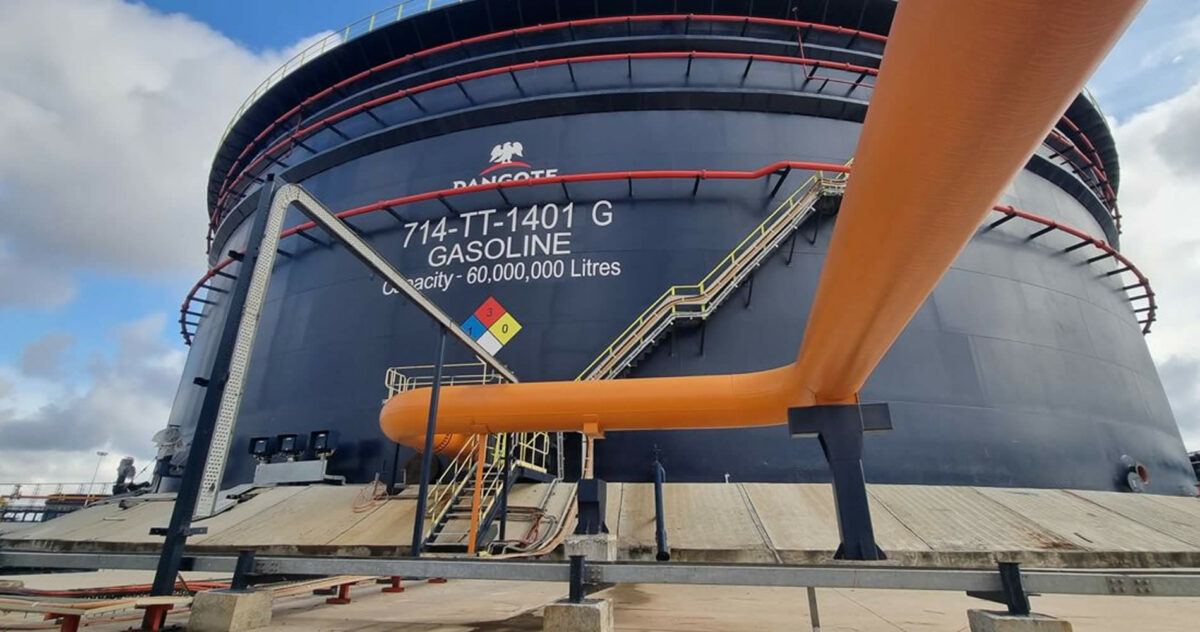
The Dangote 650,000 barrels a day (bd) refinery has restarted its Residual Fluid Catalytic Cracker (RFCC) after maintenance.
According to reports, the unit is now running at about 90 per cent of capacity, according to a source with knowledge of the matter.
The RFCC has a capacity of roughly 218,000 b/d and is the refinery’s main petrol producing unit. It appears to have come back online after scheduled test runs in mid-February, according to Argus Media.
The unit had been offline since December, its Chief Executive David Bird said last month.
The refinery’s naphtha hydrotreater, isomerisation unit and catalytic reformer which Dangote refers to as the “motor spirit block” were running in early February but had not yet reached full capacity following January maintenance, an industry source told Argus in mid-February.
Dangote was listed in fixtures as having booked what freight brokers described as a 37,000 tonnes gasoline cargo loading from the French port of Lavera on 10-12 March for delivery to the US, west Africa or southern Africa. But the cargo is actually carrying naphtha and “catgas” for Dangote, the source said. Catgas — also known as FCC gasoline or cracked naphtha — is an RFCC product that often requires further blending to meet gasoline specifications.
Dangote has, meanwhile, raised petrol asking prices since mid-February, according to local fuel brokers.
Flat prices were given at N875/litre on Monday, up by 14 per cent from around N750/litre on 17 February. Benchmark non-oxy petrol values rose by 12 per cent over the same period to $728.75/t.
Despite the price rise and the near-complete return of RFCC capacity, three European gasoline cargoes have recently loaded for west Africa, according to one European gasoline analyst.
Trading firm Vitol booked a 37,000t gasoline cargo on Monday loading fob Lavera for west Africa, according to a fixtures report seen by Argus, suggesting arbitrage economics remain attractive despite firmer Medium Range (MR) tanker rates.
UK Continent–west Africa MR rates rose to $52.86/t (WS275) on 3 March from $39.40/t (WS205) just before the US-Iran conflict began, which raised concerns over prolonged delays to diesel and jet fuel shipments through the strait of Hormuz and shifted buyers’ attention to US Gulf diesel supplies — Europe’s main alternative.
We’ve got the edge. Get real-time reports, breaking scoops, and exclusive angles delivered straight to your phone. Don’t settle for stale news. Join LEADERSHIP NEWS on WhatsApp for 24/7 updates →
Join Our WhatsApp Channel