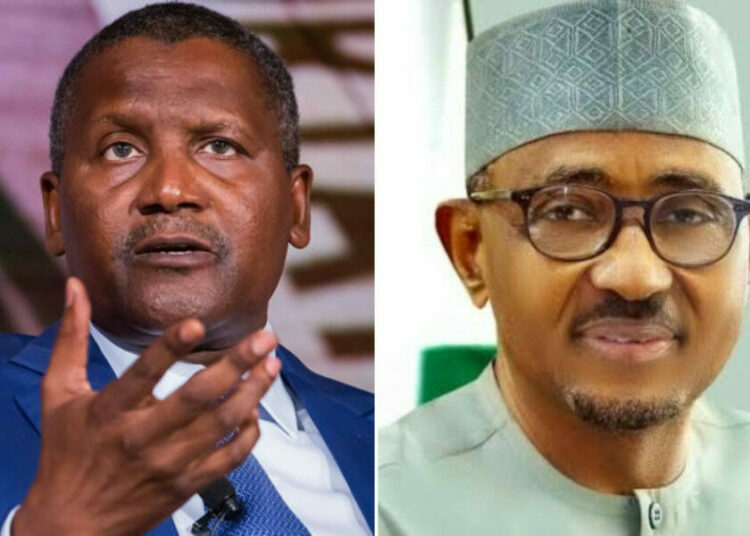
The chairman of Dangote Group, Aliko Dangote, has formally submitted his petition against the managing director of the Nigerian Midstream and Downstream Petroleum Regulatory Authority (NMDPRA), Ahmed Farouk, to the Independent Corrupt Practices and Other Related Offences Commission (ICPC), accusing him of corruption and financial impropriety.
In the petition submitted on December 16 through his lawyer, Dr Ogwu James Onoja (SAN), Dangote demanded the arrest, investigation and prosecution of Ahmed Farouk for allegedly living above his means as a public servant.
In the petition received by the office of the chairman of the ICPC, Dr Musa Adamu Aliyu (SAN), the Dangote Group chairman specifically accused the NMDPRA boss of spending without evidence of lawful means of income, amounting to over $7 million for the education of his four children in different schools in Switzerland for a period of six years upfront.
Earlier, the House of Representatives’ Joint Committees on Petroleum Resources (Downstream and Midstream) had summoned both parties and directed an immediate halt to public altercations.
The committees said the intervention was aimed at preventing an escalation of tensions capable of destabilising Nigeria’s downstream petroleum sector, which they noted had only recently begun to experience relative stability.
Dangote had expanded his allegations against the NMDPRA chief executive, Farouk Ahmed, accusing him of spending millions of dollars on his children’s foreign education.
This followed Sunday’s press conference at the Dangote Petroleum Refinery, where Dangote accused Ahmed of economic sabotage by undermining domestic refining in Nigeria.
In his petition, Dangote claimed that Ahmed was living beyond his legitimate means, claiming that four of his children attend secondary schools in Switzerland at costs running into several millions of dollars.
The business mogul said such expenditure raised serious questions about potential conflict of interest and the integrity of regulatory oversight in the downstream petroleum sector.
In a statement signed on Monday, Dangote further alleged that Ahmed spent over $5 million in tuition fees for his children’s secondary education in Switzerland.
The Dangote Group president listed the children and their schools to include Faisal Farouk, Montreux School; Farouk Jr., Aiglon College; Ashraf Farouk, Institute Le Rosey; and Farhana Farouk, La Garenne International School. He noted that the four children spent six years each in the school.
According to him, the estimated secondary education annual tuition, air tickets and upkeep per child cost $200,000, totalling $800,000 for four children.
He added that the total living expenses per child for six years are estimated at $1,200,000, amounting to $4,800,000 for four children.
“The approximate total fees for tuition and upkeep is $5,000,000,” he claimed.
Dangote further alleged that Ahmed spent $2,000,000 on tertiary education for four years for his four children, adding that $210,000 was spent on Faisal’s 2025 Harvard MBA.
“Tuition, upkeep, air tickets and other expenses for tertiary education is approximately $125,000 per annum; by 4 years is $500,000 x 4 children = $2,000,000.
“Faisal just finished the 2025 Harvard MBA at $150,000 and $60,000 for upkeep, tickets and other incidentals. Total = $210,000 spent in 2025 for Faisal’s MBA.”
Dangote questioned the source of these funds, citing economic hardship in Ahmed’s home state, where many parents struggle to pay N10,000 school fees.
“Nigerians deserve to know the source(s) of these sums of money paid by a public officer while many parents in his home state of Sokoto cannot afford to pay N10,000 school fees for their children and wards,” he added.
The NMDPRA chief executive has, however, declined any comment or response to these allegations as the Authority’s spokesperson, George Ene-Ita, told our correspondent on Tuesday, “No comment for now, please,” when contacted.
Dangote in the petition named the four children and their schools in Switzerland, including the amount paid for each of them, to prove his allegations to the anti-graft agency.
He alleged that Farouk Ahmed was using the instrumentality of the NMDPRA to embezzle and divert public funds for self-gain and pursuit of private interest to the detriment of the Nigerian people, which orchestrated uproar and protest by different groups recently.
The oil magnate further contended that throughout Ahmed’s lifetime as an adult worker in the public sector in Nigeria, his total earnings over the years was nothing close to the $7 million he allegedly diverted from the public coffers to pay for the education of his teenage children abroad.
“It is without doubt that the above facts in relation to abuse of office, breach of Code of Conduct for public officers, corrupt enrichment, embezzlement are gross acts of corrupt practices for which your Commission (ICPC) is statutorily empowered under section 19 of the ICPC Act to investigate and prosecute.
“Upon a successful prosecution of such a person under section 19 of the ICPC Act, the person is liable to imprisonment for five years without an option of fine,” Dangote said.
“We make bold to state that the ICPC is strategically positioned, along with the sister agencies, to prosecute financial crimes and other corruption-related offences, and upon establishing a prima facie case, the Courts do not hesitate to punish offenders.
“In view of the above, we call on the Commission under your leadership to investigate the complaint of abuse of office and corruption against Engr Farouk Ahmed and to accordingly prosecute him if found wanting.”
Dangote expressed hope that as the matter was now in the public domain, the ICPC would act decisively “to ensure that justice is done and the good image of the administration of President Bola Ahmed Tinubu is protected.”
Dangote vowed to be on ground to proffer evidence in proof of his allegations of corrupt enrichment, abuse of office and impunity against Engr Farouk Ahmed.
The ICPC, in a tweet on its X handle on Tuesday, said it had received the petitition and that it would be duly investigated.
Reps Probe NMDPRA’s Boss Over Alleged Corruption
In view of Dangote’s public accusations, the House of Representatives has resolved to investigate the chief executive officer of the Nigerian Midstream and Downstream Petroleum Regulatory Authority (NMDPRA), Farouk Ahmed. The allegations border on indiscriminate issuance of importation licences for Premium Motor Spirit (PMS) despite the availability of the product produced by indigenous refineries, and the issue of payment of over $5 million on tuition fees for the NMDPRA’s kids.
The resolution of the lawmakers followed the adoption of a motion sponsored by Hon. Francis Waive (APC, Delta) and presented by Hon. Midala Usman at plenary on Tuesday.
Moving the motion, Midala recalled the dispute between NMDPRA and Dangote Refinery over alleged arbitrary grant of importation licences, allegation of corruption against the Authority’s boss, PMS pricing benchmarks and other sundry issues.
Hon. Waive expressed concern that if the brewing dispute between NMDPRA and Dangote Refinery is not nipped in the bud, it is likely to escalate and thus lead to a fuel supply crisis during the yuletide season and beyond.
The lawmaker said Dangote Refinery represents a strategic national investment poised to end Nigeria’s historical dependence on imported PMS, conserve foreign exchange, stabilise domestic supply and moderate fuel pricing in the long term.
He expressed worry that “unresolved regulatory disagreements between a statutory regulator and the country’s largest domestic refinery pose a real risk of supply chain disruption, pricing volatility, policy inconsistency and erosion of investor confidence in Nigeria’s petroleum sector.”
“The absence of a clearly articulated, transparent and consistently applied Premium Motor Spirit pricing framework creates room for arbitrary determinations and market distortions to the detriment of Nigerian consumers.”
“Nigerians continue to experience frequent Premium Motor Spirit price fluctuations without adequate public disclosure of: (a) refinery gate prices; (b) regulatory pricing assumptions; (c) cost and margin components; and (d) the comparative impact of local refining versus import-based pricing.”
“Energy security, downstream stability and consumer protection cannot be achieved where regulatory uncertainty and pricing opacity persist.”
The lawmaker said urgent legislative investigation was required to clarify regulatory boundaries, harmonise pricing expectations and restore confidence in Nigeria’s downstream petroleum governance architecture.
The motion was adopted and referred to the Committees on Petroleum Resources (Midstream) and (Downstream) to investigate the root causes of the dispute and report within four weeks for further legislative action.
Meanwhile, the Petroleum Products Retail Outlets Owners Association of Nigeria (PETROAN) has called on President Bola Tinubu to urgently intervene in resolving the ongoing cold trade war in the downstream petroleum sector.
PETROAN national president, Dr Billy Gillis-Harry, made this call in a statement made available to newsmen in Port Harcourt following the current price war between petroleum product importers and the management of Dangote Refinery.
Dr Gillis-Harry stated that the ongoing allegations and verbal attacks directed at the leadership of the Nigerian Midstream and Downstream Petroleum Regulatory Authority (NMDPRA) by the President of Dangote Group, Alhaji Aliko Dangote, are capable of discouraging potential foreign investors and eroding confidence in Nigeria’s regulatory institutions.
Gillis-Harry stated that the association, at its emergency ordinary national general meeting held on Monday, passed a vote of confidence on NMDPRA under the leadership of its chief executive officer, Engr Farouk Ahmed.
He stated that this decision followed the innovative reforms, strategic governance and regulatory clarity introduced by the NMDPRA in the Nigerian downstream petroleum sector.
The PETROAN leader stated that these interventions have significantly improved operational efficiency, transparency and healthy competition within the industry.
Gillis-Harry noted that the current regulatory framework has enhanced market discipline, encouraged fair play among operators and created a more stable and competitive downstream environment, which ultimately benefits consumers and the national economy.
He reaffirmed the association’s commitment to supporting policies and regulatory initiatives that promote efficiency, sustainability and growth in Nigeria’s downstream petroleum sector.
We’ve got the edge. Get real-time reports, breaking scoops, and exclusive angles delivered straight to your phone. Don’t settle for stale news. Join LEADERSHIP NEWS on WhatsApp for 24/7 updates →
Join Our WhatsApp Channel