BY DANJUMA MUSA
With the defection of Governor Abba Yusuf of Kano State from the New Nigeria Peoples Party (NNPP) to the ruling All Progressives Congress (APC), a new political reality has crystallized in the North-West Zone, the powerhouse of votes and the coveted bride of every presidential candidate. But in a zone that has completely tilted towards the ruling party, only Dr. Dauda Lawal Dare of Zamfara State remains an opposition governor—the last man standing flying the Peoples Democratic Party (PDP) banner in the North-West.
Dr. Dauda Lawal is not a stranger to the APC and its main power brokers. In the build-up to the 2019 elections, it appeared almost certain that Abdul’aziz Yari, the outgoing governor, would anoint him as his preferred successor. The political signals were strong, and many within the party structure believed the deal had effectively been struck. However, anxiety within the powerful Yerima political family—fearing Lawal’s education, professional success, and independence—unraveled those expectations on the grounds that he might prove difficult to “control” once in office.
Shut out of the anticipated succession plan, Governor Lawal recalibrated his political strategy and eventually pitched his tent with the Peoples Democratic Party (PDP). He positioned himself as a viable alternative to the APC and won the 2023 Zamfara State governorship election. He took what many observers considered a risky gamble because Zamfara State had always been politically conservative. Yet, defying prevailing currents and expectations, Dr. Lawal won the election, defeating the incumbent, Bello Mohammed Matawalle—now serving as Nigeria’s Minister of State for Defence.
Politics, of course, is very dynamic. As politicians are fond of saying, in politics, 24 hours is enough for alliances to change. Yet, for now, there are no indications that Governor Dauda Lawal—popularly known as Gamji Gusau, now Gamji Zamfara, after the sturdy tree that symbolizes strength and endurance—intends to abandon the Peoples Democratic Party (PDP). If anything, his recent actions suggest a leader determined to hold the line rather than decamp to the APC.
Governor Lawal has also showed that defections by elected officials should not be consequence-free. Governor Lawal, unimpressed by what many Nigerians have come to accept as normal—the shenanigans of party defections—took the extraordinary step of challenging the defection of Hon. Abubakar Suleiman Gummi, the member representing Gummi/Bukkuyum Federal Constituency, Zamfara State, who had crossed over to the All Progressives Congress (APC). The court held that Gummi’s defection meant that he had automatically vacated his seat under Section 68(1)(g) of the 1999 Constitution (as amended).
Dr. Lawal has also shown a willingness to swim against the current. A former Executive Director at First Bank of Nigeria, he entered the 2023 gubernatorial race not as a career politician backed by any entrenched political machinery but as a technocrat with a reformist pitch. Against formidable APC heavyweights, he made history by becoming the first governor elected on the PDP platform in Zamfara State, a conservative state that has never aligned with the ruling party at the federal level. Mahmud Shinkafi, who later decamped to the PDP, was elected governor of Zamfara State in 2007 on the platform of the All Nigeria Peoples Party (ANPP), riding on the popularity of Alhaji Yerima Sani. He lost his re-election bid to Abdul’aziz Yari.
Governor Dauda Lawal’s victory in the 2023 elections was not a fluke. He is one of the few governors in Nigeria who decisively won on his own terms, relying on a combination of grassroots support, a message of service delivery, and a record of personal credibility rather than party machinery. Heading to the 2027 elections, this remains his joker.
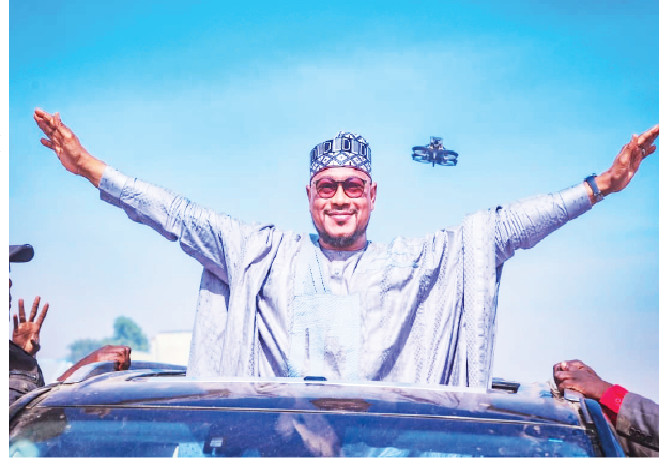
The people of Zamfara State have made no secret of their admiration for him, he is also handsome. During the 2023 campaigns, this popular enthusiasm was on full display. In several instances, what should have been a simple 30-minute journey through towns and villages often stretched into hours, as crowds thronged the streets. At every rally stop, there was a sea of faces eager to catch a glimpse of him and to show their solidarity. The sheer energy and volume of the turnout spoke volumes about the depth of his connection with the people.
The APC’s ambition for the 2027 elections is hardly a secret. The party has telegraphed its intention to consolidate power nationwide, leaving little room for opposition footholds. Within this context, analysts have speculated about Dr. Lawal’s options. Should he defect to the APC to secure his political future or keep faith with the PDP?
On paper, defection might seem pragmatic. But politics in Zamfara State is layered with rivalries that cannot be papered over. Dr. Lawal’s principal political adversary, Bello Matawalle, the Minister of State for Defence, is widely expected to run in 2027 to complete his constitutional second term, which Lawal had rudely interrupted. There is no doubt that Matawalle’s proximity to the presidency gives him significant leverage within the APC structure. For Governor Lawal, crossing over to the APC would mean stepping into a battlefield already crowded with gladiators—each armed with federal connections and long-standing structures.
Dr. Lawal is also not unmindful of the experience of Governor Ademola Adeleke of Osun State, who was “rejected by the APC.” The Adeleke camp accuses Gboyega Oyetola, the Minister of Marine and Blue Economy, of using his closeness to the president to block him from joining the APC. Adeleke was reportedly told in clear terms to perish the thought of an automatic ticket, a development that forced him to decamp to the Accord Party.
he Adeleke scenario is a cautionary reminder to Governor Lawal of what Bello Matawalle can do to him if he ever decides to cross over to the APC. He has several reasons why he can’t allow Dr. Lawal to cross over.
Dr. Lawal had been involved in a widely publicized legal battle with Bello Matawelle over the removal of official vehicles from Government House before handover. While Matawalle claimed the vehicles were lawfully his, the Federal High Court dismissed his case, a decision later upheld by the Court of Appeal, affirming the state’s recovery of the vehicles as lawful.
Against this backdrop, Bello Matawalle would definitely wage a war to stop Governor Lawal from defecting to the APC, assuming he ever decides to, for two reasons: first, his ambition to complete his second term; and second, the personal humiliation that he has suffered after losing the governorship, compounded by the court case that he subsequently lost. The whisper is that he will want to revenge what Dr. Lawal did to him.
Bello Matawalle, it must be noted, became governor largely as a result of the deep internal crisis that engulfed the All Progressives Congress (APC) in 2019. Although the APC initially won the election, Matawalle, the Peoples Democratic Party (PDP) governorship candidate, successfully challenged the results by proving that the APC had failed to conduct valid primaries. His rise to power was therefore made possible largely by the APC’s inability to manage its internal conflicts.
Within Zamfara State APC politics, former Governor Yari, now a senator, remains a powerful figure. His presidential ambition is an open secret among party members. In 2019, Yari had backed Mukhtar Shehu Idris (“Koguna”). There are serious indications that President Bola Tinubu might persuade Matawalle to step aside for Koguna. Bello Matawalle is expected to resist this move, as a Koguna candidacy could translate into eight years in office, effectively ending his ambition. The lingering question, however, is whether he might strike a strategic deal with Governor Lawal—trading support now for backing in 2031 if Koguna secures the ticket.
Whatever happens, the 2027 race would be a “clash of the titans” between Dr. Dauda Lawal and Yari or between Dr. Dauda Lawal and Matawalle.
For Governor Dauda Lawal, these dynamics make defection to the ruling party both unnecessary and risky. Entering the APC would mean navigating a crowded battlefield of well-connected rivals, while staying in the PDP allows him to consolidate his grassroots support, leverage his popularity, and continue governing with credibility. His track record, personal integrity, and deep connection with the people give him a commanding advantage that transcends party labels.
Dr. Lawal, Gamji Zamfara, remains the candidate to beat. In addition to his connection with the people and credible performance, he also possesses a formidable war chest that would enable him to mount a well-resourced campaign on whichever platform he eventually runs.
As the North-West consolidates under APC dominance, Dr. Dauda Lawal stands alone—but he is not necessarily vulnerable. Governor Dauda Lawal stands alone—but, like the Gamji tree he is nicknamed after, his roots are deep enough to withstand the storm. In politics, as with the Gamji tree, endurance is not about bending with every wind; it is also about having roots deep enough to withstand the storm.
Postscript: Towards 2027, Dauda Lawal must balance physical development and stomach infrastructure if he wants to survive.
We’ve got the edge. Get real-time reports, breaking scoops, and exclusive angles delivered straight to your phone. Don’t settle for stale news. Join LEADERSHIP NEWS on WhatsApp for 24/7 updates →
Join Our WhatsApp Channel