
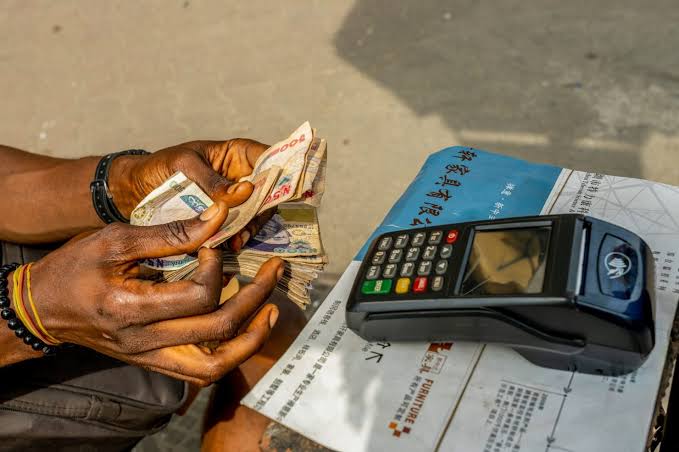
A World Bank study published has shown that digital payments are becoming increasingly central to business activity, particularly for small firms in Africa.
According to the study it goes beyond saving time as they are also associated with better access to credit.
The report, titled “Firm Credit Constraints and Electronic Payments: A Global Analysis,” notes that banks will not lend to businesses whose revenues, payment habits and commercial standing remain unknown to them. In Africa, where most business-to-business transactions are still conducted in cash, many merchants and traders remain largely invisible to banks. Without sales data or a verifiable track record, they struggle to obtain credit even when their business is thriving.
The study surveyed 48,581 firms across 101 countries and quantifies the scale of the problem. Across all countries studied, 14.78 per cent of firms have no access to external financing, while another 16.23 per cent have only partial access. In total, more than 30 per cent of formally registered private-sector firms worldwide are cut off from the credit they need to grow.
The report finds that firms receiving payments digitally via bank transfer, mobile money, card or similar methods are significantly more likely to obtain credit than those operating exclusively in cash.
The mechanism is straightforward. When a customer pays by mobile money or bank transfer, the transaction leaves a digital record: date, amount and frequency. Accumulated over months or years, these data points give banks a clearer picture of a firm’s revenue streams. To some extent, they can compensate for the lack of formal accounting records that many small African businesses do not maintain.
Receiving digital payments reduces by an average of 3.3 percentage points the probability that a firm is completely excluded from credit. That is equivalent to 22 per cent of the average exclusion rate observed in the study.
The World Bank also specifies that receiving digital payments matters more than making them. Payment inflows directly reflect a firm’s sales activity and the revenue it generates. That is the information banks rely on when deciding whether to extend credit.
The effect is strongest among the smallest firms, which are often the least visible to banks. For businesses with fewer than 20 employees, the reduction in the probability of being excluded from credit reaches four percentage points, compared with less than two points for larger firms. Companies with no formal accounting systems, no declared innovation activity or low productivity also benefit more from adopting digital payments.
At the country level, the effect is even more pronounced in low-income economies and those with underdeveloped credit registries. According to the report, the impact of digital payments on access to credit is nearly three times greater in poorer countries than in wealthy ones.
Where conventional tools for assessing borrowers are lacking, a digital transaction history can serve as a credible alternative.
Africa combines two dynamics rarely found together: limited access to formal banking services and widespread adoption of mobile payments.
According to the annual report of the Global System for Mobile Communications Association (GSMA), published in March 2026, more than $1.4 trillion passed through mobile money accounts in Africa in 2025, up more than 27 per cent year-on-year. The continent accounts for 52 per of all mobile money accounts worldwide and 66 per cent of the global value of such transactions.
These flows represent a massive reservoir of information on firms’ financial health that banks have only begun to exploit. Some fintech companies are already moving in that direction. In East Africa, 4G Capital uses mobile usage data to extend loans to small entrepreneurs. In Nigeria, platforms such as Moniepoint combine digital payment collection with lending services for small and medium-sized enterprises based on their payment histories.
For banks to make effective use of payment data, the information must be consolidated and accessible. A merchant receiving payments through several operators generates fragmented datasets that are difficult to aggregate. Interoperability the ability of different payment systems to communicate with one another therefore remains a key technical requirement.
Significant progress is under way. According to the “State of Inclusive Instant Payment Systems in Africa 2025” report by the AfricaNenda Foundation, published jointly with the World Bank, 36 instant payment systems were active across Africa in 2024, processing 64 billion transactions worth a combined $2 trillion.
The report highlights growing interoperability across the continent. “Half of Africa’s instant payment systems (IPS) now connect banks, mobile payment operators and fintechs through cross-domain platforms,” AfricaNenda states.
In the countries of the West African Economic and Monetary Union (WAEMU), the regional central bank has set Tuesday, June 30, 2026, as the deadline for all financial institutions to join the Interoperable Instant Payment System Platform (PI-SPI), a shared instant payment infrastructure launched in September 2025. This could mark an important step toward smoother transactions and broader access to credit.
The study provides African governments with a concrete policy argument: encouraging businesses to adopt digital payments is not only a modernisation strategy, but also a tool for improving private-sector financing.
Three priorities emerge from the findings: accelerating the rollout of interoperable payment systems; encouraging banks to incorporate transactional data into credit assessments; and establishing clear rules governing the use of payment data so that businesses can share it with confidence.
We’ve got the edge. Get real-time reports, breaking scoops, and exclusive angles delivered straight to your phone. Don’t settle for stale news. Join LEADERSHIP NEWS on WhatsApp for 24/7 updates →
Join Our WhatsApp Channel