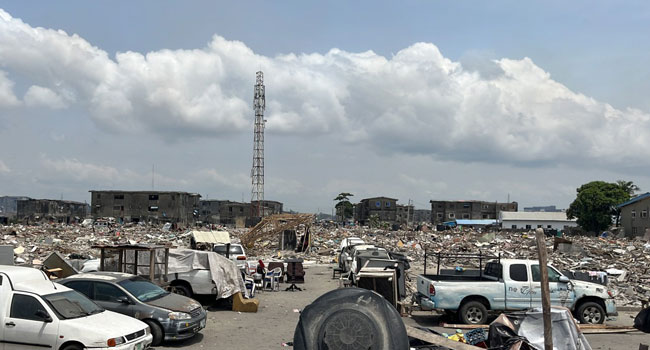
Fresh concerns have emerged across the Ajah-Lekki-Eleko axis of Lagos following reports that several residential and commercial properties marked by government officials may be demolished for a proposed electricity infrastructure project in Eleko community.
The development, which initially sparked rumours of an impending protest by residents, was however downplayed by a resident and community stakeholder who insisted that affected property owners were not mobilizing for confrontation but were instead preparing for engagement with government authorities.
Underlining the growing tension is also fear of possible “official reprisal” if anyone dare challenge the government openly. Hence what seems the reluctance of residents and property owners to identify themselves while fielding questions from LEADERSHIP.
In one of the “notice to remove” cited by LEADERSHIP, the property owner was directed to remove his building to pave way for “government development projects” within seven days.
But many aggrieved property owners who spoke to LEADERSHIP are of the view that the proposed development projects can still be carried out if the government is considerate enough to shift the alignment for the power towers and minimise the cost of damage or compensation to be paid.
In the notice, property owners are being asked to “demolish” portion of their assets to the length of ten meters.
If that is carried out, experts stated that it will affect virtually all the built structures from the Ajah junction all the way to Eleko junction.
Interestingly, also likely to be affected is the newly built Foodstuff Hub which the Sanwo-Olu government inaugurated in April this year and was officially commissioned by President Bola Tinubu.
Thousands of properties, both commercial and residential, will also be affected along the corridor all the way to Eleko junction.
This has fuelled speculations in some quarters that the government might have failed to think through the plan properly before taking stepping to execute.
For instance, findings by LEADERSHIP revealed that earlier in 2024 deep holes were initially dug to lay proposed gas pipeline some inches close to the newly constructed three-lanes Epe-inbound expressway. The big black metal pipes were already being laid, only to be stopped abruptly and fresh order given for the gas pipes to be shifted by ten meters deep into the setback.
“If you now ask property owners to remove ten meters deep into their property, will what is left still be habitable?,” asked a property owner rhetorically.
Speaking anonymously during a telephone interview, another respondent confirmed residents recently received official communication indicating that the markings on affected buildings were connected to plans to install a major power line to improve electricity supply to Eleko and adjoining communities.
“The project the government was marking our houses for is a laudable project,” the source said. They want to supply electricity to Eleko community. We don’t have problems with that because everybody wants development.”
The source explained that while residents were not opposed to infrastructure expansion, many property owners were worried about the implications of the planned demolitions, especially for families and businesses that invested heavily in the area.
“We are not protesting. We are only organising ourselves to meet the government and dialogue with them,” the respondent stated. “You cannot just tell somebody to remove his house when the person has done due diligence, secured approvals and, in some cases, obtained Certificates of Occupancy.”
The source further disclosed that properties allegedly affected by the markings include residential estates, commercial buildings and business premises.
According to the respondent, several government agencies are believed to be connected to the exercise, including the Lagos State Ministry of Lands and Physical Planning.
The clarification comes amid growing speculation that the demolition notices were linked to plans for a railway corridor expected to complement ongoing infrastructure projects around the Lekki Free Trade Zone and the Lagos-Calabar Coastal Highway.
However, the source dismissed the claims, insisting that the official letter shown to residents specifically referred to as a power transmission project and not railway construction.
“That railway information is what people are saying outside,” the source explained. “The letter they gave to us mentioned power lines to Eleko.”
The latest development has revived memories of previous demolitions and displacement exercises carried out in parts of Lagos during major infrastructure projects.
In 2024, several property owners and businesses were displaced during the construction of Section One of the Lagos-Calabar Coastal Highway, a flagship federal road project championed by the administration of President Bola Tinubu.
The demolition exercise along the coastal corridor generated widespread controversy after residents and investors complained about inadequate compensation, short notices and the destruction of businesses worth billions of naira.
Among affected landmarks during the coastal road exercise were residential properties, hospitality businesses and leisure investments situated around the Okun-Ajah and Landmark Beach areas of Lagos.
Although the Federal Government defended the demolitions as necessary for national development and infrastructure expansion, even as critics argued that many investors suffered avoidable losses despite possessing valid land documents and approvals.
Following the public outrage, President Bola Tinubu, who hails from Lagos, directed the Works Minister, Engineer David Umahi to rejig the original plan, leading to the shifting of the alignment. That way, relief came the way of many property owners along the coastal road.
Nonetheless, the issue sparked debates about urban planning, compensation frameworks and the growing tension between public infrastructure projects and private property rights in Lagos, especially along rapidly developing corridors such as Lekki-Epe.
In the present Lekki-Epe case, the anonymous stakeholder said affected residents were determined to avoid unnecessary confrontation with authorities while seeking clarity on the scope of the project and possible compensation arrangements.
The thinking is that through diplomacy a middle ground could be achieved with the Lagos State Government.
“We are professionals. Many of us are lawyers, engineers and business owners. We want to handle everything legally and properly,” the source said.
The respondent added that residents were currently consulting among themselves and would likely hold formal discussions with government representatives before making any public pronouncement.
However, when contacted the Lagos State Commissioner for Information and Strategy, Mr. Gbenga Omotoso, requested for pictures of the marked structure for him to see the seal on it and know the government agency involved, whether it is the Ministry of Physical Planning and Urban Development, Lagos State Building Control Agency (LASBCA) or the Lagos eGIS (Electronic Geographic Information System).
He said with that he can get the details before commenting on behalf of the government.
We’ve got the edge. Get real-time reports, breaking scoops, and exclusive angles delivered straight to your phone. Don’t settle for stale news. Join LEADERSHIP NEWS on WhatsApp for 24/7 updates →
Join Our WhatsApp Channel