
Crude oil supplied to domestic refineries fell in the third quarter of 2026, as the Nigerian Upstream Petroleum Regulatory Commission (NUPRC) said it is still consulting on a domestic crude swap framework aimed at improving supply and cutting costs, more than 10 weeks after it was first hinted at.
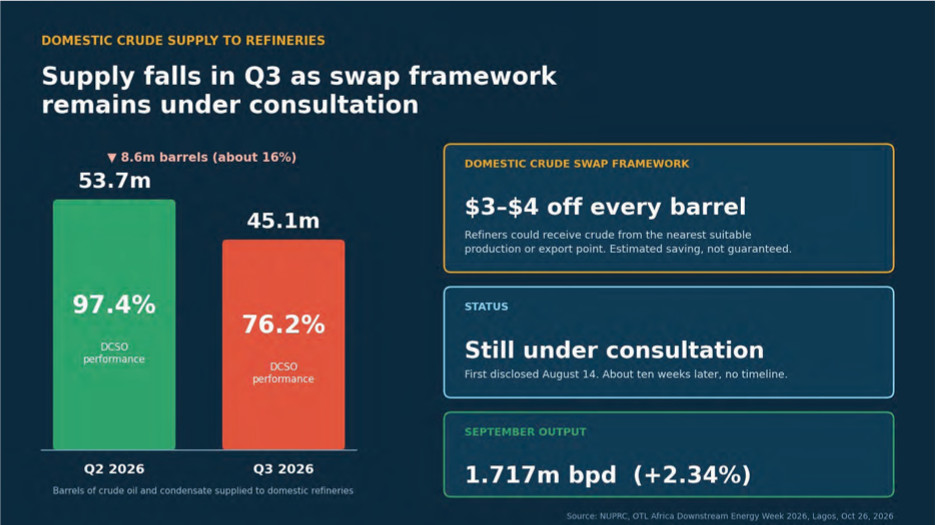
The Commission said 45.1 million barrels of crude oil and condensate were supplied to domestic refineries in the third quarter, down from 53.7 million barrels in the second quarter. That is a drop of 8.6 million barrels, or about 16 per cent.
Performance under the Domestic Crude Supply Obligation (DCSO) also fell, from 97.4 per cent in the second quarter to 76.2 per cent in the third quarter.
The commission chief executive, Oritsemeyiwa Eyesan, disclosed this on Monday in her speech at the OTL Africa Downstream Energy Week 2026 in Lagos.
Speaking on the theme, “Secure Energy, Shared Prosperity,” Eyesan, who was represented by the assistant director, Operations, Prosper Omonedo, said the commission’s intervention had improved crude deliveries after commercial disagreements between producers and refiners affected supplies in the first quarter.
“We engaged producers and refiners, and in the second and third quarters, 53.7 and 45.1 million barrels of crude oil and condensate were supplied to domestic refineries, an overall performance of 97.4 and 76.2 per cent, respectively. From Q1–Q3 of 2026, more than 127 million barrels of Nigerian crude went to Nigerian refineries,” she said.
She noted that under Section 109 of the Petroleum Industry Act 2021, the NUPRC allocates crude oil to domestic refineries before export.
Swap framework still under consultation
Eyesan said the NUPRC is consulting producers, refiners and other stakeholders on a domestic crude swap framework.
She explained that under the arrangement, a refiner could receive crude from the nearest suitable production or export point, instead of moving an allocated grade over long distances.
“Under it, a refiner could receive crude from the nearest suitable production or export point instead of moving an allocated grade over long distances, which could take an estimated three to four dollars off the cost of every barrel,” she said.
The Commission first made the plan public on August 14, when Eyesan paid a courtesy visit to the Nigerian Midstream and Downstream Petroleum Regulatory Authority (NMDPRA) in Abuja. She said then that the arrangement, once finalised, would improve compliance with the DCSO and the Domestic Gas Supply Obligation, and would be coordinated with the Gas Aggregation Company Nigeria Limited (GACN).
At that meeting, she said a producer whose obligation was close to an export facility could exchange supplies with an operator whose obligation and facility were nearer to a domestic buyer.
“How the swap works is that I have an obligation somewhere and I am close to an export facility. Somebody else has an obligation inland and his own (facility) is close to a domestic offtaker,” she said.
“So, instead of trying to move from one end to the other, we just agree on a swap arrangement, and there is a mechanism for them netting off.”
Eyesan told the meeting that talks on the swap were at an early stage and that the Commission would continue consultations before finalising the details. About ten weeks later, the Commission is still describing the framework as under consultation, and no timeline has been given.
Imports persist
At the August meeting, the NUPRC acknowledged that crude imports into the country were continuing despite the improvement in second-quarter supply. It said this had led it to engage industry stakeholders on how to address the problem.
Data from the NMDPRA’s September factsheet shows imports continued through the third quarter. Refineries received 5.13 million barrels of imported crude in July, 4.05 million in August and 2.56 million in September. That comes to about 11.74 million barrels for the quarter, compared with about 4.53 million barrels in the second quarter.
The NMDPRA also reported that domestic crude received by refineries in September fell by 6.3 per cent to 15.97 million barrels, from 17.05 million barrels in August.
Pricing and reserves
At the August meeting, the NMDPRA Chief Executive, Mallam Rabiu Abdullahi Umar, commended the NUPRC for improving enforcement of the DCSO.
He noted that the Petroleum Industry Act provides for transactions on a willing-buyer, willing-seller basis, so pricing remained a major factor in ensuring effective domestic supply. He also supported the creation of strategic reserves, saying they would strengthen Nigeria’s energy security and help stabilise prices.
Production rises in September
On production, Eyesan said Nigeria recorded an average of 1.717 million barrels per day of crude oil and condensate in September, a 2.34 per cent increase over August.
She said crude oil production alone averaged 1.53 million barrels per day, the fifth consecutive month the industry met or exceeded its quota.
She attributed the improvement to better asset integrity, enhanced security of evacuation infrastructure, stronger collaboration with operators and sustained regulatory efforts to restore shut-in production.
2026 Licensing Round
On the 2026 Licensing Round, Eyesan said the 40 blocks on offer would go through a transparent evaluation process, with published criteria and mandatory disclosure of beneficial ownership.
She added that the Commission was enforcing the drill-or-drop principle to discourage speculative holding of licences. She said 22 recent awardees were expected to contribute at least 250,000 barrels per day within five years.
Gas obligation and downstream alignment
Eyesan reaffirmed the Commission’s commitment to meeting the Domestic Gas Delivery Obligation.
She said the NUPRC would work with the NMDPRA to align refinery demand with crude supply planning, so that upstream gains translate into tangible benefits for households, industries and power generation.
We’ve got the edge. Get real-time reports, breaking scoops, and exclusive angles delivered straight to your phone. Don’t settle for stale news. Join LEADERSHIP NEWS on WhatsApp for 24/7 updates →
Join Our WhatsApp Channel