
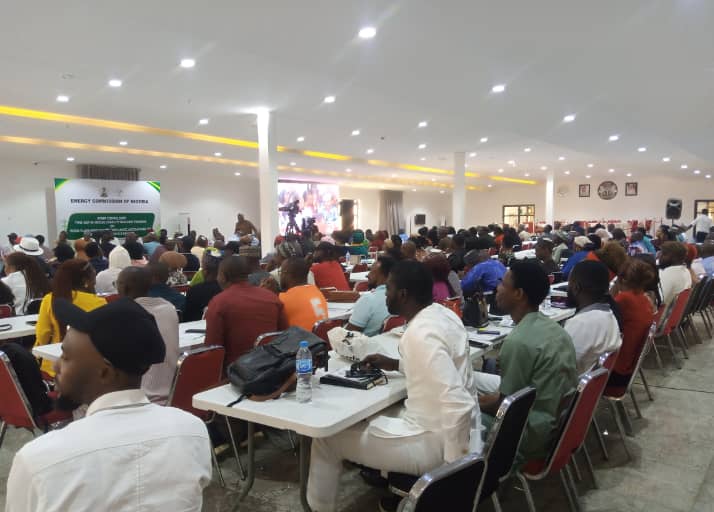
The Energy Commission of Nigeria (ECN) has commenced a compulsory capacity-building programme for over 1,000 staff to improve efficiency, strengthen accountability and enhance service delivery.
The training, which brought together management, senior and junior staff from the Commission’s headquarters and research centres, is aimed at building a competent and results-driven workforce to advance Nigeria’s energy development agenda.
Speaking at the opening ceremony in Abuja, the Director-General of ECN, Dr. Mustapha Abdullahi, described the exercise as a milestone in the Commission’s institutional development, noting that it was the first time all staff were being assembled for a training of such magnitude.
He said the initiative fulfilled a commitment he made on assuming office in October 2023.
According to him, the Commission’s ability to discharge its statutory responsibilities, particularly in energy planning, policy coordination and development of the nation’s energy resources, depends largely on the competence of its workforce.
“The training is designed to equip staff with the administrative, professional and technical knowledge required to deliver better results to Nigerians,” Abdullahi said.
He expressed confidence that the exercise would translate into improved institutional performance, more effective energy policies and stronger implementation of government programmes, particularly those aimed at expanding access to electricity.
Abdullahi linked the initiative to the Federal Government’s renewable energy agenda, including the national solarisation programme, stressing that a competent workforce was essential to achieving energy security.
He said the Commission was determined to develop policies and energy master plans that would support the administration’s development priorities and improve access to reliable and affordable energy.
On sustainability, the Director-General explained that although the Commission had organised several trainings in the past, they were conducted in separate groups.
He said the current exercise was unique because it brought together over 1,000 personnel for a common programme.
He disclosed that management was considering making it a regular institutional programme, possibly on a quarterly or twice-yearly basis, depending on resources and planning.
Abdullahi also acknowledged the support of President Bola Tinubu and the Minister of Innovation, Science and Technology, particularly in strengthening the Commission’s financial capacity.
He said the improved support had placed greater responsibility on the Commission to deliver tangible results.
Legal Director Harps On Compliance
In a separate interview, the Director of Legal Services, Elama Abdulazeez, described the training as essential to equipping staff with a better understanding of the Commission’s statutory responsibilities and the legal framework governing its operations.
He said participants would be sensitised to the provisions of the ECN’s enabling law, stressing that staff must understand the Commission’s mandate and their individual responsibilities.
Abdulazeez disclosed that the opening phase was a two-day general training, with specialised sessions planned for different professional categories.
He said the initial sessions would cover finance, procurement, stores and general administration, while subsequent modules would address engineering and research.
According to him, the modules were structured to ensure capacity development becomes a continuous process rather than a one-off intervention.
Solarisation To Free Up Power
On the Federal Government’s solarisation programme, Abdulazeez said the initiative was designed to extend electricity access to institutions that require reliable power, particularly tertiary institutions and selected healthcare facilities.
He said the programme would reduce the financial burden of electricity on beneficiary institutions, lower the cost of running their operations and potentially ease the cost of services provided to Nigerians.
He explained that by providing solar power to selected public institutions, electricity previously consumed by such facilities could be freed up for other areas experiencing inadequate supply.
“Expanding access to electricity through different energy sources, including solar power, remains critical to addressing Nigeria’s energy challenges,” he said.
The training is expected to strengthen the Commission’s capacity to coordinate national energy policies and promote sustainable development of Nigeria’s energy resources.
We’ve got the edge. Get real-time reports, breaking scoops, and exclusive angles delivered straight to your phone. Don’t settle for stale news. Join LEADERSHIP NEWS on WhatsApp for 24/7 updates →
Join Our WhatsApp Channel