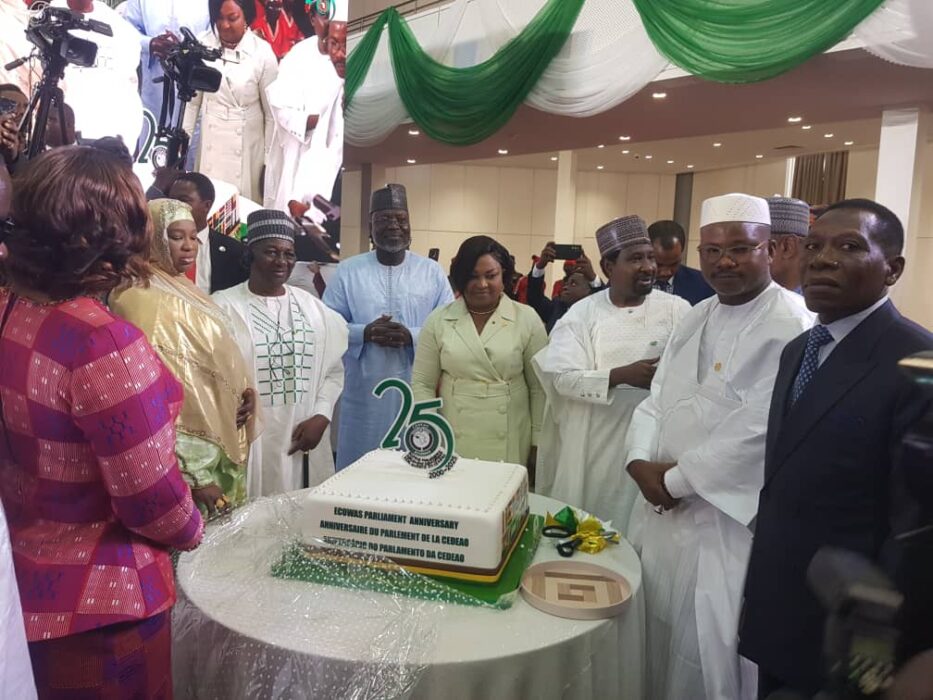
The ECOWAS Parliament on Thursday, December 4, 2025, convened at the International Conference Center (ICC), now renamed the President Bola Ahmed Tinubu International Center in Abuja, to mark its 25th anniversary, using the session to reflect on its legislative work and regional integration efforts over the past 25 years.
It was an occasion filled with the exhilaration that accompanies the remarkable evolution of an institution which, over the years, has demonstrated resilience, courage, and an unwavering capacity to offer solutions to the multitude of crises that have plagued West Africa and the far-reaching consequences they have wrought.
Though the celebration should have been officially on November 16, 2025, activities were scheduled between December 2 and 4, 2025 based on the directive of the current Speaker, Memounatou Ibrahima, to coincide with its ongoing 2025 Second Ordinary Session, which began on Monday.
During the celebration, West African leaders acknowledged the challenges facing the region, the most prominent perhaps is the threat to democracy as military coups have continued to sweep away democratic governments within the sub region.
At the moment, Burkina Faso, Mali and Niger Republic have exited ECOWAS following disagreements over military coups. Guinea Conakry, although still part of ECOWAS, is another country where the army has ousted democratic government.
While the sub region is still grappling with how to strengthen democracy, another bugbear of military coup erupted in Guinea Bissau where the army has taken over and allegedly sacked the President Umaro Embalo and suspended elections in the country a few days ago.
This repugnant situation dominated discussion during the 25th anniversary as West African leaders called for collective action by all member states to contain the prevailing threats to democracy and the rule of law in the sub-region.
Julius Maada Bio, Sierra Leone’s President and Chairman of the ECOWAS Authority of Heads of State and Government, in his address, noted that although ECOWAS had persistently supported past peace-building efforts, regional cooperation, security, migration and human rights it would not survive the prevailing threats if drastic measures are not deployed to address this menace.
Giving his country as a beneficiary of the enormous efforts of ECOWAS to promote democracy and regional stability, Bio said member states must rise up and take drastic action by fighting tooth and nail to arrest the current threats to democracy in the sub-region.
President of the ECOWAS commission, Omar Touray, urged the parliament to commit itself to the fight for the survival of democracy in the sub-region and use the 25th anniversary celebration to frame the future in which democracy, the rule of law, and human rights are the norms in West Africa rather than tribulations.
“The silver jubilee of the ECOWAS parliament is coming at a time when we are celebrating ECOWAS’ golden jubilee as a community.
“As we celebrate this silver jubilee, let us take stock of our achievements and progress, as well as our challenges and opportunities into the future. We must therefore fight for democratic space, human rights and rule of law if we want our democracy to survive,” he said.
The Speaker of the ECOWAS Parliament, Mémounatou Ibrahima, said that the Silver Jubilee celebration affords the regional legislature a time to reflect on past milestones and undertake a clear introspection on contemporary challenges toward a renewed future ambition.
Former President of Nigeria Dr. Goodluck Jonathan said the parliament plays a vital role in protecting democracy and inclusivity by supporting peaceful electoral processes across the sub-region. He admonished leaders to strengthen the foundations of democracy in the sub-region and to remain firm against unconstitutional changes in governments.
“In an era where democracy faces new threats, your role in promoting credible elections, good governance, and a peaceful resolution of disputes is more critical than ever. Let the Parliament be the strong voice for political stabilisation and for the principles enshrined in our ECOWAS protocols,” he said.
The Parliament came into existence on November 16, 2000 in Bamako, Republic of Mali, with the inauguration of the First Legislature, which elected Professor Nahum Diallo as the First Speaker. Today, the Parliament is in its Sixth Legislature now led by the Togolese lawmaker, Ibrahima as the Speaker and incidentally she is the first female speaker.
Regional leaders had promulgated the Protocol Relating to the Community Parliament (A/P2/8/94), which is the primary legal instrument that established the structure, composition, and functions of the ECOWAS Parliament. This protocol was signed in Abuja on August 6, 1994, and entered into force on March 14, 2002, following its establishment under Articles 6 and 13 of the 1993 Revised ECOWAS Treaty.
At inception, the Parliament swung into action and provided a legion of platforms for crisis management and resolution as evident in the Mano River crisis in the early 2000s where it played significant role in quelling the violence and displacement of people in the region bringing peace and democracy to the affected countries, namely Liberia, Sierra Leone and Cote D’ Ivoire.
The Parliament made an arduous effort to migrate from an advisory and consultative body to a co-decision-making and legislative body with increased financial autonomy when the Supplementary Act on the Enhancement of its Powers was adopted in December 2014.
It is steadily making efforts to expand and strengthen its mandate to become a truly legislative body modeled after the European Parliament, whose decisions are binding on the 27-member state of the European Union. This can be achieved through Direct Election into the Parliament but this has not been achieved yet by the ECOWAS Parliament as efforts are being intensified towards this goal.
The West African Region is replete with crises of immense proportion. Member states of the Community are ravaged by terrorism and violent extremism, deplorable levels of poverty, irregular migration and drug abuse among its youth, inflation induced by economic downturn, poor infrastructure, and malnutrition among others.
As the Community Assembly marks this important milestone, there are sectors that are vital to economic development and integration in the region where investments are needed to tackle the myriad of crises and the Community Assembly can pay massive attention to these.
We’ve got the edge. Get real-time reports, breaking scoops, and exclusive angles delivered straight to your phone. Don’t settle for stale news. Join LEADERSHIP NEWS on WhatsApp for 24/7 updates →
Join Our WhatsApp Channel