
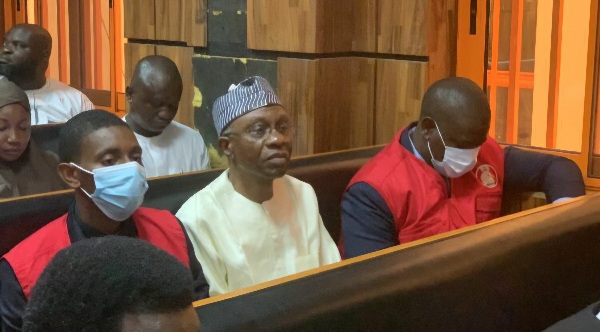
A former governor of the Central Bank of Nigeria (CBN), Godwin Emefiele, on Friday urged the Lagos State Special Offences Court in Ikeja not to admit five extra-judicial statements he made to the Economic and Financial Crimes Commission (EFCC), claiming that they were obtained under duress.
Emefiele, who made the allegation through his lawyer, Olalekan Ojo (SAN), also claimed that he made the statements after he was held incommunicado for over 157 days under harsh, oppressive, and dehumanising conditions.
He, therefore, asked the trial judge, Justice Rahman Oshodi, to order a trial-within-trial to verify whether the statements were made voluntarily before they were admitted as evidence.
The former CBN boss was arraigned before the court alongside Henry Omoile on allegations of accepting gratification, accepting gifts through agents, corruption, and fraudulent property receipts.
The anti-graft agency also accused the defendant of conferring a corrupt advantage on his associates, in contravention of the Corrupt Practices Act 2000.
They, however, pleaded not guilty to the charge.
At the resumed hearing of the matter on Friday, the move by the EFCC prosecutor, Rotimi Oyedepo (SAN), to tender the five statements through a prosecution witness, Alvan Ikoku.
Ikoku had testified that the EFCC questioned Emefiele on different dates, including October 26 and 27, 2023, and obtained statements.
The move was objected to by Ojo, who argued that the statements violate the Evidence Act and Anti-Torture Act because they were obtained while Emefiele was held under illegal, inhumane conditions.
The lawyer also submitted that the Anti-Torture Act prohibits admitting statements obtained through torture. “The objection is predicated on the provisions of the Evidence Act and the Anti-Torture Act,” Ojo told the court.
He added that the statements were forced out of Emefiele, who was kept incommunicado for over 157 days in EFCC custody, and stressed that the prosecution must prove each statement was made voluntarily and without oppression.
At the stage, rhe prosecution indicated it would withdraw the October 26 statement since it only contained personal details.
However, Oyedepo opposed a trial-within-trial for the other statements, claiming they were not confessional and thus didn’t require such proceedings.
He argued that the Evidence Act should govern the admissibility of evidence over the Anti-Torture Act, asserting that the remaining statements are not confessional.
The anti-graft agency’s lawyer further asked the court to expedite proceedings, citing public interest.
Ojo countered that the court needs to determine whether the statements were voluntary first, arguing the prosecution failed to address the claim that they were obtained through torture and oppressive treatment.
“The issuance of a trial-within-trial is necessary to decide the voluntariness of the statements,” he said.
After listening to both parties, Justice Oshodi reserved judgment on whether the statements are admissible until July 9.
He then adjourned the main trial to October 6, with sitting starting daily at 12 noon.
We’ve got the edge. Get real-time reports, breaking scoops, and exclusive angles delivered straight to your phone. Don’t settle for stale news. Join LEADERSHIP NEWS on WhatsApp for 24/7 updates →
Join Our WhatsApp Channel