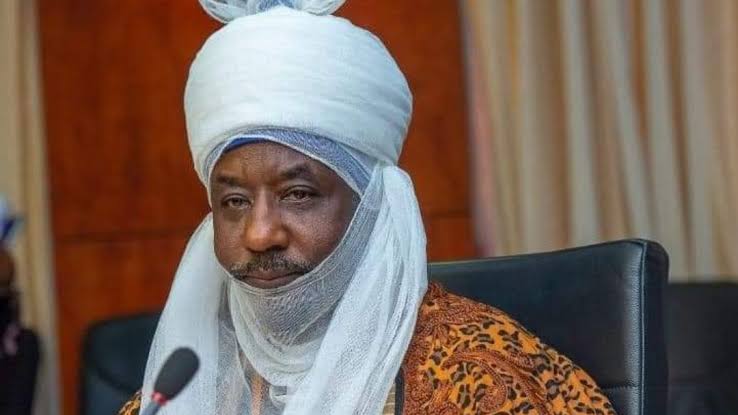
The Emir of Kano, Alhaji Muhammadu Sanusi II, has urged the Federal Government to stop treating criticism of President Bola Tinubu as an attack on the administration, stressing the need to tolerate constructive dissent.
Sanusi gave the advice while speaking virtually at the Oxford Global Think Tank Leadership Conference, organised by the Oxford Global Think Tank, on Tuesday.
He said Nigerians who raised concerns about poverty, hunger and economic hardship should not automatically be regarded as enemies of the government.
“It’s not every time people talk about poverty or talk about difficulty that they’re just enemies of the government or making an attack on the president.
“That is not how to respond to economic distress,” he said.
The Emir also expressed concern over government expenditure, warning that Nigeria could not achieve fiscal consolidation while continuing to spend without restraint.
He cited the World Bank’s observation that debt servicing consumed 124 per cent of the Federal Government’s revenue in the first half of the year, stressing the urgent need to address the sustainability of the country’s debt and implement outstanding structural reforms.
Sanusi said economic reforms must go beyond the removal of fuel subsidies and exchange rate liberalisation, describing them as part of a broader package that should address other critical sectors.
He urged the government to establish clear spending priorities, taking into account available resources and the country’s competing needs in roads, electricity, agriculture and technology.
The former Central Bank of Nigeria (CBN) governor said the government must make deliberate choices about how to allocate scarce resources.
“Every $10 billion spent on roads is $10 billion taken away from electricity and agriculture,” he said.
Sanusi, however, acknowledged that the Tinubu administration’s economic reforms had recorded measurable progress, citing improvements in economic growth, inflation and foreign reserves.
He said Nigeria’s gross domestic product (GDP) growth had risen from an average of 0.9 per cent under the previous administration to 4.5 per cent.
“I think moving from an average growth rate of 0.9 per cent to 4.5 per cent is progress. Moving from inflation of over 30 per cent to 14.5 per cent is progress.
“Moving from the point where in 2023 the Central Bank’s reserves were maybe negative to where we are now, having reserves of $55 billion, is progress,” he said.
Despite the gains, the Emir said poverty, hunger, maternal mortality, malnutrition, education and healthcare remained major challenges that the reforms had yet to adequately address.
He stressed that the government should have introduced social safety net policies from the outset to cushion the effects of economic reforms on vulnerable Nigerians.
Sanusi called for a balanced approach that combines economic stabilisation with measures to protect the poor and improve living conditions.
We’ve got the edge. Get real-time reports, breaking scoops, and exclusive angles delivered straight to your phone. Don’t settle for stale news. Join LEADERSHIP NEWS on WhatsApp for 24/7 updates →
Join Our WhatsApp Channel