
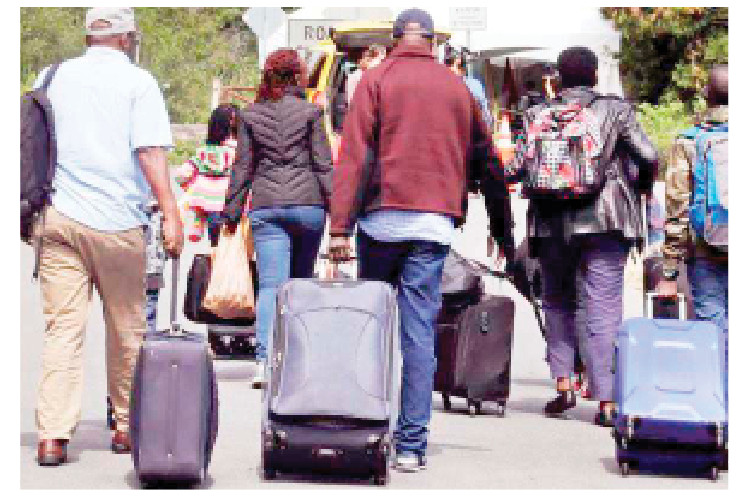
The japa syndrome is taking a toll on some elderly people. ANAYO ONUKWUGHA, JOSHUA DADA, NNAMDI MBAWIKE, KAMAL IBRAHIM, FEMI OYEWESO, INIOBONG EKPONTA, BABAJI USMAN BABAJI and EMMANUEL MGBEAHURIKE found some elderly persons whose children have left them at home, bearing the brunt of boredom and loneliness.
The adverse effects of Nigerians seeking greener pastures abroad, popularly known as ‘Japa Syndrome’, on some parents left behind have become a major concern in our society.
A 78-year-old grandpa, Sunday Babatunde, who spoke with LEADERSHIP Weekend in Ilesa, Osun State, lamented being left alone to face the rigours of life at old age, despite having children who are outstanding in their careers but have relocated to a foreign land.
The old man noted that, though his three children, who have all relocated abroad, did not abandon him, they often sent him money, yet he lacked affection and prompt attention, especially when he had health challenges.
He appealed to the government to create a conducive atmosphere for Nigerians to thrive, adding that his children relocated to a foreign land out of frustration.
The old man noted that his worst predicament was his wife’s relocation to London following the birth of a baby by one of their daughters, adding that his expectation of a brief sojourn abroad for his wife was prolonged by the lack of a caregiver for the nursing mother.
Also, Mama Tinu Agbedahunsi, speaking with our correspondent in Ijebu-Jesa, Osun State, blamed her predicament on the government, saying that her only daughter told her the Nigerian government pushed her out of the country because of the low salary she was receiving as a professional nurse in Nigeria.
The old woman said she could not survive the cold weather in the United States of America when she visited her daughter, which prompted her to be brought back home.
According to her, apart from suffering loneliness, her health is deteriorating, and nobody can sufficiently stand in for her daughter, pleading with the government to bring her daughter back home.
One of them, Elder Honest John, who will be 76 years old in April, told our correspondent that he is living alone because he refused to join his children and wife in the United States of America.
“My children, all three of them, have been living abroad for more than 20 years now. In 2024, they came home and asked their mother and me to join them, but I refused. My wife joined them. Since then, I have been living alone,” he said.
Elder John, however, stated that the children of his relatives who live within the neighbourhood come from time to time to assist him with most of the house chores.
Also speaking with our correspondent, an elderly woman, Madam Lucy Ngeribo, said that although it has not been easy, her children have secured the services of a young lady who comes daily to assist her with washing her clothes, cleaning the house, and cooking her meals.
She said, “I have a young lady who comes to help me out daily. My children are responsible for her monthly salary. But, at my age, I can’t be sleeping alone in this big house. I need someone to stay with me, and I have told them.”
Similarly, some parents who spoke with our correspondent in Enugu expressed concern about their children’s prolonged absence.
They stated that the absence of physical presence of their children has created feelings of emptiness and emotional loss, even when their children are still alive.
An elderly man residing at Abakpa in Enugu, Pa Udegbulam Uzoukwu, said his two sons travelled abroad 20 years ago and have not returned since then.
He noted that since they travelled, they have been struggling with loneliness, emotional distress and social isolation.
Mr Uzoukwu further told our correspondent that his wife often locks herself indoors to cry over the absence of their children.
An elderly widow, Mrs Amarachi Ogbonnaya, told our correspondent that since her only son travelled to the United States, she has been swimming in the ocean of loneliness.
She expressed sadness that all attempts by her son to return and see her have met brick walls because he has not obtained all the necessary papers.
“I’m worried because now that they said that the American president is arresting people without papers, I don’t know what will happen to my son. I want him to come back honourably and not in shame,” she said.
Regarding how they are coping, they told our correspondent that they interact with them by phone, saying that whenever they speak with them, they feel happier.
The elderly parents added that they now have to cope alone or rely on neighbours and distant relatives for assistance.
A medical doctor currently operating his own private clinic in Enugu, Dr Clifford Ugwu, described japa syndrome as a bad thing for youths, especially experts like them.
Narrating his ordeal during his trip to Oman, West Asia, he stated that he never enjoyed a single day in the country due to numerous restrictions.
“Although I was seeing money, there was no freedom, as there were a lot of restrictions; I never drank alcohol for one day. The worst thing is that their women can set you up even when you did nothing wrong. So, I advise young people, especially professionals, to stay at home and help develop the country.
“There are a lot of opportunities here in the medical profession. They can get the money here if they work hard. After all, we don’t have enough doctors in Nigeria,” he stated.
In Jaja, a quiet community in Bauchi metropolis, two elderly residents said the wave of migration, popularly known as the “japa” in Nigeria, has changed their lives in ways they never imagined.
The trend, which has seen thousands of young Nigerians relocate abroad in search of better opportunities, has left some ageing parents behind to navigate old age largely on their own.
For 72-year-old Musa Abdullahi and 68-year-old Zainab Mohammed, the departure of their children has brought both pride and loneliness.
Abdullahi, a retired farmer, sits most afternoons outside his modest home, recalling the day his two sons left Nigeria for jobs in Europe.
“I was happy for them because there was no work here,” he said. “But the house has been quiet since they left.”
He said the occasional phone calls help ease the silence, though months sometimes pass before he hears from them.
For Zainab Mohammed, a widow and mother of four, the story is similar. Three of her children relocated to Kenya between 2021 and 2024, leaving her to live alone in the family house.
Neighbours occasionally stop by to help with errands, but she admitted that the absence of her children is deeply felt, especially during religious celebrations and family gatherings.
Despite the distance, both parents said their children try to maintain some form of support.
Abdullahi explained that his sons send money when they can, though irregular exchange rates and the cost of living overseas mean the transfers are not always consistent.
“Sometimes they send something after two or three months,” he said. “It helps me buy food and medicine.”
Mohammed said her children are slightly more regular with financial support, sending small remittances through money transfer services several times a year. Still, she said what she misses most is not the money but their presence.
“Money cannot sit with you in the evening or take you to the clinic,” she stated.
An over-70-year-old retired Customs officer, Alhaji Abdul-Hakeem Bolaji, and his wife, Madam Bolatito, are among the elderly parents in the Olomore community of Abeokuta metropolis in Ogun State on whom the “japa syndrome” is currently taking its toll.
Born around 1953, Alhaji Bolaji was blessed with three children before retiring from the Nigeria Customs Service (NCS) in 2010, attaining the rank of Chief Superintendent of Customs (CSC).
His three children, two boys and a girl, are doing well in Canada and the United States of America (USA).
But despite his fulfilment in life, the retired Customs officer, who lives with his wife in the Olomore are of the conviction that they are a typical example of the ‘left-behind generation (elderly people) affected by the “japa syndrome” owing to a few domestic chores which they could not carry out by themselves unless there is assistance from somebody.
Before their children left them at home, the three children employed two female househelps to take care of their aged parents in the house that Alhaji Bolaji had built for himself while he was in service.
One of the female house-helps has the responsibility of cooking the food, taking care of the laundry and other home duties as may be assigned by the parents, while the other female staff has the functions of taking care of the environment, in addition to running errands for the elderly Bolajis and others, as may be assigned.
Notwithstanding having all the assistance needed at their disposal, Pa and Ma Bolaji are of the opinion that “japa” is real and has been negatively affecting their old age.
Speaking with LEADERSHIP Weekend, the retired officer disclosed that their two domestic staff only resume work by 8 am and would always close by 6:30 pm, thereby creating a significant gap in their services throughout the night.
“Take, for instance, if the power distribution company seizes the light and there is a need to switch on the generator, such becomes a big problem!”
“It is usually better if there is no light before our house helps close for the day, because I can easily switch off the generator, but if it is not on before IBEDC takes off their light, it becomes a great issue because I cannot switch the gen on,” he said.
Alhaji Bolaji disclosed that his children had provided all the necessary amenities to ease their burden and make life more comfortable, but lamented the lack of assistance from nightfall to daybreak.
“Of course, no parent would want to go against the desires of their children to seek greener pastures. Hence, responsible parents should just have to manage whatever assistance they can get from the caregivers.
“Again, we need to stop blaming governments for everything; rather, we should blame ourselves because even when the government makes provision for taking care of the elderly, it is the same people among us who would bastardise the system.
“So, I want to plead that our people should have a rethink of the way we handle government properties, programmes and policies in the interest of our very selves. Always bear in mind that whatever we do today will surely come back to us,” he said.
In Akwa Ibom State, a distraught 80-year-old father, Mr Uduka Ibekue, from Udianga Enem, a remote agrarian community in Etim Ekpo local government area, has relocated to his son’s hotel located at Ukanafun local government area.
His two sons – Okpongette and Udeme – he said, had since moved for greener pastures abroad, though sadly, the eldest, Udeme, died last year and was brought home for burial from his base in Italy, and his younger brother had since relocated to the United States.
“Since I lost my wife years back, I have no one, except my brother’s children, who could barely respond to my immediate needs – food and medications.
“Despite the availability of these needs, who cooks for and ferries you to a nearby hospital or drug store for check-up, and the right drugs to take for hypertension and other maladies associated with old age?
“The most troubling is boredom; no one to exchange words or boil water for you at the right time. They established that hotel in Ukanafun town. So the managers could feed and care for me with the proceeds, but I couldn’t stay alone in the village. So, I had to relocate to a hotel room.
“My only companions are members of my Catholic church, who occasionally come to pray and to raise my hopes,” he stated.
To take care of the elderly, Governor Umo Eno has built a massive old people’s home in an expansive land mass along the Ibiono Ibom portion of the Uyo-Ikot Ekpene Expressway, equipped with relaxation facilities – televisions, games of all sorts, free medical facilities –which was commissioned last week by the wife of the president, Senator Oluremi Tinubu.
Most of the older generations who daily thronged the recently renovated Ibom Plaza relaxation spot in the heart of Uyo told our correspondent that they were nursing plans to relocate there, citing what they described as “the noisy nature of the Uyo city centre.”
“We thank the governor for considering us in his policies. Now, we have a cool place to go on a daily basis to interact with our peers and free our minds of the pains of not feeling the body and soul of our children in far-flung places, but only their occasional cash transfers for feeding and medication,” Chief Usoro Ekong, a retired federal civil servant from Etinan LGA, lamented.
In Gombe, 68-year-old Musa Abdullahi Akko, one of only two sons, now lives in Malaysia, despite receiving some financial support from him. The family compound that once bustled with activities now feels empty.
“He calls sometimes and sends money when he can. But you know money cannot replace the presence of your child,” he said.
According to Abdullahi, he uses the little money he receives from his son, Muawiya, to run his vegetable-selling business, which he says is enough to sustain his simple livelihood.
He revealed that across communities in Gombe, several elderly parents now live alone, some relying on neighbours, distant relatives or community members for assistance with daily tasks.
While some receive financial support from their children abroad, emotional support remains scarce.
For ageing parents dealing with health challenges, the physical absence of their children can be particularly difficult.
Abdullahi said he is still managing his health, which is relatively okay, allowing him to run his petty business, but explained that ‘japa’ is changing family structures that traditionally emphasised close intergenerational care.
“In the past, elderly parents depended on their children for companionship and daily support. Now, many of them spend long periods alone. It is better for me here compared to others,” he said.
However, the migration story is not always one-way. Some professionals who left Nigeria in pursuit of greener pastures have returned after facing difficulties in the job market.
A design professional from Gombe who simply identified himself as Idris is a recent returnee after three years in Europe. According to him, life overseas was not as easy as expected. “You may earn more, but you lose family connection and community support,” he stated.
He said most of his returnee colleagues are slowly contributing to local development by bringing back skills and experiences gained abroad.
He regretted that socioeconomic factors, including unemployment, economic instability, and limited opportunities for young professionals in Nigeria, are driving the growing migration wave.
In Imo State, the japa syndrome is also taking its toll on the elderly. Elder Uchegbu Ibezim expressed astonishment at the rate at which the elderly are being abandoned in the state by their children in search of greener pastures.
Ibezim submitted that the impacts on elderly parents include loneliness and depression. He revealed that the prolonged absence of children leads to feelings of isolation and depression.
He stated that, as things stand, society is structured around elderly individuals, often depending on their children, wives, and in-laws for support.
He, however, indicated that inadequate care for the elderly often results in some elderly people working into old age. He highlighted that as an elderly man, he works assiduously to keep afloat, coupled with occasional support from his children.
In Rivers State, especially in Port Harcourt, several elderly people live alone, not by choice but because their children have relocated abroad.
We’ve got the edge. Get real-time reports, breaking scoops, and exclusive angles delivered straight to your phone. Don’t settle for stale news. Join LEADERSHIP NEWS on WhatsApp for 24/7 updates →
Join Our WhatsApp Channel