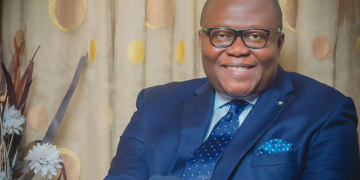
We are Unilag Mass Comm Topaz 88 as we belong to 1985-1988 Class of Mass Communication Department of the University of Lagos.
Quite a number of us are making waves in broadcasting, journalism and PRAD (public relations and advertising). A number of us work in NGOs, and few are in the academia. We also have some in Dawah (Islamic work) and in the Lord’s vineyard. We have some in the business of entertainment and public service.
Although a number of us have reached 60 and perhaps retired, most of us are now in our late 50s. But we still relate the way we did over 38 years ago when we first stepped into Unilag to begin our journey into journalism as students of mass communication.
We are still very cohesive, although a number of us have answered the Lord’s call. We’ve always wanted to give back to Unilag, QUALITATIVELY.
Indeed, one of us, John Momoh, is among the highest employers of labour in the media industry with his ownership of Channels TV. He was the immediate past Unilag alumni president. Another is Azu Ishiekwene, leading LEADERSHIP NewspaperS Group as Senior Vice Chairman after setting some records at The Punch.
As many of us are outside Nigeria, time and clime however, may not permit physical touch. But we connect almost on a daily basis with WhatsApp, poking jokes, sharing thoughts, offering insights, even benefitting ourselves spiritually and temporally.
One of our means of qualitative connection is WhatsApp or Zoom conferences, during which, as responsible citizens of Nigeria and proud ambassadors of the Unilag brand, we interrogate public issues.
Today, broadcasting trained Tunde Odediran, now a wizard of information technology led us into the enriching engagement we had with Prof Ogunsola, the first female VC of our alma mater from where we graduated almost 36 years ago.
Before this lecture, I struggled with understanding why Nigerian universities can’t run independently and financially – healthy like their peers in Western countries do. The guest lecturer and Vice Chancellor of our alma mater, Prof Ogunsola, provided strong insights that have helped me shift certain perspectives.
Prof Ogunsola started by taking us through the challenges peculiar to federal universities in Nigeria, which revolve around the lack of adequate funding.
According to her, every country is expected to spend between four to six percent of GDP on education. Nigeria has, however, never kept up with this requirement, leaving the universities in a state where they could not efficiently transform people and materials into value for national development.
Universities are supposed to be funded from a myriad of sources, only one of which is the government. Most nations fund their universities through tuition and fees, research grants and contracts as well as endowments and donations. Other ways include income from investments, commercialization of intellectual property and continuing education and professional development programmes.
While these revenue streams are varied, they do not generate enough financial throughput to balance the books in Nigerian universities.
The UNILAG Vice Chancellor also revealed what the universities spend money on, of which personnel cost is the highest. Other big expenditure channels include operating expenses, constructions, research and development, student services, infrastructure and capital projects, financial aid and scholarships and administration or overheads.
Prof. Ogunsola compared our university system with foreign universities, which are better able to provide services because they have steady revenue streams, usually from tuition and healthcare services, such as their teaching hospitals. In Nigeria, there are serious challenges, with the universities unable to manage the finances of their teaching hospitals and unable to determine or collect tuition according to the cost of teaching. In addition, Nigeria’s large population, made mostly of young people, imposes extreme stress upon federal universities’ resources.
She noted that the Federal Government pays salaries of staff, but leaves every other cost of education to the universities to bear. The adverse effect is that regular closure of universities leaves a devastating impact on the ability of the universities to meet their budgetary plans because the session is often short. The universities are left crushed in their ability to meet strategic plans, financial commitments and budgetary outcomes.
Consistently, allocations from the government has been low, the Vice Chancellor remarked, adding that government funding has been dwindling while inflation trends upwards.
The big challenge, she noted, is that the government allocates funds without tying it to the actual cost of education. It is a funding system not supported by data. And with the proliferation of federal universities, it got even worse. She gave a picture of a parent who keeps having more children on a fixed income. The more federal universities are established, and more are added annually, the less the ability of the government to ensure adequate funding.
Prof. Ogunsola also stated that there are many regulations and policies preventing universities from growing their potential revenue base, even when the cost of running federal regulatory agencies kept being passed on to the universities.
She not only identified the challenges, she had solutions. Among them, she advocated the following: that endowment funds should be released to the universities to manage; that the true cost of education should be determined scientifically and funding should be released on the basis of valid and reliable data and that government should provide a grant tied to student population.
Other recommendations include: that funds should be released per quarter and the universities should be able to manage such funds independently, according to their financial plans; that research is expensive and must be properly funded by the government and private organisations; that Governing Councils should be properly constituted to include professionals rather than politicians; and that Student loans, bursaries, work study, scholarships from various sources, and alumni support should be strengthened.
Prof Ogunsola advocated holistic policy review, and payment of appropriate fees by students just as it is done in state and private universities. When tuition is normalised, she also wants those who cannot pay what it requires to run world-class universities to be offered financial aid. Lastly, she said traditional university education is not the only solution, requesting for more use of technology to expand university education through other means, such as open and remote learning.
– Odediran and Solanke, both Alumni of UNILAG write from Lagos.
We’ve got the edge. Get real-time reports, breaking scoops, and exclusive angles delivered straight to your phone. Don’t settle for stale news. Join LEADERSHIP NEWS on WhatsApp for 24/7 updates →
Join Our WhatsApp Channel