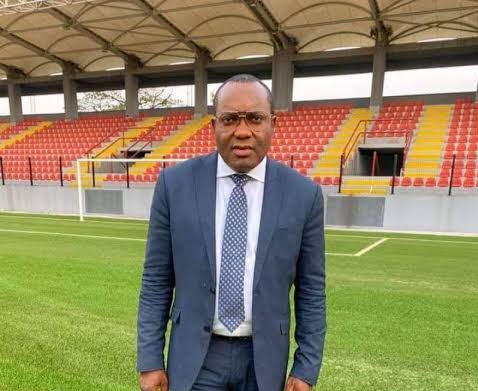
Nigeria’s long-standing stadium woes are not due to a lack of facilities but a failure to maintain and modernise them, according to the Chief Executive Officer of Monimichelle Sports Facilities Construction Limited, Ebi Egbe, who has delivered a scathing assessment of the country’s sporting infrastructure.
In an interview with LEADERSHIP Sports, Egbe dismissed the widely held belief that Nigeria suffers from a shortage of stadiums, arguing instead that the real problem lies in their functionality. “Nigeria does not have a shortage of stadiums — what we have is a shortage of functional stadiums,” he said.
Despite boasting more than 40 stadiums nationwide, only a handful meet international standards. Egbe singled out the Godswill Akpabio International Stadium and the Remo Stars Stadium as notable exceptions. He highlighted the latter’s hybrid synthetic pitch — the only one in the country with FIFA Quality certification — as a benchmark for modern infrastructure.
At the heart of the crisis, Egbe argued, is a systemic failure in how stadiums are conceived and delivered. “We build stadiums as projects, not as performance systems,” he explained, pointing to recurring issues such as poor pitch substructure, inadequate drainage, weak irrigation, and the absence of maintenance frameworks.
According to him, these shortcomings inevitably lead to rapid deterioration, rendering facilities unsuitable for elite football within a short period. “Once the pitch fails, the stadium is effectively unusable,” he added.
However, Egbe insisted that viable solutions already exist within the country, urging stakeholders to shift from criticism to adopting proven execution models. He cited ongoing upgrades at the Yakubu Gowon Stadium in Rivers State, the Aper Aku Stadium, and the Sardauna Memorial Stadium as examples of a new approach.
“These are not just upgrades; they represent a complete systems rethink,” he said. “The projects incorporate all-weather hybrid synthetic pitch technology designed for durability in Nigeria’s climate, engineered drainage systems featuring extensive pipe networks, and broadcast-standard floodlighting integrated with athletics facilities.”
Egbe noted that such designs are tailored to withstand what he described as the “zero-maintenance culture” often associated with public infrastructure, by embedding durability and reduced upkeep into the construction itself while maintaining the playing quality of natural grass.
He further highlighted developments in Benue State as evidence of growing awareness among authorities. “What’s happening there reflects a shift in thinking — sustainability must come before aesthetics, and maintenance must be built into the design, not left for later,” he said.
Beyond infrastructure, Egbe stressed the direct link between quality pitches and football development. He argued that modern hybrid surfaces improve the speed of play, boost player confidence, reduce injuries, and enhance overall match quality — all of which are essential for building competitive teams and a stronger domestic league.
Looking ahead, he called for a strategic overhaul of Nigeria’s approach to stadium development. This includes focusing on fewer, high-performance venues, adopting hybrid pitch systems certified by FIFA for local conditions, and implementing professional facility management structures.
“Every stadium must be treated as a long-term operational asset, not a one-off project,” he said.
Egbe also addressed industry challenges, particularly the role of administrators who double as contractors. While acknowledging them as competitors, he suggested that such dynamics often limit fair access to projects. Nonetheless, he maintained that his company remains focused on delivering quality, with completed projects serving as proof of competence.
In a pointed message to government and football stakeholders, Egbe warned that the future of Nigerian football cannot be determined in boardrooms alone. “It will be decided by the quality of our pitches nationwide,” he said, drawing comparisons with Morocco’s infrastructure-led football rise.
He pointed to ongoing and completed projects — including facilities in Port Harcourt, Zamfara, Ogun, Abia, Katsina and Lagos — as evidence that the solutions are already within reach.
“The solution is not theoretical,” Egbe concluded. “It is practical execution. If we get the infrastructure right, football development will follow naturally.”
We’ve got the edge. Get real-time reports, breaking scoops, and exclusive angles delivered straight to your phone. Don’t settle for stale news. Join LEADERSHIP NEWS on WhatsApp for 24/7 updates →
Join Our WhatsApp Channel