
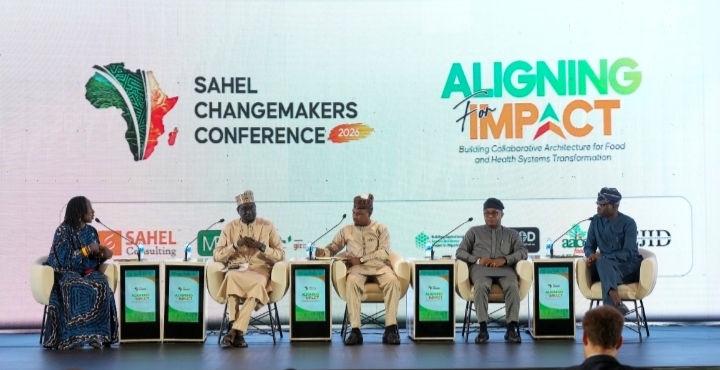
Agriculture and development experts have faulted the fragmented approach to addressing Nigeria’s food and nutrition security challenges, calling for stronger collaboration among government institutions, private sector operators, development partners and civil society organisations to achieve sustainable transformation.
They warned that treating agriculture, healthcare and nutrition as separate development concerns was undermining efforts to improve food security, maternal and child health, agricultural productivity and household welfare, despite the interconnected nature of the challenges.
The experts made the call in Abuja on Thursday at the 2026 Sahel Changemakers Conference, themed “Aligning Impact: Building Collaborative Architecture for Food and Health Systems Transformation,” where stakeholders examined strategies for aligning investments, policies and interventions across Nigeria’s agri-food system.
Speaking at the conference, Executive Board Chair of Sahel Consulting, Ndidi Okonkwo, said Nigeria’s poor maternal and child health outcomes demonstrated the consequences of failing to integrate agricultural production, household nutrition and healthcare delivery.
She cited the country’s child mortality situation, noting that one in every nine Nigerian children dies before the age of five, describing the figure as a disturbing reflection of the country’s development challenges.
Okonkwo explained that maternal mortality and poor child health were influenced by interconnected factors, including early pregnancies, maternal malnutrition, inadequate healthcare services and poor nutrition for newborns.
She noted that many mothers suffered vitamin A and iodine deficiencies, while inadequate access to clean water further exposed children to health risks.
According to her, similar vulnerabilities affect farming households, where climate change, insecurity and other agricultural challenges undermine farmers’ incomes, food production and household welfare.
She observed that primary healthcare centres and agricultural extension facilities serve many of the same households across Nigeria’s 774 local government areas, presenting opportunities for integrated interventions.
Recalling an initiative explored by Sahel Consulting about six years ago, Okonkwo said the organisation considered providing seeds and poultry to farming households when women visited health facilities for antenatal care, while exploring incentives linking agricultural support with vaccination services.
However, she regretted that little progress had been made towards integrating such interventions.
She urged policymakers and development organisations to design programmes around household needs rather than institutional boundaries, insisting that food, health and nutrition challenges must be addressed together.
She said, “When we hear statistics that one out of every nine Nigerian child dies before their fifth birthday, actually the worst indicator in the world.
I remember once we actually looked at the possibility of saying, can we provide seeds to farmer households when the woman comes for her antenatal care? Can we provide chickens? Is there a way to incentivise vaccinations when the same household is benefiting from the same services? And this was about six years ago. Sadly, very little progress has been made to integrate the same services to the same families.
When we design our programmes, whether by designing them abroad or locally, we often forget that it’s the same households that have the same needs.”
Earlier, Managing Partner of Sahel Consulting, Temitope Adegoroye, described Nigeria’s food system as critical to the livelihoods of more than 200 million people, with approximately one-third of the country’s working population connected to agriculture and food.
He, however, lamented that despite significant investments, the sector remained poorly coordinated, with institutions, programmes and budgets operating independently.
Adegoroye explained that climate shocks, insecurity and rising agricultural input costs reduce harvests and farmers’ earnings, subsequently affecting household diets, nutrition, health and productivity.
He said the resulting cycle of vulnerability left households increasingly exposed to subsequent economic and environmental shocks.
According to him, addressing the challenges requires more than introducing additional programmes or increasing investments, stressing the need for shared frameworks, aligned data, coordinated institutional responsibilities and accountability mechanisms.
He also warned that declining development assistance and increasing pressure on public finances had made effective coordination more urgent, as governments and development partners could no longer afford to sustain disconnected interventions.
Adegoroye said, “Nigeria’s food system is one of the most consequential in the world. It carries the livelihoods of a nation of over 200 million people. Roughly one in three working Nigerians is worldwide connected to agriculture and food.
And yet, it remains one of the most under-coordinated spaces in our entire urban landscape. So much investment, but poorly earned. That is the paradox we have come together here to confront.
The deeper work ahead of us is not about programmes. It is not about more investment per se. It is about architecture. The shared framework, aligned data, the coordinated mandates, and the governance that holds us accountable to one another across boundaries of all our institutions”.
Also speaking, Andrea Ruediger, who represented the Country Director of German Development Cooperation (GIZ), Dr Markus Wagner, said transforming Nigeria’s agri-food system required coordinated action capable of delivering nutritional, economic, environmental and social benefits simultaneously.
She said the transformation agenda should guarantee healthy diets, decent employment opportunities for women and young people, protection of natural resources, particularly soil and water, and support for smallholder farmers to adapt to climate change.
Ruediger stressed that no single institution could achieve these objectives independently, calling for stronger partnerships among government, private sector operators and development organisations.
She identified poor information-sharing, disconnected institutional objectives, weak sustainability of project outcomes and inadequate accountability as obstacles to effective collaboration.
The GIZ representative disclosed that German Development Cooperation was committed to moving beyond individual projects towards stronger platforms for collective action.
We’ve got the edge. Get real-time reports, breaking scoops, and exclusive angles delivered straight to your phone. Don’t settle for stale news. Join LEADERSHIP NEWS on WhatsApp for 24/7 updates →
Join Our WhatsApp Channel