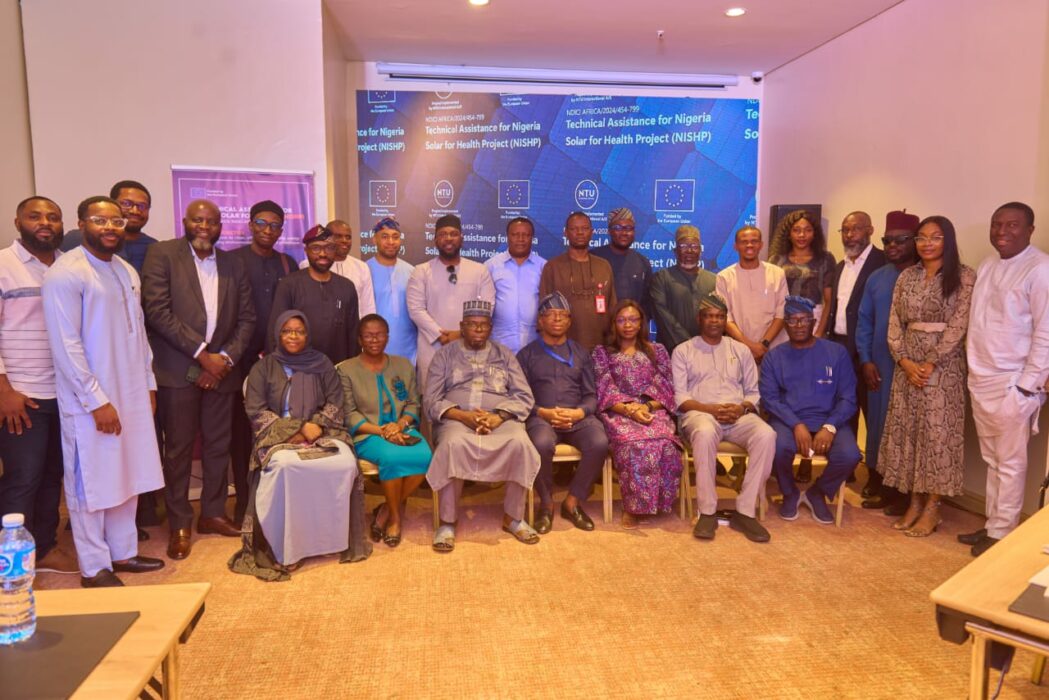
The Federal Government and the European Union (EU) have reaffirmed their commitment to deepening the implementation of the Nigeria Solar for Health Project, a flagship initiative aimed at providing sustainable power solutions to healthcare facilities across Nigeria.
The renewed commitment was expressed at the third Federal Steering Committee meeting of the project held in Abuja, during which two additional states were formally admitted, bringing the number of participating states to seven.
Speaking at the meeting, the Minister of Power, Adebayo Adelabu, described the project as a strategic intervention at the intersection of energy access and healthcare delivery. Adelabu, who was represented by Temitope Dina, Assistant Director in the Renewable and Rural Power Access Department, stressed that reliable electricity remains fundamental to quality healthcare services.
“Electricity is not a luxury in healthcare facilities; it is a necessity. From powering life-saving equipment to preserving vaccines, supporting surgical procedures and running laboratories, electricity underpins effective healthcare delivery,” he said.
He noted that many primary healthcare centres, particularly in rural and underserved communities, continue to grapple with unreliable power supply, a gap the Solar for Health Project was designed to address through clean, sustainable solar energy solutions.
According to him, the initiative aligns with the Federal Government’s broader agenda on universal energy access, renewable energy expansion and improved social service delivery, while also supporting Nigeria’s energy transition strategy.
Adelabu further described the steering committee meeting as timely, emphasising the need to assess implementation progress, address emerging challenges, strengthen inter-agency collaboration and ensure transparent and efficient deployment of the project nationwide.
He commended the collaboration between the Federal Ministry of Power, the Federal Ministry of Health, development partners and implementing agencies, noting that the success of the project could serve as a model for deploying clean energy solutions across other critical social sectors.
On its part, the European Union described the third steering committee meeting as a testament to shared commitment and confidence in the transformative role of sustainable energy in strengthening Nigeria’s health system.
Head of Cooperation at the EU Delegation to Nigeria, Massimo De Luca, announced the onboarding of two additional states, noting that the expansion reflects strong alignment with the project’s vision and a seriousness of purpose by participating states.
He disclosed that the project has so far supported clean solar power deployment to over 135 health facilities and provided electricity to more than 400 businesses, outcomes he described as translating into improved livelihoods and real economic opportunities.
“The foundation of this initiative is sustainability, which remains critical to its long-term success,” De Luca said.
Also speaking, Stakeholder Manager at NTU International, Tinyan Ogiehor, said discussions at the meeting focused on sustainability, distribution and operational frameworks.
He explained that emphasis was placed on state ownership, stakeholder roles, maintenance structures and private sector participation to ensure effective delivery and long-term viability of the Solar for Health Project at both state and national levels.
We’ve got the edge. Get real-time reports, breaking scoops, and exclusive angles delivered straight to your phone. Don’t settle for stale news. Join LEADERSHIP NEWS on WhatsApp for 24/7 updates →
Join Our WhatsApp Channel