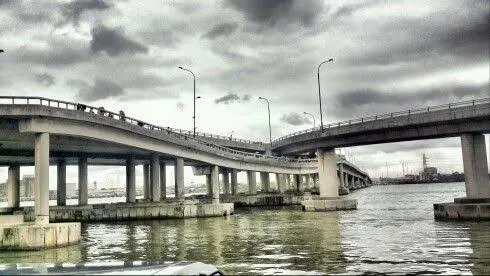
The Federal Government has officially handed over the construction of a brand-new Carter Bridge in Lagos to China Civil Engineering Construction Corporation (CCECC).
The event took place at the Carter Bridge in Lagos Island, Lagos State.
In his address at the handover, the Minister of Works, David Umahi, said the decision to reconstruct the bridge became necessary after years of alarming defects beneath both the Carter Bridge and the Third Mainland Bridge.
Umahi said investigations into the underwater structural elements of the bridges began as early as 2013, with another assessment conducted in 2019.
The reports, he said, showed that the defects were increasing at a rate described by experts as “geometrical progression.”
“The past administration commissioned an investigation of what was happening with the structural elements below the water in 2013. Very disturbing defects were noticed in Carter Bridge and the Third Mainland Bridge,” Umahi’s aide, Francis Nwaze, quoted the minister as saying in a statement.
He explained that upon assumption of office, the present administration immediately engaged geologists and specialist divers to conduct further underwater investigations, which confirmed that some piles supporting the bridges had already shifted from their pile caps.
“It’s just like the hip of the leg is cut off,” the minister explained while describing the severity of the damage.
The former Ebonyi State governor said extensive consultations were held with bridge experts, stakeholders, and members of the National Assembly, including foreign professionals, to determine the best solution.
According to him, repairing the Carter Bridge would cost almost twice as much as building a completely new structure.
Umahi said that part of the new Carter Bridge will feature a world-class cable-stayed design to improve navigation and enhance Lagos’s aesthetic value.
“We decided that a section of this Carter Bridge will be a cable bridge.
You see the cable bridges we see overseas, very beautiful, and that is to enhance our navigational activities,” he said.
The minister disclosed that the project is expected to last 36 months.
He praised Tinubu for what he described as bold leadership and commitment to infrastructure renewal across the country.
The minister stated that due process was strictly followed in selecting the contractor, noting that seven firms were invited to bid, of which six submitted bids, including Julius Berger.
“The CCECC was technically and commercially most viable. That is why the BPP recommended them, and the Federal Executive Council has awarded the project to them,” he said.
He directed the company to immediately mobilise to the site, while assuring Nigerians that the ministry would closely monitor the project monthly to ensure compliance with all technical and safety standards.
The project, valued at ₦545 billion, will be financed through a combination of Federal Government counterpart funding and external borrowing, with 30 per cent to be paid by the Federal Government and 70 per cent sourced externally.
We’ve got the edge. Get real-time reports, breaking scoops, and exclusive angles delivered straight to your phone. Don’t settle for stale news. Join LEADERSHIP NEWS on WhatsApp for 24/7 updates →
Join Our WhatsApp Channel