The federal government has unveiled a five-year plan to end child marriage in Nigeria by 2030.
It estimates N140.8bn for the implementation of the plan.
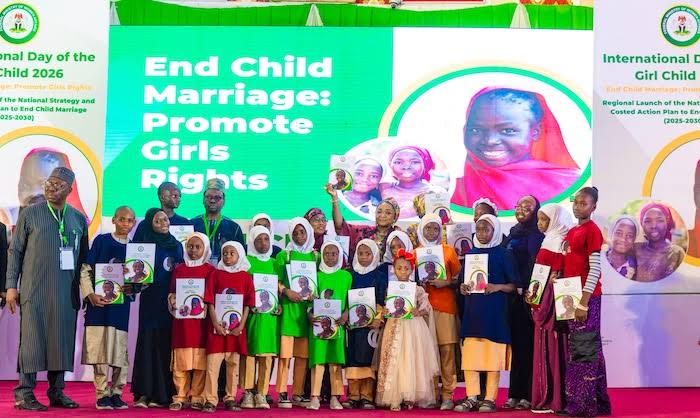
The funding requirement was disclosed by the Federal Ministry of Women Affairs and Social Development during the launch of the National Strategy and Costed Action Plan on Ending Child Marriage in Nigeria (2025–2030), held in collaboration with the Kano State Ministry of Women Affairs and UNICEF in Kano.
At the event, the minister of Women Affairs, Hajiya Imaan Sulaiman-Ibrahim, said the strategy was designed to translate the government’s commitment to protecting girls into concrete action, adequate funding and measurable results.
She said its success would be measured by increased school retention among girls, the abandonment of harmful practices by communities and a reduction in child marriage.
The minister urged federal and state governments to integrate the strategy into their policies and budgets, stressing the need for coordinated action across education, healthcare, social protection and child protection institutions.
She identified poverty, insecurity, school exclusion, gender discrimination and harmful traditional practices as major factors contributing to child marriage.
Sulaiman-Ibrahim also called for stronger enforcement of child protection laws and improved access to education and social welfare services for girls at risk of early marriage.
She commended the Kano State Government for its scholarship programmes, free bus transportation for girls and adoption of re-entry guidelines for married adolescent girls.
Presenting the financial framework, the ministry’s Director of Economic Services, Musa Aliyu Musa, said the plan would require N140.802bn over five years, with the Federal Government expected to provide 60 per cent of the funding, while development partners and other stakeholders would contribute the remaining 40 per cent.
He said the previous national strategy, launched in 2014, lacked a costed action plan, making implementation difficult.
According to him, the new framework outlines funding requirements, institutional responsibilities and monitoring mechanisms.
Also speaking, the Chief of UNICEF Field Office in Kano, Mr Shafeeq Ur-Rehman, said the 2024 Nigeria Demographic and Health Survey showed that 33.4 per cent of young women nationwide were married before the age of 18.
He said the figures were higher in the North-West and North-East, with Bauchi recording 74 per cent, Jigawa 72 per cent, Katsina 69 per cent and Kano 39 per cent.
Ur-Rehman urged state governments to translate the strategy into funded programmes and stronger protection services.
The Kano State Commissioner for Women Affairs, Children and Persons with Special Needs, Hajiya Amina Abdullahi, reaffirmed the state government’s commitment to protecting girls through initiatives such as the AGILE Project, the Girl Child Initiative and free and compulsory education.
We’ve got the edge. Get real-time reports, breaking scoops, and exclusive angles delivered straight to your phone. Don’t settle for stale news. Join LEADERSHIP NEWS on WhatsApp for 24/7 updates →
Join Our WhatsApp Channel