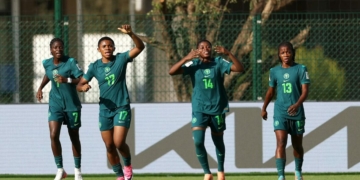
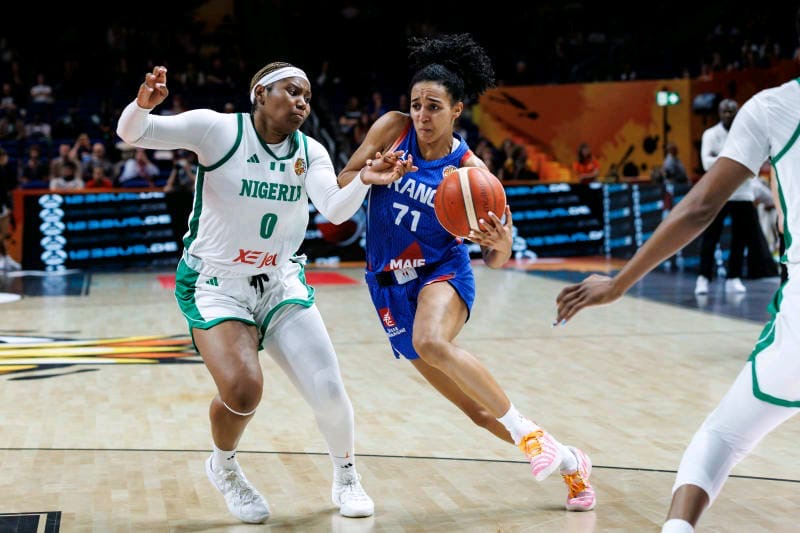
African champions Nigeria suffered their third consecutive defeat at the ongoing D’2026 FIBA Women’s Basketball World Cup in Germany after France produced a record-breaking shooting display to cruise to a 111-56 victory and finish top of Group B.
The D’Tigress struggled from the opening tip as France imposed their pace and quality on the contest at the Berlin Arena, leaving Nigeria unable to find any rhythm throughout the one-sided encounter.
France raced to a 31-12 lead in the opening quarter before adding 34 points in the second to take a commanding 65-26 advantage into half-time.
The French continued their dominance after the interval, producing another 30-point third quarter before easing off in the final period with the result already beyond doubt.
France’s 111 points were powered by an outstanding long-range shooting performance, with the hosts making a World Cup-record 22 three-pointers. They surpassed their previous best of 15 and also bettered Japan’s previous tournament record of 20.
They were particularly ruthless before the break, converting 14 three-pointers, with Gabby Williams and Marine Johannes combining for eight from 11 attempts.
The 65 points scored by France in the first half also represented their highest first-half total in a FIBA Women’s Basketball World Cup match.
Williams made further history by becoming the first French player to sink six three-pointers in a Women’s World Cup game.
For Nigeria, the heavy defeat brought a disappointing end to a group-stage campaign in which the reigning African champions failed to record a victory.
D’Tigress captain Amy Okonkwo admitted that Nigeria struggled to cope with France’s quality and intensity.
“It was a tough game. France is a great team. We saw that at the 2024 Olympics, and we’ve seen it throughout the qualifiers,” Okonkwo said.
“They’re a really great team, and they came out to play today. Again, I think we just struggled to find our rhythm early and weren’t able to get the win or really stop them.”
Head coach Rena Wakama acknowledged that Nigeria are going through a rebuilding phase and cannot depend on the success of the squad that reached the Olympic quarter-finals in Paris two years ago.
“A lot of people saw what we did in 2024, and the reality of where we are today is that we’re in a rebuilding process,” Wakama said.
“I think connectivity is a big thing for myself, my team and my staff. Where we are today isn’t where we were two years ago.
“We can’t rely on the success we had two years ago. Who we are today, we’re still figuring that out, and I know we will.”
Wakama also pointed to the experience and competitive sharpness of the French players, several of whom are regular WNBA starters.
“A lot of those players are in playoff shape. They play in the WNBA, and my players just weren’t there yet to be able to compete at the level that they were competing at,” she explained.
Despite the emphatic defeat, the coach praised her young players for continuing to compete, particularly as several were making their first appearance at this level.
“I’m most proud of our fight,” Wakama said.
“When you have a new team and I have so many young players, I think I have about five or six young players on this team who have never been at this stage before, some of whom just graduated from college.”
She singled out Grace Efosa for praise after the youngster scored 15 points in around 20 minutes.
With the 2028 Los Angeles Olympics now the next major target, Wakama said rebuilding the squad must begin with identifying Nigeria’s best available players and improving preparation.
“It starts, one, with just who we’re getting in the uniforms, right? Just making sure that I’m continuing to put the best talent that Nigeria has to offer in these uniforms,” she said.
Wakama also acknowledged the support of the Nigeria Basketball Federation but insisted that the team must raise its level of preparation if it is to return to the heights reached in Paris.
“We had great preparation, but I think there’s another level that we have to get to in that preparation,” she added.
While the World Cup campaign ended in disappointment, Wakama said the increasing presence of African and Nigerian players in elite competitions was encouraging for the future of women’s basketball.
“This is the best time to be a part of women’s basketball specifically,” she said.
We’ve got the edge. Get real-time reports, breaking scoops, and exclusive angles delivered straight to your phone. Don’t settle for stale news. Join LEADERSHIP NEWS on WhatsApp for 24/7 updates →
Join Our WhatsApp Channel