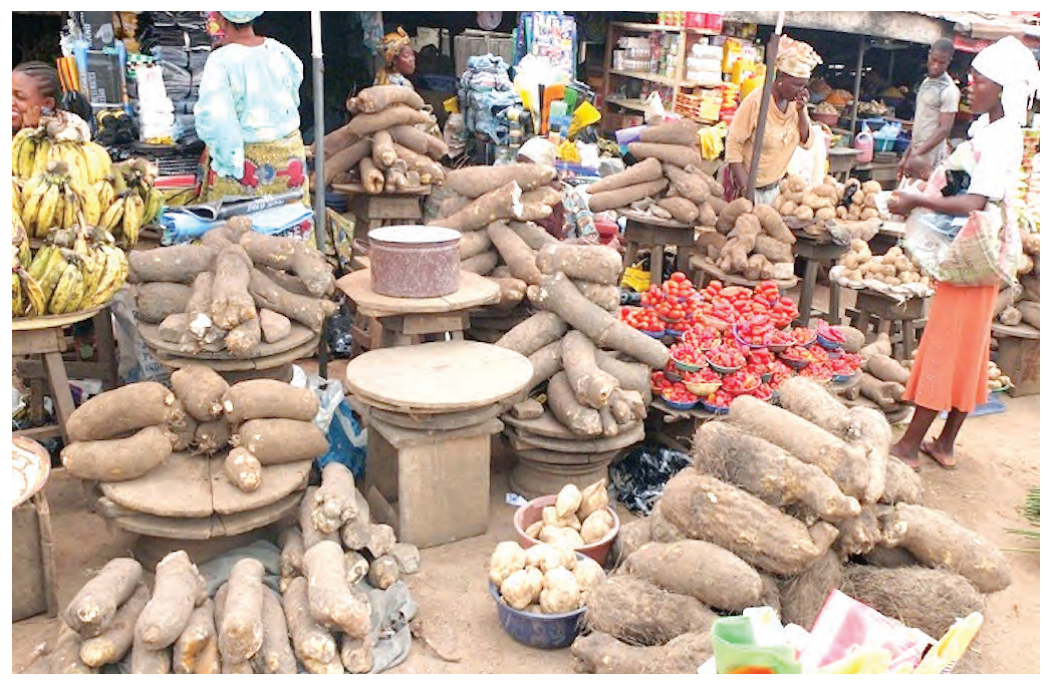
As the Christmas and New Year celebrations approach, the prices of food items such as rice, garri and yam appear to have reduced drastically across the nation.
Most food items witnessed increased prices due to the removal of fuel subsidy by the President Bola Ahmed Tinubu administration in 2023 and rising insecurity across farming communities; however, investigations by LEADERSHIP Weekend show that the majority of the food items have experienced a drop in their prices.
The festive mood usually creates excitement and tension in the market as people rush to buy the same products at the same time.

When LEADERSHIP Weekend visited Relief and World Bank markets in Imo State, a 50kg bag of rice which was usually sold for N75,000 now sells for N60,000.
A 10kg gallon of garri which was sold for N7,600 in November now sells for N5,000. Also, a tuber of yam which was initially purchased at N2,500 now sells for N1,900, while a 50kg bag of beans, which was bought at N34,000 previously, now sells for N30,000.
Lagaos
In Lagos, the price of rice has equally dropped significabtly.
At Mushin and Daleko markets, the price of a 50kg pof rice now goes for N54,000 away from N75,000 which it was sold in Novermber and before then.
Delta State
In Delta State, particularly Asaba, a visit to some markets revealed that prices of foodstuffs are stable across major markets like Oko (Hausa) Market, Midwifery Market and Ogbogonogo Market, except at the weekly village markets.
Findings in the Delta State capital show that the costs of essential food items are stable, but traders and buyers expressed frustration over the lack of means to purchase them.
A paint-bucket measure of tomatoes that sold for N5,000 a few months ago now costs N4,000. Yam prices remain stable, ranging between N1,800 and N2,000 per tuber, while garri still sells at N3,000 per paint bucket, unchanged despite the harvest season.
At Ogbogonogo Market, a food vendor, Mrs Beatrice Nnamdi, said some food items are still on the high side, even with the influx of new harvest food items.
‘The price of a bag of rice now is between N60,000 and N65,000. It was between N90,000 and N120,000 before. A bag of beans is now N50,000. We’ve sold it here before between N70,000 and N90,000,’ she said.
‘Normally, when it is harvest time and yam, maize and potatoes start coming out, garri is normally supposed to be cheap. Tomatoes are now between N7,500 and N8,000 per paint bucket. Beans and rice have dropped only slightly – from N6,000 to N5,500 per paint bucket,’ she stated.
At village markets, the prices of foodstuffs are gradually reducing owing to the harvesting of yam, maize and cassava. Once cassava, yam and maize are being harvested, it brings down the prices of other foodstuffs like rice, beans and other fruit items.
Beans experienced a reduced price range, from N80,000 a bag in May to N70,000 in August. New tubers of yam now sell between N5,000 and N6,000. A 50kg bag of maize that sold for N66,000 in May now goes for N60,000, while a bag of yellow garri dropped to N50,000.
Where prices were unstable, it was attributed to the prevailing insecurity in the country, particularly in Delta.
‘That’s why food is expensive now. People can’t afford to buy much anymore. They just come in to buy small quantities because there’s no money,’ a buyer said.
A cattle dealer at Oko Market in Delta State, Alhaji Yekini Adeojo, confirmed that livestock prices have remained high.
‘A cow that sold for N800,000 months ago is still the same. Nothing has come down,’ he said.
A farmer, Mrs Akpobomie Mary, said that the constant attacks on farmers and transporters by bandits and herdsmen have led to a significant decrease in food supply, resulting in higher prices.
‘Farmers are afraid to go to their farms due to fear of being attacked, and those who manage to cultivate crops struggle to transport them to the market because of the insecurity on the roads and bad roads. Let the government at all levels help us fight banditry and insecurity.
“We want to appeal to the new Minister of Defence, General Christopher Musa (retd), to help us wage war against criminals to enable us the farmers to access our farms and also work.’
A market leader, Francis Akpomire, urged the federal government to address the security challenges facing farmers and traders in the country.
They also urged the government to provide support to farmers and traders, such as financial assistance, fertilisers and modern farming equipment.
‘The government at all levels needs to act urgently. Many families can no longer afford basic food. Hunger is everywhere. Transport costs are killing us. We pay nearly double now to bring in food from the farms. It’s affecting how we stock and sell,’ he lamented.
Bayelsa
Residents of Bayelsa State are already feeling the heat of unstable food prices in major markets as the festive season approaches.
A survey across markets in the state capital, Yenagoa, shows that while the cost of rice, beans and garri has reduced slightly, items such as yams, palm oil, stockfish and meat remain expensive, leaving many families struggling.
Traders, farmers and market leaders who spoke to LEADERSHIP Weekend attributed the sharp price movements to poor road conditions, high transport costs and the anticipation of festive season demand.
They noted that food supplies from the northern part of the country now take longer to arrive, worsening the situation.
A farmer in Yenagoa, Mr Martin Ebisine, blamed transportation challenges for the persistent high prices, stating that moving livestock from the North to Bayelsa has become more expensive and risky due to bad roads and longer travel routes.
‘The dollar is not coming down anytime soon. Everything is just going up and becoming more expensive. Very few vegetables are coming from the North because transporters now use longer routes that take up to five or six days to reach Yenagoa, which increases costs.
‘Also, transporting cows from the North takes five days and in that process, two or three may die of dehydration because they don’t eat or drink water in transit. Food stuff will not come down unless we start growing our own,’ he added.
At Swali Market, a major food hub in Yenagoa, a beans seller, Mohammed, said the price of beans has dropped slightly in recent weeks.
‘A bag of iron beans is N120,000 now while the small seed is N110,000. Last month, iron beans were N130,000, and the small seed was N125,000. By the end of November, it may come down further,’ he said.
Rice traders also confirmed a gradual decline in prices. One of them said:
‘White Horse and Optimum Mango areN64,000 per bag, another brand is N63,000, and Premium is N75,000. Two months ago, we sold Premium for N82,000, so prices are coming down.’
Palm oil sellers are also adjusting to market realities. Mrs Sinclair, who trades in oil, said the price per gallon has increased.
‘A 25-litre gallon is N65,000 now, compared to N62,000 two months ago. Many people prefer selling in smaller bottles at N4,500 each instead of big gallons,’ she explained.
The leader of Swali Market, who spoke under anonymity, said that while rice and garri are cheaper due to the harvest season, the cost of other food items remains very high.
‘Meat is very expensive. Garri has reduced from N34,000 per half bag to N28,000, while a tuber of yam which was sold for N4,000 before is now N2,500,’ she said.
In the poultry sector, small farmers are also struggling. The CEO of Tush Agro, Mr Levi Uche Onyekaonwu, said the high cost of feed and low farm capacity make it difficult to reduce prices.
‘One crate of eggs is N6,000, meaning one egg costs N200. I recently sold chickens for N8,000, but the same chickens were sold for N8,500 at Swali Market,’ he said.
Benue State
In Benue State, prices of food items have dropped sharply due to the harvest season and supply exceeding demand.
However, insecurity remains a major challenge, threatening food security as farmers continue to flee their ancestral homes and abandon farms for fear of attacks by marauding herdsmen and local bandits.
Most farmers are now producing at subsistence level, growing only what their families can eat instead of farming commercially.
Farmers like Nengenen Igba (soybean farmer), Terkura Tyona (rice farmer) and Mama Kubee Iorliam (yam farmer) told our correspondent they cannot farm in large quantities due to attacks which have driven them away from their ancestral homes.
‘The rice and soybean we produced last year are still in stores; we refuse to sell below production and storage costs,’ said Igba and Tyona.
They cited additional problems where the Federal Government’s policy of lowering market prices of food items hurts farmers, making them sell below production cost amid the high costs of inputs, labour and post-subsidy fuel prices.
In Zone A (seven LGAs), the worst affected are Katsina-Ala, Ukum and Logo (the Sankera axis), and Kwande, which face both herders’ and local bandits’ attacks.
In these LGAs, 90 per cent of the population has been displaced and now lives in IDP camps or with relatives in safer council headquarters.
In Zone B (seven LGAs), the worst-hit are Guma, Gwer-West, Makurdi and Buruku. Many residents have abandoned their communities and now live in camps or with relatives.
Sokoto State
A market survey on the price of foodstuffs in Binji, Bodinga, Gada and some other major markets in Sokoto showed that a 50kg bag of foreign rice is sold at the range of N55,000 – N57,000, depending on different brands, while a 100kg bag of local rice (grade A) is sold for N92,000.
Also, a bag of millet is sold for N35,000, the same for a bag of maize, while an average single tuber of yam goes for N2,000.
LEADERSHIP Weekend findings indicated that the prices of garri, rice – local and foreign – and beans per bag have been on the increase as the festive periods approach.
From mid-last month, garri came down from N60,000 to N50,000, local rice (100kg) N100,000 to N90,000, foreign N70,000 to between N63,000 and N65,000.
Responding to inquiries, many dealers of the food items lamented low patronage, expressing worry that they might encounter huge losses if the trend continued.
Anambra State
In Anambra State, prices of beans and rice have dropped reasonably compared their prices last year, but the situation is different for yam and red oil as the prices of the latter two have soared.
Uzodinma Eze, a beans and rice seller in Eke Awka Market, a major market in Awka, the state capital, told LEADERSHIP Weekend that the prices of a bag of two different brands of beans he sold at N180,000 and N230,000 about this period last year have now dropped as he sells each at N100,000 and N120,000, respectively.
However, the prices of yam and red oil in the market have soared from similar prices last year.
For instance, Mrs Ifeoma Nwosu, a yam seller in Eke Awka said that a tuber of yam she sold at N2,300 about this period last year is now sold at N2,700.
Similarly, Mrs Linda Ukwueze, a red oil seller in the same Eke Awka Market said that 25 litres of red oil she purchased at N55,000 this period last year now costs N70,000.
Some parents spoken to lamented that they were passing through challenges in raising their children due to the economic downturn.
Plateau State
Resident of Jos, the Plateau State capital and its environs are gnashing their teeth over the hike in prices of foodstuffs in the state.
Investigation by our correspondent who went round the Terminus and Bukuru markets revealed that a kilo of cow meat which was hitherto sold at N5,000 now goes for N6,500 while a kilo of Scumbia and Titus fish at the cold room goes for N7,000.
However, prices of grains are affordable because of the new harvest. A mudu of Oyankede or Ijebu Gari which went for N1,000 before is now sold for N500.
Similarly, a mudu of local rice is sold at N1,800 while the one called ‘local foreign’ goes for N2,000. The price of beans has also reduced as a mudu of iron beans goes for N1,500 while red beans is sold at N1,700.
Our correspondent gathered that they bought a bag of corn last year at N54,000 but now it is sold in some places at N37,000 and with the coming of new corn, it is likely that the price will crash further.
Besides, a bag of newly harvested Irish potatoes which was sold for N27,000 early August is now sold for N53,000.
In the same vein, a bag of 50kg foreign rice at the Bukuru and Terminus markets goes for N80,000. Likewise, 10 medium-sized tubers of Yam go for N10,000 as against the earlier price of N7000.
A further market survey also revealed that small rubber paint of tomatoes is sold at N2500, as against N1800, while a two-litre bottle of vegetable oil is now sold for N5,000.
One litre of palm oil is also sold for N2,000 as against N1,500
Speaking with our correspondent in Bukuru Market, Mrs. Adah Emmanuel lamented the hike in prices of foodstuff in some cases in the market.
Speaking with our correspondent, the Plateau State chairman of the Nigeria Labour Congress (NLC), Eugene Manji, expressed readiness to seek renegotiation of the minimum wage, considering the high cost of living in the country.
According to him, given the current economic realities and rising costs of foodstuffs, they are pushing for a substantial increase in the minimum wage.
Manji further argued that they want a living wage that takes into account the high cost of food, transportation, accommodation, school fees and healthcare.
In Enugu State, investigations by our correspondent revealed that a 50kg of rice is sold between 125,000 and 130,000 while a bag of beans is sold for between 130,000 and 135,000.
A 30-litre of red oil is sold between 75,000 and 80,000.
A labour leader at one of the markets in Enugu, Mrs Patricia Ndukwe while comparing the prices said improved rains helped to reduce the prices, adding that before the rains, the prices were high.
Ekiti State
In Ekiti, some residents have expressed divergent views over the present price of food items in the state.
To some of them, the price of some food items has slightly reduced while for others, the cost of the items still remains stable, while some others are of the view that the price of the food items keeps increasing.
Speaking with LEADERSHIP Weekend in Ado Ekiti, the state capital, a housewife, Mrs Adenike Ajayi said the food items on which noticeable slight price reduction was recorded across the state are rice, beans and garri.
Ajayi said, “By this time last year, a rubber of rice was sold for N3500, beans (white/red) between N3,000 and N5,000, garri between N700 and 1,000, a bag of rice and beans were close to N90,000 but now, there have been a reduction of over 40 per cent on almost all the food items.”
A market survey carried out by our correspondent on the current price of some food items in the state showed that a bag of foreign rice is sold at N67,000, a bag of local rice N52,000, rubber of foreign rice N2,500 and rubber of local rice N2,200.
A bag of white beans goes for N80,000, a bag of red beans N85,000, a rubber of white beans N2,000, a rubber of red beans is sold between N2,700 and N3,500 and a bag of maize N25,000.
A 50-litre of groundnut oil is sold at N66,500, 5 litres of palm oil N10,500, a bottle of palm oil N2,000, bottle of groundnut N2,500 and 30 litres of palm oil N58,000.
A farmer, Mr Olakunle Adeyanju, said there is no doubt that the price of food items has reduced.
Adeyanju who posited that the reduction is minimal said, “ The food item prices could have gone down drastically but for the high cost of transporting from the farm to the market or wherever the consumers are. This is the reason why government must ensure that the price of fuel is reduced to the barest.”
Also, a market woman, who simply identified herself as Mrs Jayeoba, said that though the price of a bag of rice and other foodstuffs has slightly reduced, the majority of people still can’t afford it.
The chairman, Trade Union Congress (TUC) in the state, Comrade (Dr) Omotola Farotimi, said the price of food items is gradually reducing.
Niger State
Amid perennial floods and insecurity, small farm holders have decried the lack of access to subsidised farm inputs and storage facilities to check food security.
In the past three years, floods have washed away many farmland, especially in the lower course of the River Niger around Mokwa, Lavun, Edati, Katcha and parts of Agaie and Lapai local government areas.
Similarly, areas around Shiroro, Kainji and Wushishi, housing the hydropower dams, were often prone to floods, invariably affecting the yields.
Areas like Mariga, Magama, Shiroro, Rijau, Rafi and Munya were also faced with incessant bandit attacks and made small farmers abandon their homes.
Besides the ecological and security problems, the chairman of the Niger State chapter of Small Farm Holders, Usman Kwatu, said the farmers in the state may not be able to sustain the tempo of production, considering the high cost of farm inputs like fertilisers and insecticides.
He said, “This year, we purchased fertilisers as high as N80,000 per bag. How many hectares can one bag cover and how can we sustain this to help improve food security?”
A farmer who specialises in growing root crops, Gambo Mohammed, said the problem of some of them growing root crops was access to storage facilities and value chain that could guarantee all year-round availability.
Yobe State
Farmers in some parts of Yobe State, particularly in and around Damaturu, the state capital, are grappling with devastating impact of a drought that has left crops withered due to the shortage of rainfall.
Many farmers and residents of the affected areas have expressed deep concern over the shortage of rainfall this year, which they said reduced their harvest and worsened their living conditions.
Some of the farmers told LEADERSHIP Weekend that the lack of rain in the zone, as compared to other parts of the state, which have been experiencing steady rainfall, has left crops like maize, millet and rice withered and could lead to more food shortages.
One of the farmers, Mallam Bukar Abba, a resident of Damaturu, said the drought, as a result of the shortage of rainfall, has left crops drying up.
Bukar said the rain ceased too early and the few times it fell, it only drizzled and not enough to nourish the crops.
He further explained that this year’s short rainfall has left many farmers worried about food security, noting that many farmers lost millions of naira as the crops did not reach maturity before they dried up.
Also lamenting the drought, another farmer, Mohammed Salisu, a resident of Gashua LGA, said the shortage was devastating as their means of livelihood was seriously affected
Another rice farmer, Mallam Haruna Gini, said, “ I have five plots of land where I planted rice and other crops, but I lost everything because there was no rainfall. My farm is in Yunusari, and to make matters worse, it’s a dangerous area due to the Boko Haram activities. Farming is already risky, and now the drought has made it worse.”
Our correspondent who visited some of the affected areas, which included Gashua, Yunusari, Fika, Jakusko, Tarmuwa, Dapchi, Yusfari, Karsuwa, Nguru and Damaturu, noticed that some premature crops have since withered.
Sokoto State
A market survey on the price of foodstuffs across major markets in Sokoto showed that a 50kg bag of foreign rice is sold at the range of N55,000 – N57,000, depending on different brands, while a 100kg bag of local rice (grade A) is sold for N92,000.
Also, a bag of millet is sold for N35,000, the same for a bag of maize, while an average single tuber of yam goes for N2,000.
LEADERSHIP Weekend findings indicated that the prices of garri, rice – local and foreign – and beans per bag have been on the increase as the festive periods approach.
From mid-last month, garri went up from N60,000 to N70,000, local rice (100kg) N100,000 to N110,000, foreign N70,000 to between N73,000 and N75,000.
White beans (preferred choice for making of beans cake) went up from N70,000 to N80,000; iron beans went up from N80,000 to N100,00, and brown beans N90,000 to N110,00.
Responding to inquiries, many dealers of the food items lamented low patronage, expressing worry that they might encounter huge losses if the trend continued.
Anambra State
In Anambra State, prices of beans and rice have dropped reasonably compared their prices last year, but the situation is different for yam and red oil as the prices of the latter two have soared.
Uzodinma Eze, a beans and rice seller in Eke Awka Market, a major market in Awka, the state capital, told LEADERSHIP Weekend that the prices of a bag of two different brands of beans he sold at N180,000 and N230,000 about this period last year have now dropped as he sells each at N100,000 and N120,000, respectively.
However, the prices of yam and red oil in the market have soared from similar prices last year.
For instance, Mrs Ifeoma Nwosu, a yam seller in Eke Awka said that a tuber of yam she sold at N2,300 about this period last year is now sold at N2,700.
Similarly, Mrs Linda Ukwueze, a red oil seller in the same Eke Awka Market said that 25 litres of red oil she purchased at N55,000 this period last year now costs N70,000.
Some parents spoken to lamented that they were passing through challenges in raising their children due to the economic downturn.
Plateau State
Resident of Jos, the Plateau State capital and its environs are gnashing their teeth over the hike in prices of foodstuffs in the state.
Investigation by our correspondent who went round the Terminus and Bukuru markets revealed that a kilo of cow meat which was hitherto sold at N5,000 now goes for N6500 while a kilo of Scumbia and Titus fish at the cold room goes for N7,000.
However, prices of grains are affordable because of the new harvest. A mudu of Oyankede or Ijebu Gari which went for N1,000 before is now sold for N500.
Similarly, a mudu of local rice is sold at N1,800 while the one called ‘local foreign’ goes for N2,000. The price of beans has also reduced as a mudu of iron beans goes for N1,500 while red beans is sold at N1,700.
Our correspondent gathered that they bought a bag of corn last year at N54,000 but now it is sold in some places at N37,000 and with the coming of new corn, it is likely that the price will crash further.
Besides, a bag of newly harvested Irish potatoes which was sold for N27,000 early August is now sold for N53,000.
In the same vein, a bag of 50kg foreign rice at the Bukuru and Terminus markets goes for N80,000. Likewise, 10 medium-sized tubers of Yam go for N10,000 as against the earlier price of N7000.
A further market survey also revealed that small rubber paint of tomatoes is sold at N2500, as against N1800, while a two-litre bottle of vegetable oil is now sold for N5,000.
One litre of palm oil is also sold for N2,000 as against N1,500
Speaking with our correspondent in Bukuru Market, Mrs. Adah Emmanuel lamented the hike in prices of foodstuff in some cases in the market.
Also, in his reaction to the development, Prof Ademu Wada of the Department of Economics, University of Jos, said the reason for hike in the prices of foodstuffs in the country is attributed to the removal of fuel subsidy.
According to him, another factor for the hike is as a result of insecurity in the country.
He pointed out that farmers cannot go to their farms for fear of being attacked and killed while on the farm.
Speaking with our correspondent, the Plateau State chairman of the Nigeria Labour Congress (NLC), Eugene Manji, expressed readiness to seek renegotiation of the minimum wage, considering the high cost of living in the country.
According to him, given the current economic realities and rising costs of foodstuffs, they are pushing for a substantial increase in the minimum wage.
Manji further argued that they want a living wage that takes into account the high cost of food, transportation, accommodation, school fees and healthcare.
In Enugu State, investigations by our correspondent revealed that a 50kg of rice is sold between 125,000 and 130,000 while a bag of beans is sold for between 130,000 and 135,000.
A 30-litre of red oil is sold between 75,000 and 80,000.
A labour leader at one of the markets in Enugu, Mrs Patricia Ndukwe while comparing the prices said improved rains helped to reduce the prices, adding that before the rains, the prices were high.
Ekiti State
In Ekiti, some residents have expressed divergent views over the present price of food items in the state.
To some of them, the price of some food items has slightly reduced while for others, the cost of the items still remains stable, while some others are of the view that the price of the food items keeps increasing.
Speaking with LEADERSHIP Weekend in Ado Ekiti, the state capital, a housewife, Mrs Adenike Ajayi said the food items on which noticeable slight price reduction was recorded across the state are rice, beans and garri.
Ajayi said, “By this time last year, a rubber of rice was sold for N3500, beans (white/red) between N3,000 and N5,000, garri between N700 and 1,000, a bag of rice and beans were close to N90,000 but now, there have been a reduction of over 40 per cent on almost all the food items.”
A market survey carried out by our correspondent on the current price of some food items in the state showed that a bag of foreign rice is sold at N67,000, a bag of local rice N52,000, rubber of foreign rice N2,500 and rubber of local rice N2,200.
A bag of white beans goes for N80,000, a bag of red beans N85,000, a rubber of white beans N2,000, a rubber of red beans is sold between N2,700 and N3,500 and a bag of maize N25,000.
A 50-litre of groundnut oil is sold at N66,500, 5 litres of palm oil N10,500, a bottle of palm oil N2,000, bottle of groundnut N2,500 and 30 litres of palm oil N58,000.
A farmer, Mr Olakunle Adeyanju, said there is no doubt that the price of food items has reduced.
Adeyanju who posited that the reduction is minimal said, “ The food item prices could have gone down drastically but for the high cost of transporting from the farm to the market or wherever the consumers are. This is the reason why government must ensure that the price of fuel is reduced to the barest.”
Also, a market woman, who simply identified herself as Mrs Jayeoba, said that though the price of a bag of rice and other foodstuffs has slightly reduced, the majority of people still can’t afford it.
The chairman, Trade Union Congress (TUC) in the state, Comrade (Dr) Omotola Farotimi, said the price of food items is gradually reducing.
Niger State
Amid perennial floods and insecurity, small farm holders have decried the lack of access to subsidised farm inputs and storage facilities to check food security.
In the past three years, floods have washed away many farmland, especially in the lower course of the River Niger around Mokwa, Lavun, Edati, Katcha and parts of Agaie and Lapai local government areas.
Similarly, areas around Shiroro, Kainji and Wushishi, housing the hydropower dams, were often prone to floods, invariably affecting the yields.
Areas like Mariga, Magama, Shiroro, Rijau, Rafi and Munya were also faced with incessant bandit attacks and made small farmers abandon their homes.
Besides the ecological and security problems, the chairman of the Niger State chapter of Small Farm Holders, Usman Kwatu, said the farmers in the state may not be able to sustain the tempo of production, considering the high cost of farm inputs like fertilisers and insecticides.
He said, “This year, we purchased fertilisers as high as N80,000 per bag. How many hectares can one bag cover and how can we sustain this to help improve food security?”
A farmer who specialises in growing root crops, Gambo Mohammed, said the problem of some of them growing root crops was access to storage facilities and value chain that could guarantee all year-round availability.
Yobe State
Farmers in some parts of Yobe State, particularly in and around Damaturu, the state capital, are grappling with devastating impact of a drought that has left crops withered due to the shortage of rainfall.
Many farmers and residents of the affected areas have expressed deep concern over the shortage of rainfall this year, which they said reduced their harvest and worsened their living conditions.
Some of the farmers told LEADERSHIP Weekend that the lack of rain in the zone, as compared to other parts of the state, which have been experiencing steady rainfall, has left crops like maize, millet and rice withered and could lead to more food shortages.
One of the farmers, Mallam Bukar Abba, a resident of Damaturu, said the drought, as a result of the shortage of rainfall, has left crops drying up.
Bukar said the rain ceased too early and the few times it fell, it only drizzled and not enough to nourish the crops.
He further explained that this year’s short rainfall has left many farmers worried about food security, noting that many farmers lost millions of naira as the crops did not reach maturity before they dried up.
Also lamenting the drought, another farmer, Mohammed Salisu, a resident of Gashua LGA, said the shortage was devastating as their means of livelihood was seriously affected.
Another rice farmer, Mallam Haruna Gini, said, “ I have five plots of land where I planted rice and other crops, but I lost everything because there was no rainfall. My farm is in Yunusari, and to make matters worse, it’s a dangerous area due to the Boko Haram activities. Farming is already risky, and now the drought has made it worse.”
Our correspondent who visited some of the affected areas, which included Gashua, Yunusari, Fika, Jakusko, Tarmuwa, Dapchi, Yusfari, Karsuwa, Nguru and Damaturu, noticed that some premature crops have since withered.
In Zone C (nine LGAs), the worst affected are Agatu, Apa, Otukpo, Ado and Ohimini. Displaced persons there mostly live with relatives in safer neighbouring communities.
Gandepuun Igbawua, a youth leader in Kwande, said Turan community members abandoned their farms due to persistent attacks and now engage only in subsistence farming.
Aondongu Saaku, ex-chairman of the All Farmers Association of Nigeria (AFAN), blamed climate change and insecurity for the looming food shortage.
He urged governments to curb insecurity to enable farmers return home and called for sensitisation on climate-adapted farming.
Akwa Ibom State
Meanwhile, prices of most staples, including garri, beans, rice, onions, pepper and other edibles, have remained stable, according to a survey in major markets in Uyo, and the adjoining Itu and Etinan LGAs.
Although it is too early to predict what would happen as the state has not yet experienced festive-season influx, prices remain stable at Akpan Andem Market (Uyo), Itam International Market (Itu) and Okpokpo Market (Etinan).
Garri, once sold at 5–6 cups for ₦1,000 a few months after President Tinubu took office, now sells at 12–13 cups for the same amount.
A bag of rice, formerly ₦70,000–₦80,000, now sells between ₦38,000, ₦47,000 and ₦60,000 depending on grade and grain quality.
Beans have reduced from ₦450–₦500 per cup to ₦250–₦300.
Beef remains high at ₦3,000–₦3,200 per kilogramme, while chicken prices have dropped from ₦10,000–₦15,000 to ₦6,000.
A dealer in grains from Sokoto, Adamu Isa, attributed the drop in prices to the Akwa Ibom State Government’s decision to dismantle market unions across major markets.
A livestock dealer, Abubakar Garba, noted that the Nigeria Governors’ Forum (NGF) decision to clear toll points along highways ‘is also a major factor in the drop in prices of essential goods’.
Kwara State
In Kwara State, there is a slight increase in the cost of millet, maize and palm oil, but rice and beans have dropped.
A jerrycan of palm oil which previously cost ₦58,000 now sells for ₦63,000.
A bag of millet now costs ₦45,000, up from ₦40,000, while maize is now ₦25,000, up from ₦22,000.
However, a bag of rice has dropped to ₦53,000 from ₦58,000, and a bag of beans to ₦90,000 from ₦95,000.
A farmer and community leader, Comrade AbdulRahoof Bello-Labelabe, blamed the rise in some prices on insecurity in northern and southern Kwara.
He noted that most farmers had abandoned their farms out of fear, but added that the security situation is gradually improving following the deployment of a full army brigade to Kwara South and improved collaboration with hunters and vigilantes.
Market women blamed the price hikes mainly on high transportation costs.
Gombe State
Food prices in Gombe State appear to be defying the national trend, with the harvest season keeping staple foods relatively affordable.
A survey across Gombe Main Market, Tumfure and Pantami shows that the prices of key food items such as maize, millet, rice and beans have remained steady over the past month.
A bag of millet which was sold for N45,000 in November now goes for N40,000
A measure of local rice still sells between ₦800 and ₦1,300, while maize goes for ₦350–₦400.
Beans remain moderate at about ₦1,000 per measure.
Traders attribute this stability to fresh supplies from newly harvested farms.
Bello Mai Awu, a grain seller in Pantami Market, said:
‘This is harvest time. Farmers are bringing new produce to the markets, and that is why things have not gone up yet. But it is still low compared to the 2024 harvest season when the price was about 100 per cent higher.’
Residents expressed relief, though traders warned that prices might increase once harvest stocks diminish.
Kaduna State
In Kaduna, a food seller at Sabon Tasha Market, Elias Samson, said food prices have remained stable since the federal government reduced food prices.
‘The food price surge will be in December close to Christmas, but for now the price relatively remains stable. You know, farmers are still harvesting maize, beans, and that is why we have old and new food items in the market now. During harvest season the price of food items cannot just jump up like that,’ he said.
A food buyer, Laadi Onoja, said: ‘Food prices are still okay compared to what we were buying some months back. The rush period is December and I think that is when some middlemen will be adding more money on their items to make more profits. I bought a mudu of clean rice at ₦1,800 and some places are selling ₦1,700 especially in the bush markets.’
Kogi State
Prices of foodstuffs in Lokoja, the Kogi State capital, are relatively stable, except for beef, which has risen steadily in recent months.
When LEADERSHIP Weekend visited the new market in Lokoja, a measure of rice was selling for ₦7,000 as against the previous price of ₦14,500.
A trader in rice and beans, Hajia Lami Sule, said there has not been any increase in the prices of food items.
However, at the meat stand, the situation is different as the price of a kilogramme of meat has been steadily rising.
A middle-aged man, Ismail Jegede, said:
‘Apart from the price of meat, the prices of other food items have been stable in the last five markets. The price of a kilogramme of meat which we were buying for between ₦3,500 to ₦4,500 is now going for ₦6,000.’
A meat seller in the Lokoja new market, Mallam Danladi Abu, attributed the high cost of beef to transportation costs and insecurity.
“We have to go very far to be able to get cows because of insecurity. The farther the distance the higher the cost of transportation,’ he said.
We’ve got the edge. Get real-time reports, breaking scoops, and exclusive angles delivered straight to your phone. Don’t settle for stale news. Join LEADERSHIP NEWS on WhatsApp for 24/7 updates →
Join Our WhatsApp Channel