

France’s National Assembly has approved a landmark bill to legalise assisted dying under strict conditions, marking a significant step in the country’s long-running debate over end-of-life care.
Lawmakers voted 291 to 241 in favour of the legislation, which seeks to grant eligible adults with terminal illnesses the right to request medical assistance to end their lives. However, the bill must still undergo constitutional scrutiny before it can become law.
Prime Minister Sébastien Lecornu announced that key provisions of the legislation would be referred to France’s Constitutional Council for review, following concerns raised during parliamentary deliberations.
Under the proposed law, assisted dying would be available only to French adults suffering from a “serious and incurable” life-threatening illness in an advanced or terminal stage. Eligible patients must also be experiencing constant physical or psychological suffering that is considered unbearable or cannot be relieved through treatment.
The legislation requires patients to voluntarily express their request to a doctor, who must make a decision within 15 days after consulting other medical professionals.
Following approval, patients would observe a mandatory two-day reflection period before administering a prescribed lethal substance themselves. Where a patient is physically unable to do so, a doctor or nurse would be permitted to administer the medication. The attending physician must also verify the patient’s consent on the day the procedure is carried out.
If enacted, France would join several European countries that have legalised some form of assisted dying.
The Netherlands and Belgium introduced assisted dying laws in 2002 for patients experiencing unbearable suffering caused by incurable illnesses, while Switzerland has long permitted assisted suicide provided the person assisting has no selfish motive.
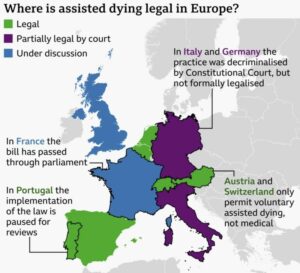
The issue has remained deeply divisive in France, drawing opposition from the Catholic Church and sections of the medical community.
Although the bill has now secured approval four times in the National Assembly, it was previously rejected on three occasions by the Senate, where conservative lawmakers hold a majority.
Despite the political divisions, opinion polls indicate that most French citizens support giving terminally ill patients the option of choosing between palliative care and assisted dying.
Ahead of Wednesday’s vote, Lecornu said he would seek constitutional clarification on aspects of the bill, noting that while the lower chamber had conducted extensive debate, the Senate’s examination did not adequately address both supporters’ expectations and critics’ concerns.
His office stated that the Senate had not provided scrutiny that met “both the aspirations of its supporters and concerns of those worried about its implementation.”
According to the Prime Minister’s office, the Constitutional Council has been asked to examine three key areas of the legislation: the adequacy of the two-day reflection period, whether patients under legal protection due to impaired judgment can provide free and informed consent, and the responsibilities of healthcare and social care institutions—particularly those focused on palliative care—in providing assisted dying services.
President Emmanuel Macron has consistently supported legislation on end-of-life care. However, progress on the bill was delayed after he dissolved parliament and called snap elections in 2024.
The proposed law now awaits a ruling from the Constitutional Council before France can move closer to becoming one of the latest European nations to legalise assisted dying.
We’ve got the edge. Get real-time reports, breaking scoops, and exclusive angles delivered straight to your phone. Don’t settle for stale news. Join LEADERSHIP NEWS on WhatsApp for 24/7 updates →
Join Our WhatsApp Channel