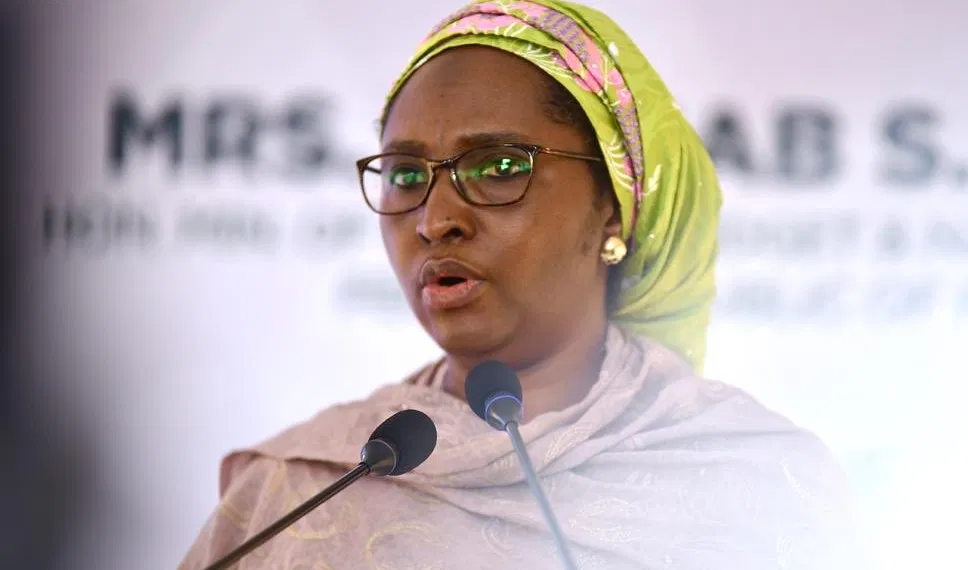
Having spent N898.6 billion on servicing debt obligations in the first three months of the 2022, Nigeria’s minister of Finance, Budget and National Planning, Zainab Ahmed has said the burden of the fuel subsidy being paid by government has made servicing its debt challenging.
Ahmed stated this at the Hybrid Launch of World Bank’s Nigeria Development update titled “The Urgency for Business Unusual” held yesterday.
Despite the initial plan to halt fuel subsidy this year, the federal government had in March this year, rescinded adding up to N4 trillion to the N16 trillion budget of the country.
According to the minister, the federal government’s continuous intervention in Premium Motor Spirit (PMS) is becoming a challenge for Nigeria to service its debt as the country’s borrowing continuously increases.
“This PMS subsidy is costing us an additional N4 trillion than was originally planned. So, this is an unplanned plant deficit. We have gone to the National Assembly, we have got approvals but the approval was simply for us to cut down on some of the investment costs. So, investments that we needed to make an oil and gas sector, we are delaying and deferring to a later time and reducing the rollout of those investments.
“We also had asked that we needed to borrow more which is very serious. Already we have borrowing increasing significantly and we are struggling with being able to service debt because even though revenue is increasing, the expenditure has been increasing at a much higher rate so it is a very difficult situation.
“So Nigerians need to understand that this PMS subsidy we are carrying now is hurting the nation, its impeding the government’s ability to be able to invest in human capital development. N4.5 trillion is money that we could have invested in health or education.”
we’re not investing it in consumption, which is very wasteful, because how many Nigerians own cars that are benefiting from this subsidy.
“We are in some kind of crossroads. It is not hearsay to say that Nigeria is not derived what it should from the current high crude oil prices, rather rising crude oil prices are posing significant fiscal challenges to our economy and may lead to some negative receipts and indeed we have started seeing already those negative receipts.
“There are three factors preventing Nigeria from fully benefiting from the current boom in the international crisis. First of all, our prediction had fallen below Nigeria’s estimated capacity and the OPEC quota because of insecurity vandalisation and theft. Secondly, the domestic price of payments has remained fixed, while global PMS prices have continued to rise.
“The third is that rising international crude prices also increase the burden of PMS. Because we buy refined petroleum products, the higher the crude oil price goes up in the global market, the more we’re paying for PMS, and by maintaining this PMS subsidy we as a country are forgoing unfortunately, investments that will have used the monies into essential infrastructure, goods or services that would have increased the overall productivity of the nation. So this is really the bane of the major issue that we’re facing now,” she pointed out.
Meanwhile, the World Bank Nigeria Development update titled “The Urgency for Business Unusual” notes that “due to the petrol subsidy and low oil production, Nigeria faces a potential fiscal timebomb.
“Amid heightened risks, the government has kept a “business-as-usual” policy stance that hinders prospects for economic growth and job creation. Multiple exchange rates, trade restrictions, and financing of the public deficit by the Central Bank of Nigeria (CBN) continue to undermine the business environment. These policies augment long-standing weaknesses in revenue mobilization, foreign investment, human capital development, infrastructure investment, and governance.
“Notably, during 2020 and 2021, when oil prices were much lower, the government lost an opportunity to address one of the primary sources of fiscal vulnerability by choosing to maintain the subsidy for premium motor spirit, more commonly known as petrol—this subsidy is unique, opaque, costly, unsustainable, harmful, and unfair,” the report stated.
Also speaking at the event, former governor of CBN and current governor of Anambra state, Prof Chukwuma Soludo called for an immediate cease to subsidies citing it as the origin of all Nigeria’s macroeconomic woos.
“We have had this analysis over and over and so the diagnosis is clear, we know this problem, we know that Nigeria is grappling with several unsustainables, be it in the area of security or in the area of macroeconomic framework and subsidies that nobody gets. We subsidize those who own cars but have no money to build the roads for them to drive on,” he stressed.
We’ve got the edge. Get real-time reports, breaking scoops, and exclusive angles delivered straight to your phone. Don’t settle for stale news. Join LEADERSHIP NEWS on WhatsApp for 24/7 updates →
Join Our WhatsApp Channel