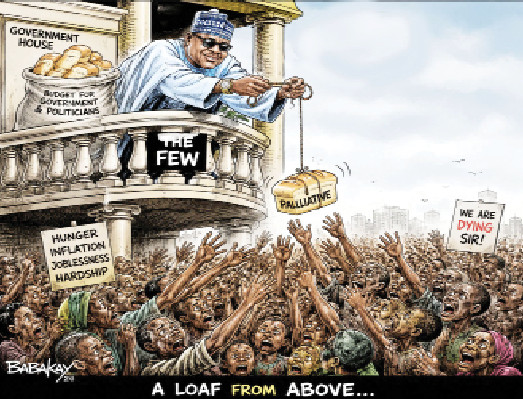
For Christians everywhere: “Give us this day our daily bread” is a humble plea for sustenance, a recognition that humans need food, shelter, and the basic conditions of life to thrive. But in the heat of the recent governorship election in Ekiti State, that sacred phrase acquired a bitter political meaning.
A viral video, circulated just before the poll, showed items being thrown from a campaign vehicle to people gathered by the roadside. Many viewers believed the items were loaves of bread. Others insisted they were campaign materials. The exact content of the items may be disputed, but the public outrage was not really about the object itself. It was about the image; the optics of citizens being treated as though their loyalty could be bought with whatever could be tossed from a moving vehicle.
That scene offended the conscience of many Nigerians because it captured, in one humiliating moment, the poverty of our political culture. Whether the items were bread, rice, souvenirs, or some other giveaway, the message was the same: voters are expected to be impressed by handouts rather than persuaded by ideas. Citizens are expected to respond to crumbs instead of demanding competence, accountability, and vision. That is not democracy. That is patronage dressed up as politics.
In a healthy democracy, the voter is not a beggar or a recipient of politicians’ charity. Rather, the voter is sovereign, and owner of the mandate politicians seek. Yet in Nigeria, election season too often turns this relationship upside down. Politicians behave like benefactors.
Here Comes The Season of Vote Buying
The Ekiti election also revived the familiar and troubling allegations of vote-buying. Across the state, reports and counter-reports emerged. Opposition voices alleged inducement, manipulation, and the use of material incentives to sway voters. Some candidates and political actors openly expressed concern that the exchange of money and gifts for votes had compromised the process.
These allegations are not new but part of a long and shameful pattern in our electoral life. Vote-buying has become one of the most persistent threats to Nigeria’s democracy. It has evolved over time. In one election, it may be cash in envelopes. In another, it may be food items, transport fare, wrappers, household goods, or other inducements. The packaging changes, but the intention remains the same: to convert poverty into political advantage.
This is why vote-buying is so dangerous. It feeds on desperation, exploits hunger and weaponises hardship. For many citizens who are struggling to survive, the immediate certainty of a small gift can appear more real than the distant promise of good governance. A politician who understands this reality can manipulate it with ease. But while poverty may explain why vote-buying works, it does not excuse it.
The deeper tragedy is that the same poverty that makes voters vulnerable is often the product of years of failed governance. When people lack decent jobs, reliable electricity, quality schools, accessible healthcare, and social protection, they become easier to manipulate during elections. Hunger becomes a campaign strategy. Desperation becomes an electoral tool. The failures of governance are then recycled into the machinery of political control.
That is why the Ekiti episode should trouble every serious Nigerian because it is about a national disease that keeps reproducing itself. We have normalised the abnormal. We have allowed inducement to become part of the electoral vocabulary.
Stomach Infrastructure and Allied Matters
What made the viral video especially offensive was not only the suspicion of vote-buying; it was the humiliation.
There is something profoundly insulting about reducing citizens to the level of people who must be fed, tossed, or bribed before they can exercise their civic duty. It suggests that the political class sees the electorate not as partners in nation-building, but as a mass of stomachs to be managed. It is a contemptuous view of the people, and it is one of the reasons our democracy remains fragile.
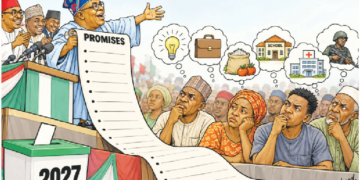
The irony is painful. In the weeks and months before elections, politicians speak the language of service, development, and transformation. They promise roads, schools, hospitals, jobs, and security. But when the campaign becomes serious, many of them abandon persuasion and resort to inducement. Instead of explaining how they will govern, they distribute cash. Instead of presenting policy, they hand out food. Instead of respecting the intelligence of the voter, they appeal to immediate need.
A citizen who is treated with dignity is more likely to think critically about the future. A citizen who is treated as a beggar is more likely to vote out of survival. That is why the politics of handouts is so destructive. It weakens the link between public office and public trust. It turns elections into transactions and teaches politicians that the cheapest way to win is to buy the poor, not serve them.
And once public office is won through inducement, accountability becomes weaker. Leaders who spend heavily to capture power often feel compelled to recover their investment. Corruption follows. Public resources are diverted. Contracts are inflated. Development stalls. Poverty deepens. Then, at the next election, the cycle begins again. This is the vicious circle that has trapped our politics for too long.
Ekiti, to its credit, has often been regarded as one of the more politically conscious states in the country. It has an educated population and a history of intense electoral engagement. Yet even there, the allegations of vote-buying and the viral symbolism of roadside giveaways show how deeply the culture of inducement has penetrated our democratic life. If it can happen in a state known for political awareness, then no part of the country is immune.
Restoring Dignity to Democracy
The real lesson from Ekiti is that Nigeria must decide what kind of democracy it wants to build: democracy of dignity or breadcrumbs? Bread may silence hunger for a moment, but dignity for a lifetime is what democracy should promise.
To move forward, we must begin by insisting that voters are not commodities. Their votes are not for sale. Their dignity is not negotiable. Political parties must be held to higher standards. Electoral offences must be investigated and punished, regardless of who commits them. Civil society, the media, religious institutions, and traditional leaders all have a role to play in educating citizens and exposing the corrosive effects of vote-buying.
But beyond enforcement, we must also address the conditions that make inducement effective in the first place. Poverty is the oxygen of vote-buying. When people are hungry, unemployed, and abandoned by the state, they become vulnerable to manipulation. That means the fight against electoral corruption cannot be separated from the fight against economic injustice.
We need jobs that give people independence, schools that expand opportunity, hospitals that treat the sick, infrastructure that supports enterprise, and a social order in which citizens are not forced to choose between their conscience and their next meal.
That is the real meaning of “daily bread.” It is not the bread thrown from a campaign truck. It is the bread earned through a functioning economy and a just society, from work, dignity, and fair opportunity. It is the bread that allows citizens to stand upright, not crouch before politicians.
Nigerians deserve more than handouts. They deserve leaders who understand that public office is a trust, not a trophy and a democracy in which the voter is honoured, not humiliated.
We’ve got the edge. Get real-time reports, breaking scoops, and exclusive angles delivered straight to your phone. Don’t settle for stale news. Join LEADERSHIP NEWS on WhatsApp for 24/7 updates →
Join Our WhatsApp Channel