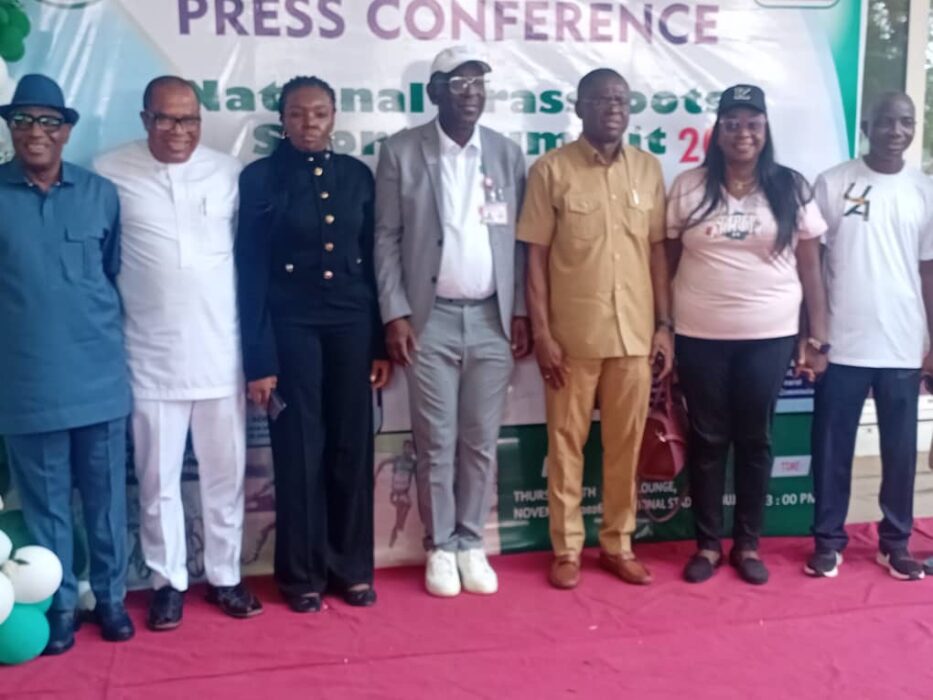
The Senior Special Assistant to the President on Grassroots Sports Development, Adeyinka Adegboye, has declared that the upcoming National Grassroots Sports Summit 2026 will mark a decisive shift from rhetoric to measurable action in Nigeria’s sports development, stating that the era of discovering talents by accident must end. Speaking at a press conference held at the MKO Abiola National Stadium in Abuja on Thursday, Adegboye said the summit, scheduled for November 18 and 19, 2026, in Abuja, would create a new pathway for sustainable grassroots sports development across the country.
“We want to move from promises to practical, measurable action,” Adegboye told journalists, emphasizing that the summit is not merely a gathering for speeches and photographs but a deliberate effort to build a coordinated national approach to talent discovery. He posed a series of poignant questions about the countless Nigerian children—from the streets of Lagos to villages in Borno—who possess world-class talent but lack access to opportunities, coaching, and basic equipment, describing their plight as “the reality of the struggles and constraints of every Nigerian who believes in the future of her children.”
Adegboye lauded President Bola Ahmed Tinubu for demonstrating unwavering commitment to sports development, citing the administration’s recognition of Nigerian athletes, the restoration of the National Sports Commission (NSC), and the President’s personal interest in the welfare of sportsmen and women. He said the President’s actions send a powerful message that Nigeria values its sporting heroes, but stressed the need to also tell the Nigerian child who has not yet won a medal that their dreams matter. “Talent is everywhere in Nigeria. Opportunity is not. Our responsibility is to close that gap,” he said.
The summit, according to Adegboye, will bring together the 30 sports organisations that make up the main organising committee, value partners, and key stakeholders to move the sector from isolated efforts to a coordinated national approach. He explained that the event will focus on replacing accidental talent discovery with a deliberate system, adding that the calibre of participants expected would contribute meaningful ideas to shaping a comprehensive policy direction for grassroots sports.
In his remarks, the Director-General of the National Institute for Sports (NIS), Philip Shaibu, threw his weight behind the summit, saying President Tinubu has demonstrated the political will required to reposition Nigeria’s sports sector. Shaibu noted that the establishment of the NSC was driven by the need to eliminate bureaucratic bottlenecks associated with ministerial administration and introduce a more efficient, private-sector-driven approach. “One of the major problems affecting sports development in Nigeria is bureaucracy. We believed that moving to a commission would help bridge that gap and create a new approach to managing sports,” he said.
Shaibu, however, charged Nigerians to shift public scrutiny beyond the President, governors, and local government chairmen to appointed officials responsible for implementing government policies. “If sports does not succeed under President Bola Ahmed Tinubu, hold civil people, hold Olopade, hold Seyi, hold the special assistants. The President wants to develop sports and has consistently charged us to take sports to the grassroots,” he said, urging that officials who fail to deliver should face calls for their removal.
The NIS boss disclosed that the institute had opened offices in the six geopolitical zones to deepen its grassroots programmes, describing the development as a major step in the institute’s 52-year history. He said the initiative was part of the mandate given to the institute to decentralise sports development and create opportunities for Nigerians across the country, adding that grassroots development remained central to the President’s vision of maximising Nigeria’s population and sporting potential.
Commending the organisers of the summit, Shaibu expressed confidence that the gathering would help align the country’s sports administration with the President’s development agenda and produce recommendations capable of shaping a comprehensive policy direction for the sector. Stakeholders are expected to seize the opportunity to develop a sustainable framework that moves Nigerian sports away from bureaucratic constraints towards a more inclusive and results-oriented system.
We’ve got the edge. Get real-time reports, breaking scoops, and exclusive angles delivered straight to your phone. Don’t settle for stale news. Join LEADERSHIP NEWS on WhatsApp for 24/7 updates →
Join Our WhatsApp Channel