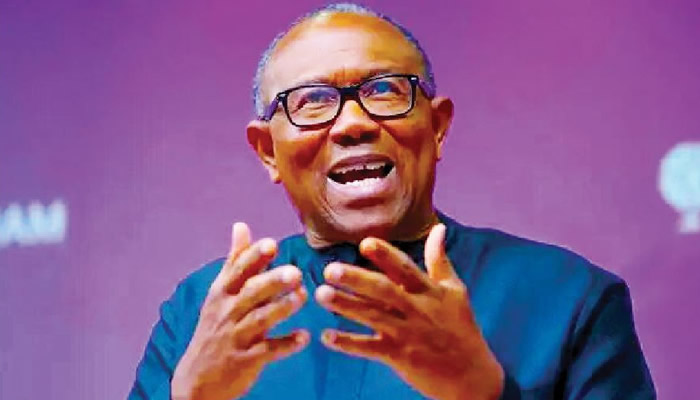
Two groups, Grassroots Mobilisation Initiative (GMI) and the Democracy Watch Initiative (DWI), have criticised the recent call by Nigeria Democratic Congress (NDC) presidential candidate, Peter Obi, for asking President Bola Ahmed Tinubu to resign.
They described the demand as “childish, unconstitutional and disconnected from democratic realities.”
In a joint statement signed by GMI director of Media, Emeka Wogu, and DWI director of Strategic Communications, Tunji Bamidele, the groups argued that Nigeria’s democracy provides constitutional mechanisms for leadership evaluation and change, not pressure through social media campaigns.
The organisations said Obi’s comments amounted to political grandstanding and failed to recognise the ongoing reforms and institutional changes being implemented by the Tinubu administration.
The coalitions described Obi’s comments as “social media grandstanding” by a political actor completely disconnected from constitutional realities, democratic processes, and the incremental, foundational victories currently taking shape on the ground across Nigerian communities.
The statement read: “We need to remind Mr Obi that Nigeria operates under a constitutional presidential democracy, not a social media echo chamber or an internet debate.
“You do not bully a democratically elected sitting president out of office simply because you are dissatisfied with the pace of governance. The proper test of public support remains the ballot box and democratic institutions.”
The coalitions pointed to recent electoral outcomes across various parts of the country as evidence that Nigerians continue to engage with democratic processes and make their choices through elections rather than online discourse.
According to the groups, the local government and senatorial elections conducted in Ekiti State and across key constituencies in Nasarawa, Enugu, Ondo and Rivers states reflected public confidence in the governing party and demonstrated that democratic participation remains active across the country.
The organisations urged political actors and citizens to assess the administration based on measurable developments rather than partisan narratives.
“Restoring Security and Territorial Integrity: President Tinubu did not inherit a stable nation; he inherited severe security deficits across multiple zones. Today, the Armed Forces are systematically taking the fight to criminal elements, clearing over 15,000 terrorists out of critical forest reserves and neutralising high-profile bandit kingpins.
“Placed families in Borno and the Northwest are steadily returning to reconstructed communities. Fiscal Decentralisation & Empowering Local Governance: For decades, local government areas (LGAs) and state governors complained of a lack of funds to fix community infrastructure.
Following bold reforms to halt wasteful subsidy regimes, state and local statutory revenues have more than doubled compared to 2022 levels. Wealth is finally being decentralised to the third tier of government, enabling local leadership to fund rural access roads, primary health centres, and community pipes.
“Academic Stability and Human Capital Investment: For three consecutive years, Nigerian public university students have remained in the classroom without losing a single day to ASUU or NASU industrial actions. A four-year course is once again a four-year course, eliminating the need for prolonged tuition and accommodation expenses for families.
Furthermore, through institutionalised student loan frameworks, nearly two million students from low-income households now have access to interest-free loans to secure their higher education.
Transition to Clean Energy & Infrastructure Expansion: The strategic rollout of Compressed Natural Gas (CNG) infrastructure is providing commercial drivers and commuters with a viable, lower-cost alternative to premium motor spirit (petrol).
Concurrently, legacy infrastructure projects such as the Lagos-Calabar Coastal Highway and the Sokoto-Badagry superhighway are transitioning from conceptual blueprints to active construction sites, generating thousands of local jobs.
“Dismantling the ‘Estimated Billing’ Monopoly: By signing the Electricity Act into law, the administration decentralised power generation and distribution, empowering states to build independent grids.
“For everyday consumers and small businesses, the aggressive deployment of prepaid meters is systematically eradicating the extortionist “estimated billing” practices that have long penalised market stalls and small enterprises.””
They said the measures would help reduce dependence on estimated billing and improve service delivery to households and small businesses.
While acknowledging the economic difficulties currently faced by many Nigerians, the organisations maintained that some of the pressures stemmed from global economic conditions beyond the control of any single government.
“President Tinubu did not trigger global inflation, but his administration is actively constructing the institutional shields to insulate Nigerian households from its worst effects.
The Naira is gradually finding its macroeconomic equilibrium, foreign reserves remain robust at over $50 billion, and domestic oil production has covered 1.8 million barrels per day. The macroeconoDay foundation is solidifying.
The 2027 general elections remain the next constitutional arena for LEADERSHIP evaluation. If Mr Obi wishes to gauge the popularity of the Tinubu administration’s structural reforms among real people on the street, he must exercise patience until the ballot boxes open.
“Until then, the opposition must allow governance to proceed, allow our military forces to secure the land, and allow national institutions to function without manufactured crises.”
We’ve got the edge. Get real-time reports, breaking scoops, and exclusive angles delivered straight to your phone. Don’t settle for stale news. Join LEADERSHIP NEWS on WhatsApp for 24/7 updates →
Join Our WhatsApp Channel