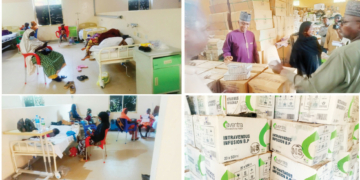
At the peak of the COVID-19 pandemic, the then Secretary to the Government of the Federation (SGF), Boss Mustapha, was reported to have lamented the deplorable state of the nation’s healthcare sector. He was not the first top government official to raise questions about the state of affairs in that all-important social service.
The late General Sani Abacha, while giving reasons for one of the military coups, described Nigerian hospitals as mere consulting clinics. In fairness to him, then there were doctors to consult. The situation has worsened now with the exodus of doctors, nurses, and other healthcare providers who leave the country in search of the proverbial greener pastures.
According to a recent report, the Coordinating Minister of Health and Social Welfare, Prof. Muhammad Pate, stated that over 16,000 Nigerian doctors have left the country in the last five to seven years to seek greener pastures in other countries.
As if that was not bad enough, the National Association of Nigerian Nurses and Midwives (NANNM) recently disclosed that over 75,000 nurses and midwives have left the country in the past five years to seek greener pastures.
A former Minister of Labour and Productivity, Dr Chris Ngige, himself a doctor, rationalised this disturbing trend when he said that it was good for the country because the doctors would acquire relevant experience in the process. In his opinion, Nigeria has more than enough doctors to meet the World Health Organisation (WHO) requirement. But that is a white lie.
That world body recommends a doctor-to-patient ratio of at least one doctor per 1,000 people to ensure adequate healthcare coverage. Additionally, they suggest that there should be at least 2.5 medical staff per 1,000 people, which includes physicians, nurses, and midwives, to achieve sufficient primary care coverage.
An international survey of physicians from 197 countries, with a population-to-physician ratio of 10,000, ranked Nigeria at position 127. In Africa, the country ranks 15th, behind countries like Cape Verde and the Benin Republic.
The survey defines a physician as a medical practitioner, medical doctor, or simply a doctor, as a health professional who practices medicine, which is concerned with promoting, maintaining, or restoring health through the study, diagnosis, prognosis, and treatment of disease, injury, and other physical and mental impairments.
The sad angle to it is that Nigerians perceive the trend as an expression of their despondency on the harrowing economic situation in the country and how they are left with little choice but to leave the country for ‘greener pastures. They highlight scarce job opportunities, insecurity, and a general sense of hopelessness as part of the reasons for relocating.
The reality on ground is that the healthcare givers – doctors, nurses, and other professionals in the team are overworked and grossly under remunerated. The general working conditions are nothing to write home about, as they, in most cases, have to provide for themselves with basic tools like gloves, which they must necessarily put on before examining any patient.
What is of concern to this newspaper is not just the reasons that instigate this worrisome development, but the government’s response at all levels to what ought to be a national emergency.
Nigerians who need to access healthcare at the hospitals, both public and private, have a not-too-pleasant tale to tell about delayed appointments and outrageous bills. The few doctors who remain in the country spread themselves so thin that they are compelled to make the rounds in more than four hospitals, resulting in delay and a high cost of their services.
Nigerians were once told that the telephone was not for the poor. Soon, they will also be told that healthcare is not for the poor.
The tragedy of this situation is that the political elite access medicare abroad at state expense. Recently, it was reported that retiring service chiefs are to receive approximately N90 million ($60,000) annually for medical expenses only. A retiring Major General and his colleague of equivalent rank in the other services are to get $15,000 or approximately N22.5 million. We have no information about the amount they received while in service. It is open to conjecture what these amounts can do if judiciously invested in the sector.
These are the ones that were made public. What the President, the Vice President, Governors, ministers, federal legislators and senior civil servants receive in that regard is treated as classified information.
We are persuaded to argue that no country grows when its best brains abandon it. It is also a shame that leaders across the spectrum lack confidence in the nation’s healthcare delivery system. It boils down to the absence of political will on the part of the administration to do what is imperative to reform the sector and make it relevant for all.
We’ve got the edge. Get real-time reports, breaking scoops, and exclusive angles delivered straight to your phone. Don’t settle for stale news. Join LEADERSHIP NEWS on WhatsApp for 24/7 updates →
Join Our WhatsApp Channel