Once, as President of the University of Ibadan Debating Club, I proposed to Professor Billy J. Dudley, now deceased, a change in the rules for determining a winner.
Dudley was among the finest Nigerian intellectuals. At the time, he headed the Department of Political Science.
My club was preparing to host the University of Ghana, Legon, in the institution’s annual inter-university debate, and the professor accepted our invitation to be the lead judge. The previous year in Ghana, we had lost the two-day, two-event competition by a single point.
Instead of the evaluation system in which the winner was determined by tallying the scores off all the judges for both sides—in which the skewed scoring of just one of the judges could swing the decision—I offered a “fairer” alternative that would see the score of each of the five judges simply as one vote.
Professor Dudley sat back and glared at me for a while. “How do we know that that one judge is not the only sane person in the room?” he asked, grinning.
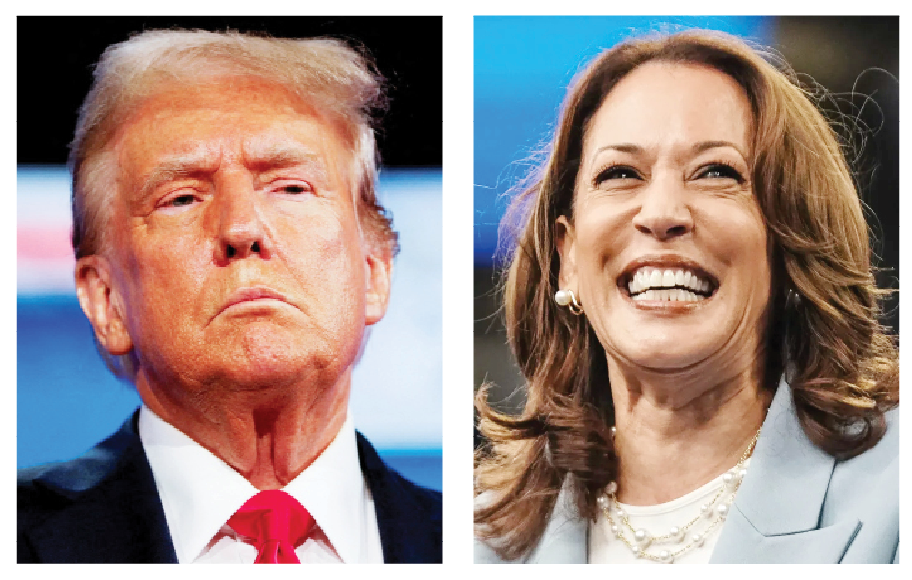
In the end, an electoral contest, such as the presidential one now playing out in the US, is a debate contest with clearer rules. In the past few months, the principal (a total of six candidates)—Republican and former President Donald Trump and current Democratic Vice-President Kamala Harris—have slugged it out relentlessly in what is probably the world’s most expensive and acrimonious campaign.
Before a global audience, there are political rallies, sometimes in different states on the same day. There is massive advertising on TV and radio. Huge billboards. Newspapers. Magazines. Social media.
There are media interviews. There is the daily, sometimes hourly, appeal to voters by email or text messaging by the candidates, their campaigns or party members seeking financial support. In these final days, there are also phone calls to individual voters. People are walking the streets and knocking on the doors of prospective voters. The target is every vote available.
The states, not the federal government, conduct US elections. Voters may take advantage of early balloting or by mail, wherever available. Using those alternatives, nearly sixty million persons had already voted as of yesterday, October 31.
But nothing beats the excitement, or the numbers, of that first Tuesday following the first Monday in November.
How does it work? A polling centre is designed to be as simple as possible. Well-trained election workers arrive as early as 5 am to set up and ensure that all the machines pass pre-determined tests. They are often selected from the two key parties to ensure balance.
Their first challenge is to validate voter eligibility. He then receives a ballot, which he completes at a private table or booth. If there is an error in his ballot, it will be invalidated and replaced, but a complete record is painstakingly undertaken, and that bad ballot is saved for further inspection.
When the voter has filled out his ballot, he votes: slips the ballot into the voting machine, which mechanically accepts and counts it. If any manual (re)count is required, those records are available in full. In the Donald Trump election challenges that followed the 2020 contest, this is one of the reasons that he had difficulty proving, anywhere, the “fraud” that he alleged.
This process is different from Nigeria’s electoral thought. While there may be occasional errors or even an attempt at fraud, the process aims to ensure the ballot’s integrity. INEC, by comparison, advertises the appearance or possibility of fairness while being a monolithic nightmare in design because it is controlled and manipulated by the ruling party.
In principle, the Nigerian process—like the old UI debate management I referred to—produces a magic number, the popular vote, the larger of which is sufficient to send an individual to the presidential villa in Abuja.
In the US, those votes merely produce a slate of electors of the states known as the Electoral College, a constitutional mechanism of 538 people, of which 270 electoral votes are required for electing the President.
On Election Day next Tuesday, a well-known former president will face an opponent who is at once familiar and yet very strange. In winning his first presidency, Mr. Trump faced Hillary Clinton, a white woman.
In 2024, Trump—now a convicted felon and full-blown misogynist, by all accounts, and bearing the weight of the January 6 attack he engineered on the Capitol on his resume—again faces a woman.
She is Harris, a fierce former prosecutor and Senator who is also black.
We’ve got the edge. Get real-time reports, breaking scoops, and exclusive angles delivered straight to your phone. Don’t settle for stale news. Join LEADERSHIP NEWS on WhatsApp for 24/7 updates →
Join Our WhatsApp Channel