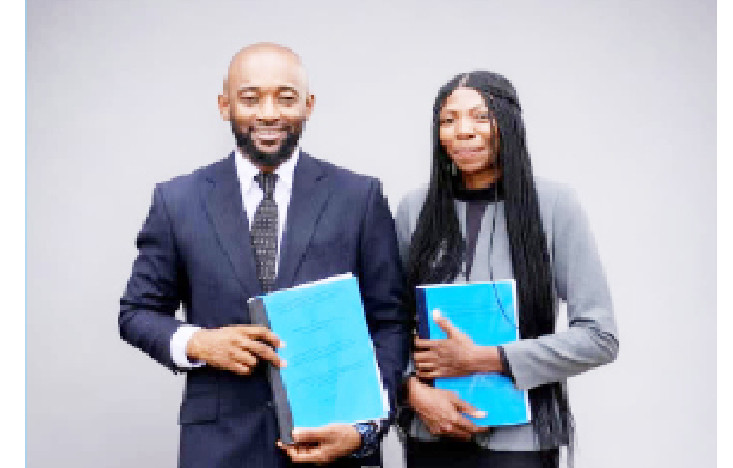
Dr Gift Okwuolise and his wife, Dr Blessing Chidinma Okwuolise, are scholars in Environmental Management who recently completed their PhDs at the Federal University of Technology, Owerri (FUTO). In this interview with HENRY TYOHEMBA, they discuss their journey to earning their PhDs together, balancing marriage, family and research, overcoming academic challenges, and how their research could help tackle Nigeria’s environmental problems.
What does it mean to have achieved this PhD milestone together as husband and wife?
Achieving this PhD milestone together as husband and wife means a great deal to us. It is more than earning academic titles; it reflects perseverance, sacrifice, mutual support, and the decision to keep moving forward together, even when the journey becomes demanding. There were moments when the pressure of research, work, family responsibilities and academic commitments could have been overwhelming. But having each other along the way made a difference. We understood the sacrifices because we were both experiencing them, and we encouraged one another whenever either of us felt tired or discouraged.
For us, this achievement is a beautiful reminder that marriage can be a partnership not only in building a home but also in pursuing dreams and becoming better versions of ourselves. We are proud of the degrees, but we are even more grateful for the journey we shared to get here. In the end, we did not simply earn two PhDs; we strengthened our partnership and created a story we hope will inspire other couples to believe they can pursue their dreams together, regardless of how challenging the journey may be.
What major challenges did you face during your research, and how did you overcome them?
The PhD journey was not without its challenges. One of the biggest was balancing academic work with our family responsibilities, professional commitments and other demands of everyday life. Doctoral research requires considerable time, patience, concentration and resources, so there were periods when the pressure was intense. For me, the research process itself brought its own demands, from extensive literature reviews and data collection to laboratory work, analysis, corrections and responding to supervisors’ feedback. There were also times when experiments did not produce the expected results, which meant going back, reviewing the procedures and trying again. What helped us most was discipline and mutual encouragement. We learned to take the journey one stage at a time rather than becoming overwhelmed by the entire process.
(Wife) When one of us was tired or discouraged, the other offered encouragement and perspective. We also learned to accept corrections, remain patient, and keep improving our work. Above all, faith, perseverance, and the support we gave each other kept us going. We understood that a PhD is not a race; it is a test of consistency and commitment. There were difficult days, but we kept reminding ourselves why we started. In the end, those challenges became part of the experience, making the achievement even more meaningful.
What are the areas of your respective PhD research, and what inspired you to choose them?
Our areas of research are both within the broad field of Environmental Management, although we approached the subject from different perspectives.
My research focused on the “Removal of Selected Heavy Metals from Spiked Water in Obinze, Owerri-West, Nigeria”. In contrast, my wife’s research focused on the “Evaluation of Functionalised Cassava Peel Biochar Adsorbent for Removal of Selected Heavy Metals Contaminated Wastewater in Naze, Owerri, Nigeria”.
I was particularly interested in the problem of heavy metal pollution in water because of the environmental and public health concerns associated with these contaminants. I also wanted to explore how agricultural and wood waste, such as sawdust, could be converted into a useful material for environmental remediation. The idea of turning what is often regarded as waste into a resource that can help clean polluted water was a major motivation for me. My wife’s research also falls within the field of Environmental Management, with its own specific focus and objectives.
(Wife) What inspired both of us, in our different areas, was the desire to contribute knowledge that is not only academically relevant but also addresses real environmental challenges in our society. For us, research should go beyond obtaining a degree. It should ultimately answer a question, solve a problem, or provide knowledge that can make a difference. That mindset shaped the choices we made throughout our PhD journey.
As people from Ndemili in Ndokwa West LGA of Delta State, how has your background influenced your academic journeys?
Although we come from different backgrounds, our roots have played an important role in shaping our academic journeys. I am from Ndemili in the Ndokwa West Local Government Area of Delta State, while my wife is from Mbano in Imo State. Despite coming from different communities, we were both raised with values that emphasised hard work, perseverance, family, and the pursuit of education.
Coming from Ndemili has given me a strong sense of identity and a desire to make my community proud. My background taught me early on that progress requires determination and that, whatever opportunity you have, you should make the most of it. My wife’s background in Mbano similarly gave her a strong foundation and the determination to pursue excellence in her own right. Interestingly, our different backgrounds became part of the beauty of our journey as a couple.
We came together with different experiences, perspectives and cultural backgrounds, but we found common ground in our commitment to education and personal development. Completing our PhDs together, therefore, means more to us than simply earning academic qualifications. It represents the coming together of two people from different communities who encouraged each other to keep reaching higher.
How did you support and motivate each other during your postgraduate studies, particularly during difficult periods?
One of the greatest advantages we had during the journey was that we were going through it together. We understood the pressure from the inside, so there was always someone who could relate to what the other person was experiencing. There were difficult moments when the workload, research demands, financial commitments, family responsibilities and academic pressure became overwhelming.
At such times, we encouraged each other not to give up. Sometimes the support was being there to listen; at other times, it was reminding each other why we started in the first place. We also respected each other’s pace. We did not expect always to have the same level of energy or motivation.
When one person was struggling, the other offered the encouragement needed to keep moving. Interestingly, our different research topics also gave us opportunities to discuss ideas, challenge each other’s thinking and learn from one another. We became each other’s sounding board. Looking back, I would say our greatest motivation was the shared understanding that we wanted to finish what we started. We celebrated small victories, encouraged each other through setbacks and kept reminding ourselves that the difficult moments were temporary. In many ways, the PhD was not just an academic journey for two individuals. It was a journey we carried together, and there were times when one person had to be strong for the other. That mutual support made the difference.
With Nigeria facing environmental challenges such as pollution, climate change and waste management, how can your research help address them?
Nigeria’s environmental challenges are complex, and we do not claim that our research provides a complete solution to all of them. However, we believe it plays an important role in the solution: finding practical and sustainable ways to address pollution. My research focused on removing selected heavy metals from contaminated water using a biochar-based adsorbent. One notable aspect of the work is the use of sawdust, a readily available waste material. Rather than allowing such waste to become an environmental burden, it can be converted into a useful material for treating polluted water.
This links waste management with pollution control and the principles of a circular economy. My wife’s research also examined the use of functionalised cassava peel biochar to remove selected heavy metals from contaminated wastewater. Cassava processing generates large quantities of peels, so finding productive uses for this agricultural waste has both environmental and economic significance. Of course, our research was conducted at a laboratory scale, so we are careful not to present it as an immediate large-scale solution.
What it does provide is scientific evidence and a foundation that can encourage further research, optimisation, and, eventually, practical application. For us, the broader message is that some of the environmental problems we face can also be addressed through locally available materials and locally relevant scientific solutions. Waste can become a resource, and environmental problems can become opportunities for innovation.
What message would you give young Nigerians, especially those from rural communities, who aspire to pursue postgraduate education but feel a PhD is beyond their reach?
Our message to young Nigerians, especially those from rural communities, is simple: do not disqualify yourself before life gives you an opportunity. A PhD may look very far away when you are just starting, but every academic journey begins with one step.
(Wife) We would encourage young people to take education seriously, seek mentors, build strong relationships, learn continuously, and make the most of every genuine opportunity available to them. They should not be ashamed to start small. Sometimes, what seems like a small academic step today becomes the foundation for something much bigger tomorrow. Most importantly, do not let fear of the journey stop you from pursuing the destination. If a young person from a rural community can dream of a PhD and eventually stand before an academic panel to defend that dream, then many more young Nigerians can do the same. Our story is not meant to say that the journey was easy. It is meant to say that it is possible.
We’ve got the edge. Get real-time reports, breaking scoops, and exclusive angles delivered straight to your phone. Don’t settle for stale news. Join LEADERSHIP NEWS on WhatsApp for 24/7 updates →
Join Our WhatsApp Channel