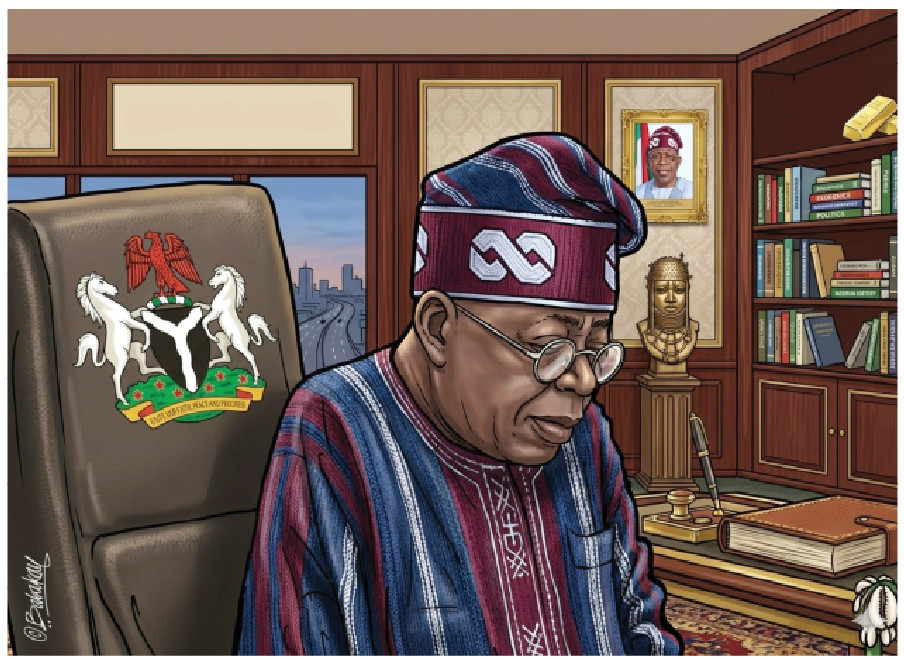
The piece is an imaginative fiction on the political methods of President Bola Tinubu. He can easily pass for a thespian. He acts out the script even before the camera starts rolling. He is a screen grabber. He provides his audience with something to talk about to gauge the public perception. For example, what does “A town hall different from balablu bulaba” mean? There have been several interpretations. He loves to keep people amused. Remember when he slipped at Eagle Square in Abuja in 2024? Afterwards, he said, “Early this morning, I had a swagger, and it’s on social media. They were confused about whether I was doing Buga or doing babariga, but it is a day to celebrate democracy while doing “Idobale” for the day. I am a traditional Yoruba boy, and I did my Idobale.” He labelled a misadventure as an adventure. This is the height of thespianism and the significance of performance.
Jigi Bola
Tinubu recently offered to give his opponents his famous “Jigi Bola” if they could not see the achievements of his administration. That was a profound statement beyond the initiative of providing free medicated glasses to people with visual impairment, an initiative he introduced as governor of Lagos State in 2001. In Yoruba culture, Jigi is a “glass/lens”. And Jigi Bola is the “lens of Bola”. “Jigi Bola” is a very deep one. It is similar to the “Leica 50mm Summicron Lens.” This lens has been adjudged the “gold standard” of optics. It is “compact, incredibly sharp, and with a focal length that mimics the human eye.”
This lens aptly describes “Jigi Bola”. Tinubu has an incredible reputation for this, as we have witnessed over the years. Niccolo Machiavelli, in his work “The Prince”, defines “the strength, skill, and adaptability of a leader to outmanoeuvre opponents” as critical. And to achieve that, the “Prince of Virtu” must see ahead and quickly before others. This is what Tinubu does, and how he does it remains a mystery. Any task that appears technically impossible. He makes it politically possible. This attribute has conferred on him a political advantage that is revered in the political circles. He reminds me of Baron Haussmann, the man who demolished and rebuilt Paris when he was appointed “Prefect of the Seine”, the administrative head of the city of Paris between 1853 and 1870 by Emperor Napoleon III. There was a task that seemed impossible. But the “Prefect of the Seine” made it possible.
Break it and fix it
Haussmann had a “vision of a Paris with wide boulevards, open squares, and geometric order”. His vision appeared impossible because it required demolishing 100,000 apartments in 20,000 buildings. He was obsessed with the image of the Paris he saw in his mind. There were riots, lawsuits, and political pressure. He ignored all of these. He went ahead with his plans, and today he is recognised as the man who transformed Paris into the “City of Light”.
Take the Lagos-Calabar Coastal Highway project as an example. What hasn’t been said about the project? It didn’t stop the project from going on. Monies were paid in compensation to property owners along the corridor. Beach resorts and several other businesses were demolished. At the flag-off ceremony, Tinubu was quoted as saying, “Today is my day to boast. The deal is done. The dream is realisable. Do not be afraid. We will do this road, and it will be a success for Nigeria.” Tinubu, like Baron Haussmann, ignored all the criticism around the project. His vision for the project was clear to him, and he went ahead regardless. Maybe tomorrow, posterity might be kind to him for this project.
Politics is not a love story
Tinubu doesn’t appear like someone who goes for quick gains. In the history of the 4th Republic, he is the most “indebted to” politician by building a system based on the principle of political reciprocity. It is the logic of “you scratch my back, I scratch yours.” I wonder why adequate attention has not been paid to the Governor’s Advisory Council (GAC) in Lagos State. The GAC is a microsome of a system that was built on the doctrine of political reciprocity. The GAC system has been very effective and successful. It made Lagos the most politically stable state in the country.
Politics is not a love story. Its affections are not unconditional. There is collateral. Written or unwritten. In politics, a reciprocal regime is the most strategic. It is of mutual debt and benefit. In Tinubu’s political bank, when you take a political loan, you are bound to repay. He doesn’t care about your name, religion, ethnicity or political affiliations. His doors are always wide open for those who wish to come in. This is a profound attribute of a political venture capitalist, “who treats power as an investment portfolio in exchange for a long-term equity stake in future loyalty and influence.” This is worth reminiscing about.
The biggest political bank
Tinubu is a political venture capitalist. He is always willing to bankroll any political idea. He acts like a central bank that disburses freshly minted banknotes. I can only imagine the number of politicians who have accounts in his bank. The list might be shocking. And they know themselves. Some of them have been very vocal in recent times. Have we wondered why he has remained relevant since 2007, after his tenure as governor? It wasn’t luck or abracadabra. He went into political banking and has made a good fortune for himself by establishing the biggest political bank in Nigeria. He is not only the president today; he is in control of the biggest political bank. In Nigeria, elections are won and lost by the dictates of the administrators of the political bank. This is the stark reality that must be embraced by those opposed to his re-election. Some of them took “political loans” from his bank; instead of repaying, they elected to default. And the political body language of Tinubu doesn’t seem like he intends to write off the political debts. If you owe him, please pay up.
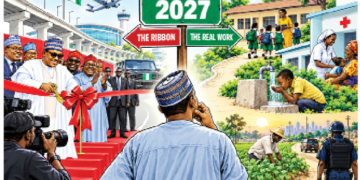
This is what would make the 2027 presidential election one of the most interesting elections in our recent annals. When I hear comments around a political upset, I struggle to understand them. The likelihood of such in the 2027 election stands at a single-digit margin. The fate of the main opposition party is hanging in the balance. There are several hurdles it has to cross to stand the chance of a good political outing. I can’t rule out anti-party activities within the ranks of the ruling party. I do not think there is a danger in this regard in the event it happens. There are several political instruments to address it. Indeed, interesting times are ahead. After the elections, political boundaries would be firmly carved. And these boundaries would be governed like territories. In all, our fingers are crossed.
– Ocheja, PhD, an alumnus of the Nigerian Defence Academy, is a military historian and creative writer. He is the author of The Prince of Virtu (2026).
We’ve got the edge. Get real-time reports, breaking scoops, and exclusive angles delivered straight to your phone. Don’t settle for stale news. Join LEADERSHIP NEWS on WhatsApp for 24/7 updates →
Join Our WhatsApp Channel