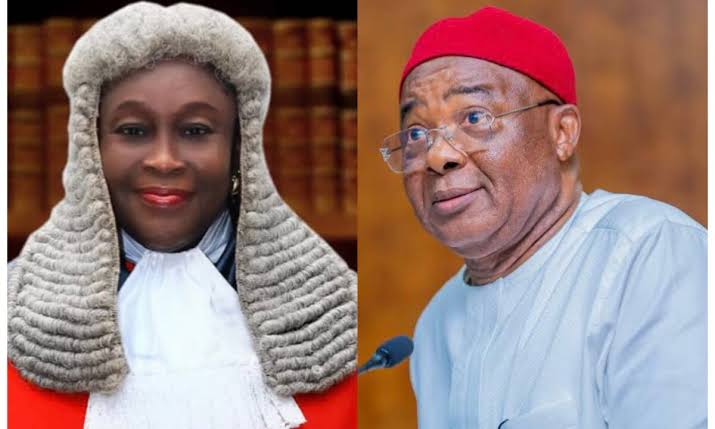
The rift between the Imo State Government and the National Judicial Council (NJC) has taken a new dimension as the Imo State Government has challenged the constitutional authority of the NJC to dictate the candidate whose name should be submitted for consideration in the appointment of a substantive Chief Judge of the state.
The State Attorney-General and Commissioner for Justice, Hon. Paul Obinatu, made this known while interacting with LEADERSHIP.
He described the council’s reported directive to the Imo State Judicial Service Commission (JSC) as an encroachment on the commission’s constitutionally guaranteed independence.
The objection followed a directive reportedly issued by the NJC at its 112th meeting held in November, concerning the appointment of a substantive Chief Judge for Imo State.
The Attorney-General argued that the NJC’s constitutional responsibility to recommend a candidate to the governor does not give it the power to determine the candidate the State JSC must submit.
He explained that the commission is constitutionally independent and cannot be subjected to the direction or control of another authority in exercising its statutory responsibilities.
The Commissioner for Justice, citing Section 202 of the 1999 Constitution, as amended, said the provision guarantees the independence of the State JSC and protects it against external interference.
He submitted that the NJC could not rely on its national institutional status to control the activities of the state commission.
He said, “Any directive requiring the State JSC to submit a particular candidate or dictating the outcome of its independent assessment would amount to unconstitutional interference.”
The Commissioner for Justice further cited Paragraph 6(a) of Part II of the Third Schedule to the Constitution, which empowers the State JSC to advise the NJC on suitable persons for nomination as Chief Judge.
According to him, “On the other hand, Paragraph 21© of Part I of the Third Schedule empowers the NJC to recommend to the governor, from among the persons submitted by the State JSC, a candidate for appointment.
“Section 271(1) also provides that the Chief Judge of a state shall be appointed by the governor on the recommendation of the NJC, subject to confirmation by the State House of Assembly.”
He highlighted that the constitutional provisions establish distinct responsibilities for both institutions, with the State JSC identifying and advising on suitable candidates, while the NJC considers the submitted names and makes its recommendation to the governor.
The Commissioner for Justice stated that the NJC’s recommendation could not be interpreted as authority to dictate the candidate the State JSC must submit.
“Doing so would effectively transfer the Commission’s constitutional responsibility to the NJC and render Section 202 meaningless,” he submitted.
Speaking in respect of the NJC’s Guidelines and Procedural Rules for the Appointment of Judicial Officers, the Attorney-General acknowledged the council’s authority to prescribe and enforce procedures for judicial appointments.
He highlighted that such guidelines could not confer powers beyond those granted by the Constitution or override the independent functions of the State JSC.
The Commissioner for Justice, cited several judicial authorities in support of his position, including Elelu-Habeeb & Anor. V. Attorney-General of the Federation & Ors. (2012), Kano State Public Complaints and Anti-Corruption Commission & Anor. V. Salisu & Ors. (2019), and Bamisile v. National Judicial Council & Ors. (2012).
Others include FRN v. Nganjiwa (2022), NJC & Ors. V. Senlong & Ors. (2010), and Attorney-General of the Federation v. Attorney-General of Abia State & Ors. (2024).
The Attorney-General stressed that the authorities reinforced the principle that every constitutional institution must exercise its powers within the limits prescribed by law.
Hon. Obinatu said the issue was not a contest for institutional superiority but the need for each institution to respect the constitutional boundaries of its authority.
The Commissioner for Justice cautioned that allowing the NJC to assume responsibilities assigned to the State JSC would undermine the judicial appointment process and public confidence in the judiciary.
The Attorney-General stated that the appointment of a substantive Chief Judge for Imo State must follow the constitutional procedure without interference with the independent mandate of the Judicial Service Commission of the state.
We’ve got the edge. Get real-time reports, breaking scoops, and exclusive angles delivered straight to your phone. Don’t settle for stale news. Join LEADERSHIP NEWS on WhatsApp for 24/7 updates →
Join Our WhatsApp Channel