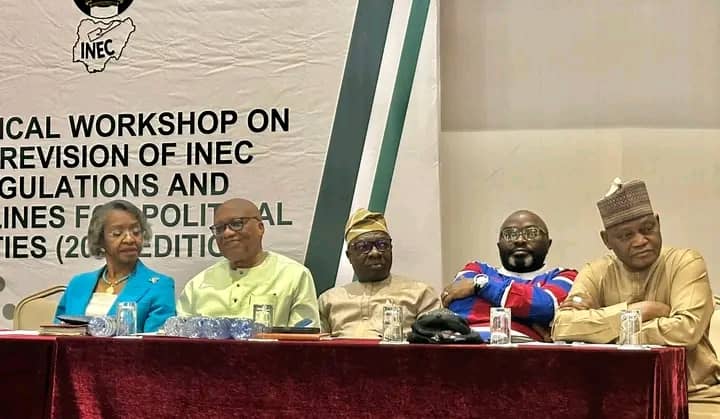
The Independent National Electoral Commission (INEC) has commenced a three-day technical workshop in Ikot Ekpene, Akwa Ibom State, to revise its 2022 Regulations and Guidelines for Political Parties in line with the newly enacted Electoral Act 2026.
The workshop, held from March 4–6, represents the Commission’s first major step toward harmonising its regulatory instruments with the provisions of the law signed in February.
National Commissioners, aides to the INEC Chairman, directors of key departments, the Obo Effanga, and development partners are participating.
Declaring the workshop open on Wednesday, INEC Chairman, Joash Ojo Amupitan, said the engagement was necessary to realign the Commission’s operations with the compressed timelines introduced by the new Act.
He announced that Presidential and National Assembly elections will now be held on January 16, 2027, while Governorship and State Assembly elections are scheduled for February 6, 2027.
Amupitan stated that the Commission is moving beyond the 2022 framework to “sanitize party operations” and incorporate findings from the Political Party Performance Index (PPPI), designed to strengthen party structures from the grassroots up.
He warned that weak internal democracy, particularly flawed primaries, remains a major risk to electoral credibility.
He cautioned that the imposition of unpopular candidates through non-transparent processes fuels voter apathy and pre-election litigation.
The revised guidelines, he noted, will introduce stricter conditions on membership records, party finances, and the inclusion of women, youth, and Persons with Disabilities (PWDs).
In his remarks, the Obo Effanga described the workshop as an important avenue for the Commission to deepen understanding of the new Electoral Act and adjust its guidelines to ensure transparency, fairness, and administrative efficiency.
He stressed that while reforms have strengthened Nigeria’s electoral system over time, continuous improvement is essential to sustaining public confidence.
National Commissioner and Chairman of the Election and Party Monitoring Committee, Baba Bila, said the review of the 2022 Regulations could not have come at a better time.
He explained that the document governs key areas such as registration and deregistration of political parties, membership structure, party congresses, campaigns, and monitoring of primaries and nominations.
According to him, its alignment with the new Act is critical to effective election administration.
Director of Election and Party Monitoring, Mrs. Joan Arabs, outlined the objectives of the workshop, which include resolving operational gaps in the 2022 guidelines, reorganising clauses for administrative clarity, integrating fresh legal provisions from the Electoral Act 2026, and harmonising the document with INEC’s six constitutional responsibilities.
She said the updated regulations must be comprehensive, compliant, and user-friendly.
A key component of the reform is the incorporation of the PPPI, developed jointly by INEC and the Westminster Foundation for Democracy (WFD).
Country Director of WFD Nigeria, Adebowale Olorunmola, acknowledged that the 2022 Regulations supported the 2023 elections effectively but noted that evolving political realities require updated operational tools.
He urged political parties to evolve into democratic institutions driven by accountability, inclusiveness, and internal discipline.
Amupitan expressed concern over the rising number of leadership disputes within parties, which often escalate into prolonged court cases.
He noted that Sections 83(5) and (6) of the Electoral Act 2026 reinforce the principle in Onuoha v. Okafor (1983), limiting judicial interference in internal party matters. Reducing such disputes, he said, will allow INEC to concentrate on its primary mandate rather than responding to avoidable litigation.
He encouraged participants to take advantage of the hospitality and cultural richness of Nigeria’s Akwa Ibom people as they engage in the review process.
The INEC Chairman affirmed the Commission’s resolve to ensure that political parties “evolve from mere election platforms into enduring democratic institutions,” especially with the 2027 general elections already on a compressed schedule.
The revised Regulations and Guidelines for Political Parties are expected to shape a more predictable, inclusive, and transparent electoral process as the nation heads toward another election cycle.
We’ve got the edge. Get real-time reports, breaking scoops, and exclusive angles delivered straight to your phone. Don’t settle for stale news. Join LEADERSHIP NEWS on WhatsApp for 24/7 updates →
Join Our WhatsApp Channel