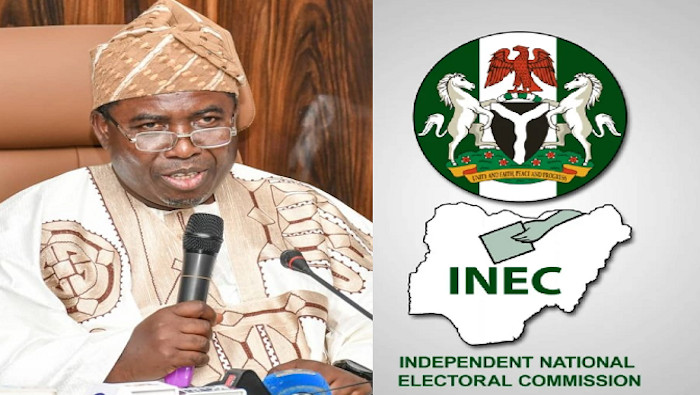
Chairman of the Independent National Electoral Commission (INEC), Prof. Joash Ojo Amupitan, has said the credibility of the 2027 elections would depend not only on the security of polling units but also on the authenticity of the information available to voters.
He spoke in Abuja yesterday at a summit tagged “Beyond the Ballot”, with the theme, “Safeguarding Electoral Information Integrity in the Age of AI”.
Amupitan said the growing use of artificial intelligence to create misleading content had made it necessary for the commission to strengthen its capacity to identify, verify and respond to digital manipulation.
He said, “The integrity of the ballot in 2027 depends not only on the physical security of the polling unit but also on the authenticity of the information environment in which voters make their decisions.”
The INEC chairman said the commission was upgrading its technical capacity to monitor public data streams for early signs of coordinated attempts to manipulate election-related information.
He added that it was also improving its ability to detect deepfakes, verify suspicious media content and issue timely clarifications through established communication channels.
According to him, the commission has moved beyond discussions of the dangers of artificial intelligence to conducting practical exercises to prepare its technical and communication teams for potential election-related disinformation.
He disclosed that INEC, in collaboration with a development partner, had recently concluded a strategic communication workshop where AI-driven election-day manipulation scenarios were simulated and addressed.
“Our expectation for this summit is clear. We need a united front for information integrity,” Amupitan said.
He, however, warned that INEC could not tackle the threat alone, calling for stronger cooperation among media organisations, technology companies, telecommunications providers, security agencies and civil society groups.
The commission’s chairman said social media platforms must establish fast-track channels to review and respond to manipulated content that could disrupt electoral activities.
He cited the possibility of an AI-generated video falsely announcing the postponement of an election, saying that such a situation would require an immediate, coordinated response rather than isolated press statements.
“Fact-checkers and independent journalists must have direct access to designated INEC communication desks to confirm operational facts within minutes rather than hours,” he said.
Amupitan also urged telecommunications companies and media organisations to establish reliable channels for broadcasting verified electoral information without unnecessary delays.
Addressing journalists, he said, “Be the first line of verification. Speed is important, but accuracy is the currency of democracy.”
He urged civil society organisations to help address digital literacy gaps, particularly in rural communities, and asked technology partners to develop tools to identify harmful synthetic content in Nigerian languages and social contexts.
Earlier, the Executive Director of the International Press Centre, Lanre Arogundade, called for a coordinated and rights-respecting framework to protect electoral information ahead of the 2027 elections.
Arogundade said Nigeria needed a trusted system through which relevant institutions could verify evidence, report incidents, communicate effectively and learn from practical exercises.
He disclosed that stakeholders would work towards establishing a Nigerian Information Integrity Partnership, with clearly defined responsibilities and timelines, to sustain efforts beyond the summit.
He, however, cautioned that efforts to tackle misinformation must not undermine fundamental democratic freedoms.
“One principle is clear: protecting elections must not weaken the freedoms that make democracy meaningful,” he said.
He stressed that any measures adopted must respect freedom of expression, media freedom, privacy and due process, adding that allegations of foreign interference must be supported by evidence rather than suspicion.
Former INEC Chairman, Prof. Attahiru Jega, also urged the commission and other stakeholders to explore the positive applications of artificial intelligence to strengthen electoral information integrity.
Jega said while the technology presented serious risks, it could also provide opportunities to improve communication, verification and other aspects of election management.
He urged participants to contribute practical ideas that would help protect the credibility of the 2027 elections.
Similarly, the European Union Ambassador to Nigeria and ECOWAS, Gautier Mignot, warned that false electoral information could deepen public suspicion, particularly when misleading claims about results circulated before official information became available.
He said artificial intelligence could improve translation, accessibility, and communication, but could also make deception easier to produce and harder to detect.
Mignot noted that misinformation was not necessarily generated by sophisticated technology, stressing that the accuracy of a claim remained more important than whether it was produced using artificial intelligence.
“The lesson is practical. We cannot leave an information vacuum and expect trust to fill it,” he said.
The EU envoy outlined three priorities for Nigeria ahead of the 2027 elections: preparing before electoral tensions arise, making stakeholder partnerships operational and protecting democratic rights while tackling harmful information.
He said verification arrangements, communication channels and responsibilities among institutions should be established and tested before election day.
Mignot also cautioned against using content moderation as an excuse to suppress criticism, independent journalism or legitimate political disagreement.
“A citizen questioning an institution is not necessarily spreading misinformation. A journalist reporting a failure is performing a democratic duty,” he said.
He further called for greater protection of women against impersonation, coordinated online attacks and false information targeting their participation in politics.
The ambassador stressed that international partners should support, rather than dictate, Nigeria’s efforts to protect electoral integrity.
“Nigeria’s electoral choices belong to Nigeria. The role of international partners is to support Nigerian-led efforts to protect the conditions in which these choices can be made freely and peacefully,” he said.
He urged stakeholders to leave the summit with practical commitments, clear response procedures and timelines for implementation rather than relying solely on a declaration.
Mignot said although eliminating false information during elections might be unrealistic, stakeholders could work towards ensuring that misleading claims were promptly challenged and voters had access to reliable information.
We’ve got the edge. Get real-time reports, breaking scoops, and exclusive angles delivered straight to your phone. Don’t settle for stale news. Join LEADERSHIP NEWS on WhatsApp for 24/7 updates →
Join Our WhatsApp Channel