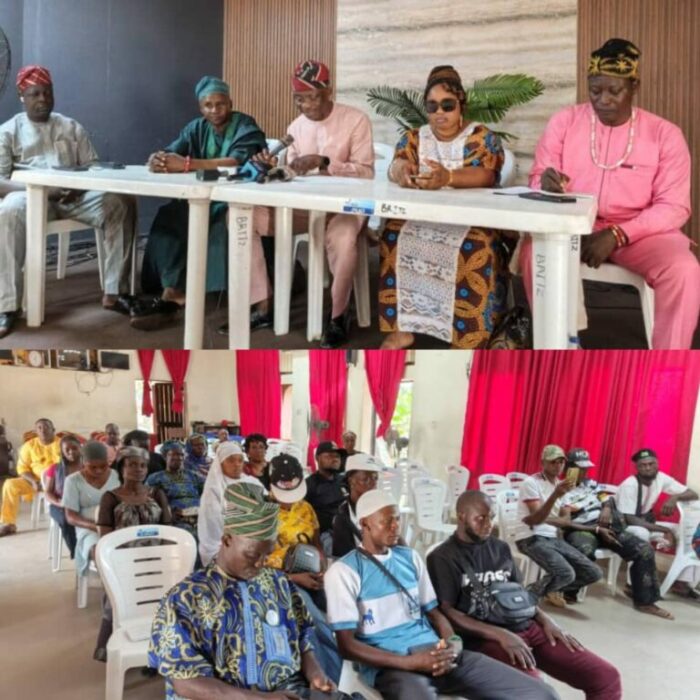
The Yoruba Self-determination Movement (YSDM) has renewed its call for the dissolution of Nigeria and the creation of an independent Oduduwa Republic, citing worsening insecurity, political tensions and disputes over ethnic identity and territorial ownership.
The group also called on lawmakers across the South-West and other areas it considers Yorubaland to introduce restrictive measures on non-indigenes’ land ownership, market participation and political activities.
The movement made the demands at a press conference organised by the Yoruba Action Group at the Nigeria Union of Journalists (NUJ) Press Centre, Iyaganku, Ibadan, on Wednesday.
Its Deputy Leader (Homeland), Architect George Akinola, said the country’s security and political challenges had reinforced the group’s position that Nigeria should be dissolved rather than restructured.
He said the movement had warned between 2017 and 2022 that Nigeria was “tottering on the brink of disaster,” arguing that restructuring, resource control and a return to regionalism would not resolve the country’s fundamental problems.
“We added, among other things, that it is too late for restructuring, resource control or regionalism in Nigeria,” Akinola said.
He maintained that an independent Oduduwa Republic remained the movement’s preferred solution to what it described as threats to Yoruba political, economic and cultural interests.
Akinola accused armed groups operating in parts of the South-West of kidnapping, killing and attacking farmers and other residents. He also alleged that disputes over commercial activities and claims concerning the historical ownership of Lagos had heightened tensions between Yoruba and Igbo communities.
“The Yoruba people are angry and fed up with Nigeria. What we desire most, at this time, is to become a sovereign nation, separate from dysfunctional Nigeria and its many encumbrances on Yoruba potential,” he said.
The movement rejected claims that Lagos was “No Man’s Land” and disputed assertions about the contribution of Igbo residents to the development of the state, insisting that Lagos was historically and culturally part of Yorubaland.
It cited communities including the Awori, Ijebu, Egba, Egbado, Remo, Ilaje and Egun, alongside Yoruba returnees from Sierra Leone, as populations associated with the historical development of Lagos.
The group also challenged claims of historical Bini sovereignty over Lagos, arguing that the traditional succession arrangements of the Lagos monarchy reflected Yoruba ruling-house traditions.
The movement’s position forms part of wider disputes over history, indigeneity and political representation in Lagos, a commercial centre with residents from different ethnic backgrounds.
Akinola further alleged that the administration of former Lagos State governor Bola Tinubu between 1999 and 2007 had allowed Igbo residents to expand their political representation and property ownership, developments he said had contributed to current disagreements.
The group subsequently declared that no Igbo candidate should contest elections in Yorubaland during the 2027 general elections.
“No vacancy for any Igbo candidate in Yorubaland,” Akinola said, urging those interested in contesting elections to return to their states of origin.
The movement also urged lawmakers to enact legislation restricting non-indigenes to no more than 20 per cent of shops and commercial spaces in individual markets.
It specifically named Alaba, Ladipo and the Trade Fair Complex markets in Lagos, alleging that Yoruba traders had faced intimidation and exclusion in some commercial spaces because of their ethnic background.
The group called for the criminalisation of harassment against indigenous traders and urged authorities to investigate allegations of discriminatory market practices.
It also proposed limiting land leases for non-indigenes to 20 years or less, compared with the 99-year leasehold arrangement it cited.
Other demands included identifying non-Yoruba residents convicted of crimes for repatriation to their states of origin, tightening migration controls into Yoruba urban centres and revoking properties where, according to its allegations, hostile groups had congregated.
Akinola argued that the proposed measures were necessary to prevent the concentration of commercial and political power in the hands of particular ethnic communities.
The group also called for an end to open cattle grazing across Yorubaland, urging non-Yoruba cattle owners to establish ranches in their states of origin rather than allow their animals to graze freely in the South-West.
However, the proposed restrictions raise constitutional questions. Section 42 of Nigeria’s 1999 Constitution prohibits discrimination against citizens on grounds including ethnic group and place of origin, while Section 43 guarantees Nigerian citizens the right to acquire and own immovable property anywhere in the country, subject to the Constitution.
The movement also challenged the legitimacy of the 1999 Constitution, arguing that it did not adequately reflect the consent of the country’s constituent ethnic nationalities.
It maintained that ethnic nationalities should be able to pursue self-determination and establish protections for their identities and indigenous rights.
The group further cited historical conflicts involving Yoruba communities, including the Fulani incursions of the 19th century, the political crisis in the former Western Region in 1963, the disputed 1983 Ondo State governorship election and the annulment of the June 12, 1993 presidential election, widely believed to have been won by the late Chief Moshood Abiola.
Akinola said these episodes demonstrated what the movement regarded as a longstanding pattern of political domination and threats to Yoruba interests.
The group also made historical claims about the origins and development of other ethnic groups, presenting them as part of its argument for self-determination.
Nigeria’s Constitution describes the country as an indivisible and indissoluble sovereign state and does not provide a unilateral constitutional procedure for an ethnic group or state to secede from the federation.
The YSDM nevertheless vowed to continue its campaign for an independent Oduduwa Republic, insisting that restructuring and other constitutional reforms would not address what it considers the fundamental problems of Nigeria.
We’ve got the edge. Get real-time reports, breaking scoops, and exclusive angles delivered straight to your phone. Don’t settle for stale news. Join LEADERSHIP NEWS on WhatsApp for 24/7 updates →
Join Our WhatsApp Channel