
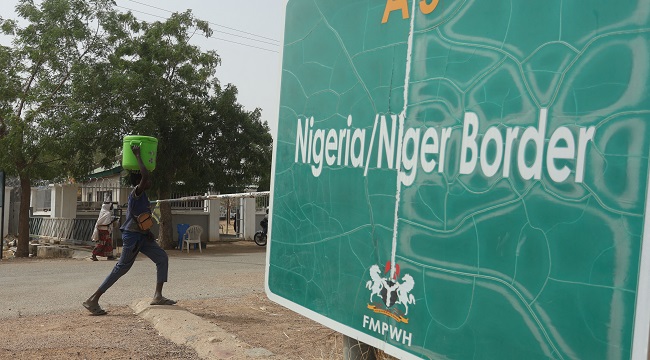
0nly 84 entry points are currently manned by security personnel – Report
Nigeria’s vast and poorly monitored borders have become silent gateways for armed groups, weapons trafficking, and cross-border crimes. With nearly 2,000 official entry points reportedly unmanned across its 4,000-kilometre frontier with neighbouring countries, security gaps are widening despite the presence of multiple security agencies. TARKAA DAVID writes military and local sources warn that insurgents and bandits are exploiting these porous routes.
Nigeria shares over 4,000 kilometres of land borders with four Francophone neighbours , namely; Benin, Niger, Chad and Cameroon , countries grappling with security threats, insurgency, banditry and deepening food crises. These vast frontiers, stretching across forests, deserts and waterways, remain critical corridors for trade and migration. However, they have increasingly become flashpoints of transnational crime, arms smuggling and the movement of non-state armed groups exploiting weak surveillance systems.
Despite the strategic importance of these borders, findings indicate that nearly 2,000 official entry points are largely unmanned, creating significant security loopholes. Security sources warn that several northern corridors, particularly around Borno, Adamawa and Sokoto states, have become vulnerable routes for terrorists and criminal networks who move with relative ease, undermining national security and worsening humanitarian conditions in already fragile communities.
The Minister of Humanitarian Affairs and Poverty Alleviation, Dr. Bernard Doro, recently disclosed that the National Commission for Refugees, Migrants and Internally Displaced Persons (NCFRMI) is currently catering for “over a conservative estimate of 6.7 million Nigerians” displaced and living in various Internally Displaced Persons (IDP) camps and host communities across the country.
The majority of these displacements are not the result of natural disasters but stem from man-made conflicts, including terrorism, banditry, communal clashes, and other forms of violent unrest.
In June 2025, General Christopher Musa (Rtd), then Chief of Defence Staff, called for the fencing of Nigeria’s borders with its neighbours as part of efforts to curb the cross-border movement of armed criminals and strengthen national security.
He warned that Nigeria, bordered by four Francophone countries in the Sahel, could face severe security risks, cautioning that the nation’s stability is at stake if the Sahel collapses under the current porous border arrangements.
“Border management is very critical. We have had countries that because of the level of insecurity in their country had to fence their borders. If mentioned this in Nigeria people will say this is impossible.
“Pakistan fenced 1,350 kilometers border with Afghanistan, that was the only time they had peace. Saudi Arabia and Iraq, 1,400 km border fenced completely.
Can we start thinking of fencing our border, we have 1,500km with Niger Republic, 1,900 km with Cameroun, Chad is there, all over us we are surrounded by francophone countries. The sahel is heating up, if the Sahel falls it is Nigeria that they are interested in,” he said.
Again, in February 2026 General Musa (Rtd) restated the call for a strengthened border surveillance and control mechanism for improved national security.
He reaffirmed the Federal Government’s commitment to strengthening border security, improving veterans’ welfare, and reviewing key defence policy frameworks to enhance Nigeria’s national security architecture.
The Minister stated these when he received members of the Alumni Association of the National Defence College (AANDEC) during a courtesy visit on Monday 23rd February, 2026 at the Ministry’s headquarters in Abuja.
A statement by the Deputy Director Information and Public Relations Enderline Chukwu said
He said “It is important that we know who is coming in, who is going out, and what is coming into our country,” he said, adding that improved border control would significantly curb transnational crimes and insecurity.
The Minister noted that Nigeria’s security environment remains dynamic and complex, requiring continuous review and upgrading of existing policies, including the National Defence Policy (2017) and its Implementation Guidelines (2019).
“Life is dynamic and our security challenges are fluid. It is important that our Armed Forces and institutional frameworks adapt accordingly,” he added.
He stated that policy documents must evolve in response to emerging threats and changing global realities.
Musa also stressed the need to prioritise the welfare of military veterans, emphasising that those who have served the nation deserve adequate post-service support, including healthcare and welfare benefits.
He informed that the Ministry would liaise with relevant authorities, including the Permanent Secretary and strategic partners, to initiate structured engagements aimed at reviewing critical defence policies and other related documents requiring updates.
Speaking further, the Minister described border security as a critical pillar of Nigeria’s national security strategy noting that the importance of strengthening surveillance and control mechanisms to ensure that authorities are fully aware of movements across Nigeria’s borders is paramount.
He assured stakeholders that the Ministry is reviewing frameworks to strengthen veterans’ welfare systems and explore best practices that will ensure dignity and improved living standards for retired personnel.
Also the President of AANDEC, Rear Admiral Ndidi Patrick Agholor (rtd) noted that AANDEC possesses the capacity and professional expertise to collaborate effectively with the Ministry of Defence in the implementation of the National Defence Policy and assured that the Association remains committed to supporting the Ministry in strengthening Nigeria’s defence architecture through research, advisory services and strategic engagements.
He further appealed for the Ministry’s support in enhancing AANDEC’s operational capacity, including assistance with mobility, office equipment, conference facilities, and the conduct of the forthcoming National Security Summit, as well as the development of the Association’s permanent facility.
Rear Admiral Agholor (rtd) further pledged AANDEC’s dedication to partnering with the Ministry in advancing national security objectives, stressing that stronger institutional collaboration would contribute meaningfully to addressing Nigeria’s evolving security challenges.
Commenting on the development, the managing director Beacon Security and Intelligence Ltd Dr. Kabir Adamu Nigeria shares land borders with four neighboring countries, totaling 4,047 kilometers.
He said the longest shared border is with Niger Republic.
He noted that Nigeria’s border security faces significant challenges, primarily characterized by its porous nature.
Citing a recent report presented to the House of Representatives, a said “out of the country’s 1,978 official entry points, only 84 are currently manned by security personnel. This leaves a vast number of unofficial and illegal routes unmonitored,”.
These he said shows a significant government expenditure on security without commensurate results, according to lawmakers.
“This lack of comprehensive oversight has led to several security threats, including: Illegal arms smuggling, human trafficking, and drug smuggling
Increased vulnerability to infiltration by terrorist groups and bandits from the Sahel region,”.
Adamu said the call by the Minister of Defence for fencing Nigerian borders should not be viewed as a single solution but part of a comprehensive strategy.
“And since the Ministry of Interior is the one with border security management mandate, it should be actively engaged,” he advised.
He reiterated that though the Nigerian government is actively implementing a multi-pronged strategy to address these challenges, focusing on personnel, infrastructure, technology, and policy. Improving manpower and infrastructure by recruiting 10,000 additional personnel; establishing seven (with 7 more planned) fully equipped border posts with solar power, water, and connectivity
“Deploying additional technology and enhancing surveillance such as the national e-border system, now covering over 60 per cent of land borders; the establishment of an 8.3-petabyte data center with a command and control center; enhanced aerial surveillance; and that of 55 high-intensity patrol vehicles,”
In the area of policy, he stressed the need to review and update the now moribund National Defence Policy (2017) and the National Security Strategy (2019); strengthening inter-agency coordination and intelligence sharing; collaborating with international partners on migration management; considering the fencing of borders as a strategic option.
Also Speaking AVM Olatokunbo Adesanya (Rtd) former NAF Spokesman and former Nigeria’s Defence Attaché to Russia said Nigeria’s borders face numerous challenges, the major one being its porosity.
He noted that Nigeria has quite extensive borders with a lot of illegal entry points, leading to illegal routes through which insurgents and other non-state actors come into Nigeria undetected and undocumented.
He added that the difficult terrains in some parts of the country further compounds the problem.
“The implication of these challenges is that the Immigration personnel at border posts are only controlling the entry/exit of immigrants who wish to be known. Those with wicked intentions often take advantage of the porosity of our borders,”.
According to him,addressing the challenge calls for a combination of solutions.
“These include but are not limited to the employment of technology such as long endurance UAVs and installation of high powered CCTV cameras in selected places, all of which would have a remote monitoring/command and control centre.
“I saw a similar model while visiting the Belarusian border as Nigeria’s Defence Attache to Moscow. The Belarusian Model also includes the building of physical fence with trigger systems along the border.
“I recollect recommending the construction of physical fence along our borders in one of my reports. Some may question the cost of constructing a physical fence but I would also question the current cost of not building one especially in terms of human lives, properties and territorial integrity,” he said.
In addition, he called for more personnel to be recruited into the Immigration Service in addition to the provision of adequate number of armed patrol vehicles.
AVM Adesanya Rtd also stressed the need for strong interagency cooperation collaboration to address the challenges.
We’ve got the edge. Get real-time reports, breaking scoops, and exclusive angles delivered straight to your phone. Don’t settle for stale news. Join LEADERSHIP NEWS on WhatsApp for 24/7 updates →
Join Our WhatsApp Channel