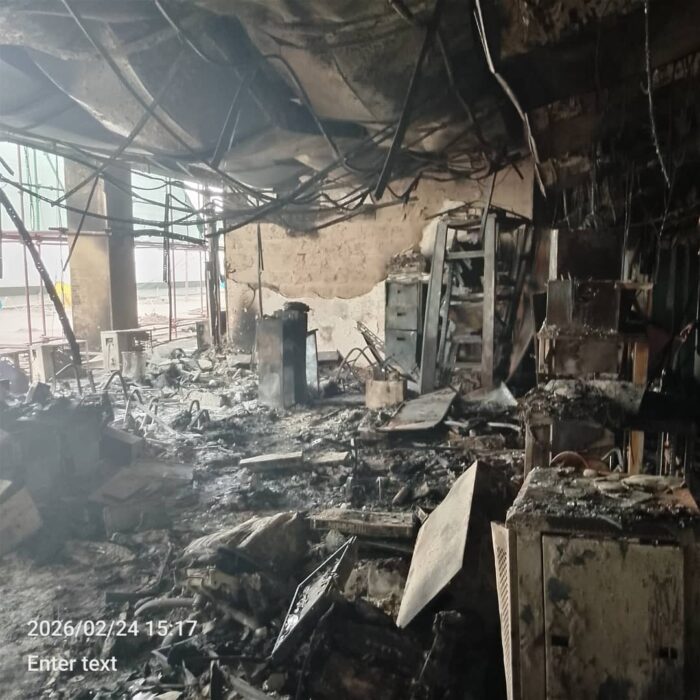
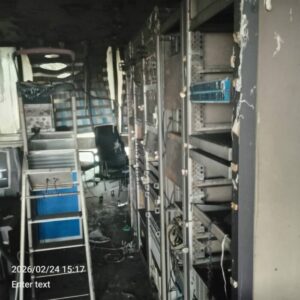
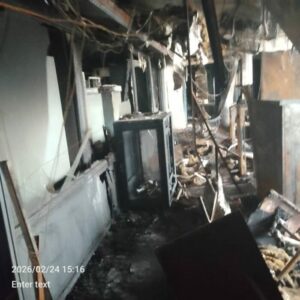
The Nigerian Airspace Management Authority (NAMA) has confirmed that the fire incident which engulfed Terminal 1 of the Murtala Muhammed International Airport (MMIA), Lagos, destroyed vital operational equipment belonging to the agency, significantly disrupting air traffic services.
Speaking to journalists on Wednesday after an inspection tour of the damaged facilities, the managing director of NAMA, Umar Farouk, disclosed that the inferno completely knocked out the Authority’s primary air-to-ground communication system, a critical infrastructure used for direct communication between pilots and air traffic controllers.
Farouk explained that although the primary system was severely impacted, NAMA swiftly activated contingency protocols, deploying emergency backup systems and rerouting support from other operational centres across the country to sustain air traffic services within Lagos airspace.
“The fire has affected our air-to-ground communication completely. What you are seeing now, in terms of sustaining air traffic services in Lagos, is the backup support being moved from other centres to stabilise operations,” he stated.
The NAMA chief revealed that the scale of the damage necessitated the temporary suspension of inbound flights into Lagos at the peak of the crisis to ensure safety.
According to him, the decision was taken as a precautionary measure after it became clear that the core communication infrastructure had been compromised.
“What we saw was actually a huge loss as far as communication is concerned. Other air traffic services were disrupted. We had no option at that time but to suspend inbound aircraft into Lagos,” Farouk said.
He noted, however, that the Director of Operations and Engineering was immediately dispatched to assess the situation, and emergency response protocols were promptly activated, helping to restore partial stability within a short period.
Despite the extensive damage to equipment, Farouk reassured airlines, passengers and stakeholders that Nigeria’s airspace remains safe.
He emphasised that while NAMA does not anticipate emergencies, it maintains high operational standards and professional readiness to manage unforeseen disruptions.
“Communication, aerodrome approach and area control remain operational. We are professionals. We may not expect emergencies, but we are always prepared to respond to unfortunate incidents such as this,” he added.
The managing director admitted that assessing the financial magnitude of the losses would take time, given the technical complexity and value of aviation communication equipment.
“It will be very difficult at this stage to determine the monetary value of the loss. It will take us a while to fully assess the extent of the damage, but we are working assiduously on it,” he said.
However, the activation of backup systems and inter-centre support prevented what could have evolved into a prolonged disruption at Nigeria’s busiest international gateway.
Terminal 1 of MMIA serves as a key operational hub within the Lagos aviation network, making the fire a significant operational setback for multiple stakeholders within the aviation ecosystem.
We’ve got the edge. Get real-time reports, breaking scoops, and exclusive angles delivered straight to your phone. Don’t settle for stale news. Join LEADERSHIP NEWS on WhatsApp for 24/7 updates →
Join Our WhatsApp Channel