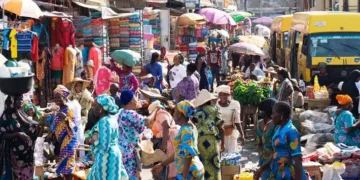
Just a few days to Christmas, markets across Lagos are experiencing increased activity as residents shop for food and clothing, adjusting spending to rising prices while keeping the festive tradition alive.
Visits by the News Agency of Nigeria (NAN) to major markets in Mile 12, Oyingbo, Lagos Island and Ajah showed crowded stalls and steady buying, as shoppers focused on essentials, negotiated harder and opted for smaller quantities to manage costs.
Many residents told NAN that Christmas holds deep cultural and religious meaning, making it a period they are unwilling to abandon, even amid economic strain.
A market survey revealed mixed price trends. While a 50kg basket of tomatoes dropped slightly from N35,000 in 2024 to N30,000 this year. A 50kg bag of atarodo climbed sharply from N68,000 to N90,000.
Similarly, a 50kg bag of red bell pepper (tatashe) dropped from N120,000 to N110,000, while a 50kg bag of red chilli pepper (bawa) declined from N110,000 to N80,000 within the period under review.
However, the cost of cooking oil surged, with 25 litres of groundnut oil increasing from N65,000 in 2024 to N85,000 in 2025.
Green bell pepper sold for N2,500 per kilogram, while red and yellow varieties were priced at N4,500.
The survey also showed that a 100kg bag of onions now sells for N120,000, up from N70,000 last year.
NAN further reports that prices of animals traditionally used to celebrate the season — including chickens, turkeys, goats and cows — have risen sharply.
A medium-sized cow ranged between N600,000 and N900, 000, while goats sold for between N90,000 and N130,000 depending on bargaining strength. Live chickens sold from N25,000 and above.
Frozen chicken sold for as low as N45,000 per 10kg at Mile 12 Market, while the same quantity was sold for about N65,000 in Ajah and Lekki areas.
Mr Femi Odusanya, spokesperson for Mile 12 Model Market, said that although prices of some commodities had eased slightly, food inflation remained a concern.
According to him, the slight reduction was due largely to lower logistics costs rather than increased national output.
Odusanya emphasised the need for Nigeria to invest in preservation and storage systems to allow longer storage of perishable food items such as tomatoes during peak seasons.
For clothing, an average baby girl’s dress at Idumota Market sold for between N18,000 and N45,000 depending on quality, while boys’ jeans ranged from N9,000 to N25,000 and shirts from N7,500 to N25,000.
The cheapest lace materials sold for about N35,000, with premium varieties running into millions of naira. Men’s fabrics such as Atiku and Voile sold from N40,000 for five yards.
Quality children’s shoes ranged from N9,000 to N40,000, while adult shoes sold from N15,000 and above.
In spite of the high cost of goods, many shoppers insisted that Christmas must be celebrated because of its significance.
Mrs Alero Magbo, a housewife, said the atmosphere, weather and excitement associated with the season made it memorable.
She described Christmas as a period of relaxation and reward for the year’s labour.
“For me, even if I don’t ask for money all year, Christmas money must drop for me and my children. Everybody must get new clothes, new shoes and new everything,” she said.
Magbo added that the season was also an opportunity to refresh personal belongings while celebrating the birth of Jesus Christ.
Similarly, Mr Simon Foladehin, a bus driver, said Nigerians had become more accustomed to current economic realities and adjusted their spending accordingly.
He noted that in spite of rising transportation and commodity costs, shoppers still thronged major markets, particularly on Lagos Island.
Foladehin urged government to further cushion the economic burden on citizens, especially the vulnerable.
“Christmas is for everyone, whether rich or poor. No one should be left out of the celebration because of lack,” he said.
Also speaking, a children’s wear trader, Mrs Isbau Mubarak, said economic pressures had failed to dampen the festive mood.
She noted that sales in 2025 were better than in 2024 when many Nigerians were still adjusting to new economic realities.
Mubarak called for adequate market sensitisation ahead of the new tax regime scheduled to take effect in January 2026 to enable traders maximise their gains.
As Christmas approaches, the bustling markets and resilient spirit of Nigerians reflect a determination to hold on to tradition, joy and togetherness, even in challenging times.
While prices may be high, many insist that the true essence of the season — hope, celebration and shared moments — remains priceless.(NAN)