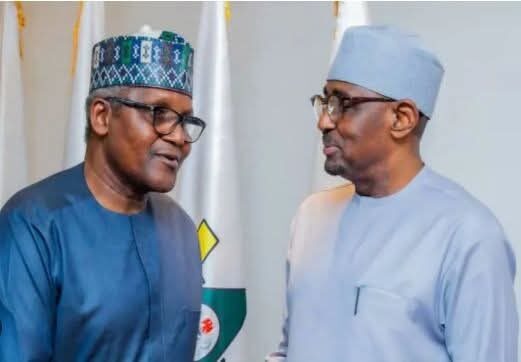
It depends on where your lens is: whether you are viewing the Dangote/ formerly Faruk of NMDPRA saga from a patriotic lens or from another type. I have long been an enthusiast of the arrival of a new entrant in the oil industry and a refiner at that after decades of fraudulent importation regimes. Late PMB labored to have Dangote refinery completed, bullishly providing foreign exchange as an FG investment for the completion of the project. There was a memorandum in place that stipulated how the relationship would work.
But somehow the NNPC withdrew from the investment and pegged its stake at the already committed funds value. President Tinubu continued to complement FPMB’s efforts as the Dangote refinery would never have come to light without his vision anyway. The free trade zone at the Ibeju Lekki area, where Dangote refinery is housed, and the re-enactment or facilitation of the naira for crude deal between Dangote refinery and the FG, to mention some of President Tinubu’s efforts. Now, after over 3 decades of importation and subsidy fraud, we finally have the much-needed energy security we have always yearned for.
A world-class refinery with huge and expanding capacities. But alas, just the way FG refineries were run aground and left underground, the power players in the oil industry came for Dangote refinery. Concerted efforts, both foreign and local, were losing their golden fleece, and the importation routine that guaranteed billions like wildfire for them was facing a death knell. They initiated frantic efforts to frustrate it. From insinuations of being incomplete, to rubbishing of its quality to aspersions of its supply capabilities, it was one joker after the other as they reeled out hoops for the smooth take off and running of the refinery. But like the biblical Noah’s ark, the refinery was built and built strong enough to weather the storm.
Those arguing for monopoly are taking us for dunces. Dangote, as a manufacturer, is not on the same value chain level as the importers/ distributors of petrol. There are different kinds of monopolies, and the Dangote refinery in Nigeria is a natural monopoly and, at worst, a government monopoly.
Unfortunately for Nigeria, the government-owned refineries had been driven aground, and so oil refining is now in private hands, which one would have thought of as a blessing, and a masterstroke that consolidates on less government participation and more private sector inclusion in business. But the economists or digital experts on everything are egging the government on to continue to participate at levels they have no business doing.
Dangote is the only producer that can supply the country at the finest prices and has evidently continued to drive down prices and that is a natural monopoly. Those importers are opportunists and spoiled brats at best who enjoy privileges and opportunities to get licenses, access slightly cheaper foreign exchange as “preferential importers”, and then go ahead to supply unscrutinised substandard petrol to the market while also charging consumers for premium quality products. The rip-offs pile up as profits for them since the subsidy is officially gone. We, the consumers, have become their new subsidy purse, and we pay heavily to sustain their lifestyles. Don’t forget the bridging receipts industry which is another fraud mine as it hardly reflects in harmonised prices across the market.
You find that arbitrary price differences are prevalent the further away you are from the Lagos vicinity. Then you have several unions that charge millions per truck before you see this golden product.
The people are usually up in arms against the government’s policies and implementation. Ironically the people are for stricter regulation. They are in support of erroneous and extremist regulatory tendencies against Dangote refinery which could eventually cripple a 33 trillion naira investment. Licences were given to oil industry players to build refineries. Where are the refineries? Aside from the upcoming BUA refiner, which other refinery can you name that can produce 10 million litres a day or can process 200,000 barrels a day? Are the current importers with licenses not enough in collaboration with the Dangote refinery?
Are we going to continue to encourage foreign exchange students to leave the country for things we have locally? Are we not celebrating a trade surplus of 6 trillion now? Why are we subsidising fuel import by dropping 15% tax on it, thereby losing government revenue? Dangote refinery will not be charged the 1 tax because this is a local product. If the tax is charged on oil imports, the petrol from importers will hit 1000 naira on the streets, while that of Dangote will be 200 to 300 naira cheaper!
Even as it is, motorists are buying from Dangote-petrol dispensing outlets for better quality and lower prices. The Dangote CNG buses transportation model makes for cheaper distribution, and the importers want the FG to continue to pay for transportation or distribution via bridging. We cannot take one step forward and two steps backward all in the name of fighting monopoly.
It is a big fat error, and we know it deep down in our skin. Refineries can become competitors to Dangote not importers, come on! The US and the UK protect their local car manufacturers and discourage or disrupt foreign car manufacturers using policies and specifications to drive up prices of imported brands.
If they encouraged imports, cheaper and less qualitative models and brands would flood their market and weaken their GDP even further. NVIDIA and chips, TikTok, and Huawei were all muscled out or muscled down for the sake of indigenous companies in the US.
So how can we be promoting refined products from foreign refineries plus transportation costs into our country all in the name of avoiding a monopoly? You have to build a refinery to compete with one; not by short-circuiting through unethical importation practices. Please..let’s shelve the embarrassing economy-based arguments for the benefit of the country and the common man. Issuing new import licenses is not a genuinely positive development in our quest for economic emancipation. It is very regressive actually.
As a fall out and a long overdue overhaul, the oil industry has now gone through a complete shake up with or without Dangote’s petition. It has been a long time coming. It is also not so surprising that an IPMAN official has come forward to cast aspersions on the accountability of the management of NMDPRA over some refundable deposits they’ve been owed for a very long while. Revelations from the previous administration’s power play and how institutions were weakened for private gain have not helped matters either, and the new appointments in the NMDPRA and NUPRC are obvious moves on the oil industry chessboard.
Before the climax of these reforms, Dangote was roughened up really badly, and one cannot blame him for toughening up. He was readied for the fight, you know, when he was severely warned by the Saudi minister for power (oil) that the industry he was rushing into could only be sustained by government resources. On several accounts before the refinery hit the ground running, Alh. Aliko Dangote was effusive with allegations of cabalism in the industry which he had referred to as more dangerous than drug cartels. He has faced so much sabotage, but never fazed at it. We all, as Nigerians, complain about sabotage from our own domestic staff and employees in private businesses, as well as public offices, but when it comes to Dangote?
No! We insist they are fabricated accounts of sabotage and theft at his refinery. The biggest employer aside from the FG, the largest taxpayer in the country, and the most generous philanthropist in Nigeria is facing a lot of jealousy and envy, and as an African, you just know why. Typically, Nigerian biases are based on either political, tribal, or religious sentiments and rarely on patriotism. If Dangote supposedly stole all of the 33 trillion from the public till to build a refinery, by Go, he is an angel amongst us; what with the discoveries of stolen millions and billions of dollars by public officials to offshore havens. And of course that is not even the case.
Well, courtesy the man you love to hate, the landing cost of petrol is no longer calculated from around the world to our cars – ramping up all sorts of charges along the way – but from Lekki free trade zone, powered by cheaper transportation to our vehicles. This promises to graduate to a door-to-door model as we go on. Happy, today’s fuel is not only free from landing cost, but of better quality as it has the lowest ppm of sulphur compared to our imported “abi” imported and blended fuel. All thanks to the Dangote battles we had no idea that the quality of imported fuel was basically hogwash.
We’ve got the edge. Get real-time reports, breaking scoops, and exclusive angles delivered straight to your phone. Don’t settle for stale news. Join LEADERSHIP NEWS on WhatsApp for 24/7 updates →
Join Our WhatsApp Channel