
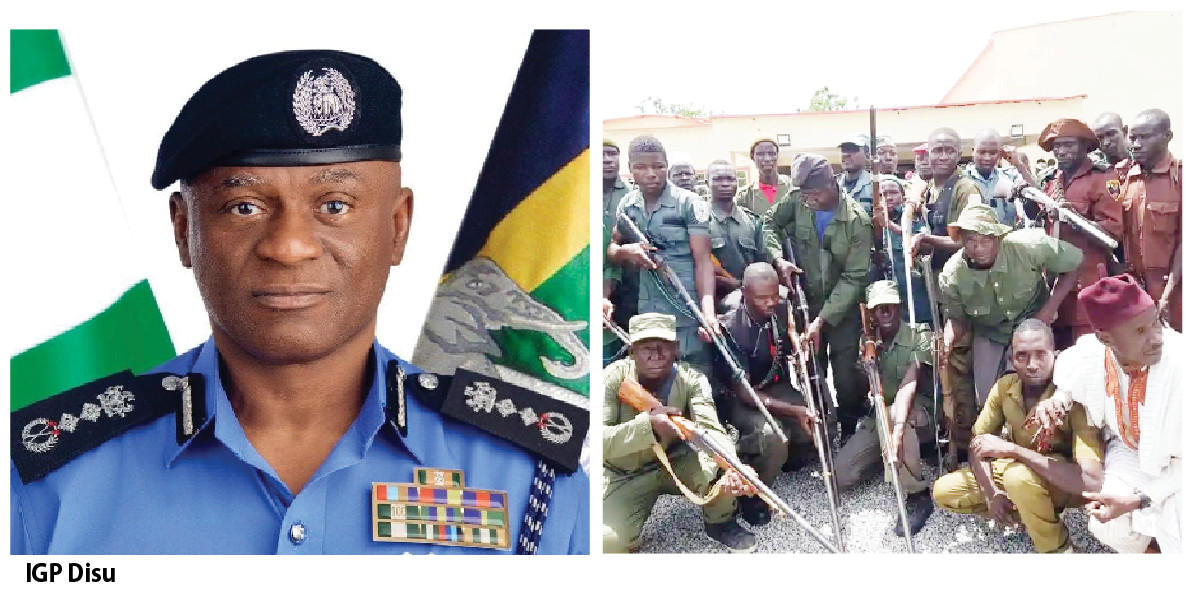
Across Nigeria’s northwest and north-central, the math of survival is blunt. Police response times are measured in days, not minutes. Soldiers come after attacks, not before. So communities are doing what states once promised: they recruit, arm and fund their own defense, write ADEMU IDAKWO, EJIKE EJIKE, Abuja; ABDULLAHI OLESIN, Ilorin; OBANSA IBRAHIM, Lokoja; FRANCIS OKOYE, Maiduguri; NICHOLAS DEKERA, Gusau; KÀMAL IBRAHIM, Bauchi; MOH’D ZANGINA KURA, Dutse.
As insecurity continues to affect rural communities across parts of Nigeria, residents, community leaders, local security actors and policy observers say communities are increasingly relying on self-help security arrangements to protect lives and property.
In interviews with LEADERSHIP Sunday, Nigerians across several states said vigilante groups, community policing structures, youth groups, traditional institutions, and informal intelligence networks are playing expanding roles in local security efforts amid concerns about a limited security presence in some areas.
In Kwara State, Chairman of the Community Policing Initiative, Alhaji Yusuf Abdullahi Yusuf, said community-based security groups have become increasingly active in gathering and sharing intelligence.
According to him, the groups collect and report credible intelligence on security threats, monitor unusual and suspicious activities, and support conflict prevention initiatives.
He added that they facilitate communication between communities and security agencies and participate in public sensitisation programmes.
However, Yusuf identified inadequate funding and logistical challenges as major obstacles to their operations.
‘In Kwara, Our Challenges Are Finance And Logistics’
“Our challenges border on finance and logistics,” he said. Also speaking from Kwara, the Chairman of the Kwara South Internal Security Network, Elder Olaitan Oyin-Zubair, said local participation was necessary to strengthen security efforts.
“We have to complement government efforts. Security is everybody’s business,” he said.
Providing the government’s perspective, Senior Special Assistant on Security, Alhaji Muhideen Aliyu, acknowledged that government security presence could not be physically felt in every community at all times.
He said local government authorities had been directed and empowered to organise local vigilante structures to support conventional security agencies.
According to him, such arrangements operate based on the threat level in different communities and work alongside the military and other security outfits.
Aliyu added that some states were also introducing welfare measures for local vigilante personnel, including enrolment in health insurance programmes.
In Zamfara State, youth and community security stakeholders also pointed to grassroots participation as an important component of local security efforts.
Chairman of the National Youth Council of Nigeria (NYCN), Zamfara State chapter, Comrade Nurudeen Salisu, said security agencies alone may not have sufficient workforce to maintain a presence across all communities.
According to him, youth groups in rural communities contribute by sharing intelligence and collaborating with security agencies.
As security challenges persist across parts of Jigawa State, communities are increasingly relying on local forest volunteers and other community-based security structures to support efforts to protect lives and property, particularly in rural areas where formal security presence remains limited.
One such group is the Nigerian Security Forest Service, popularly known as the “Hunters,” a volunteer security outfit operating across the state’s 27 local government areas. The group says its members work within communities and forest areas to provide local surveillance and share intelligence with security agencies.
According to the group, more than 3,000 members have been registered and trained over the years to support patrols, information gathering, and security responses, especially in communities near forests and remote settlements.
Residents and members of the outfit said many of the volunteers are local hunters with knowledge of the terrain and movement patterns within their communities, making them increasingly relied upon to complement broader security efforts.
Salisu said the council also facilitates training and engagement to strengthen community security and improve trust in security institutions.
Public Relations Officer of the Zamfara State Community Protection Guard (CPG), Abubakar Gumi, said that community-based security structures work closely with conventional agencies to respond to threats.
Gumi said local security groups support operations by sharing information and leveraging their knowledge of the local terrain.
He noted that cooperation with the police and the military had strengthened security responses in parts of the state.
In Kogi State, community leaders linked the rise of local security arrangements to efforts to support conventional security agencies.
A community leader in Ayegunle Gbede, Ijumu Local Government Area, Comrade Idris Miliki Abdul, said residents had introduced self-funded security measures to protect lives and property.
According to him, community members contribute resources to sustain local vigilante operations because security agencies cannot effectively cover all communities.
“Our community had to tax ourselves to fund local security operatives. Conventional security agencies cannot do it alone, especially when it comes to intelligence gathering at the grassroots level,” he said.
Also, in Ayegunle Gbede, Ijumu Local Government Area, Funsho Salami said local vigilance and information sharing had become increasingly important in helping residents respond to security concerns.
According to him, residents now pay closer attention to local security alerts and communication channels to identify unusual activities and improve response time.
Salami added that greater community participation has strengthened cooperation between residents and security operatives while contributing to a stronger sense of safety.
Meanwhile, the Kogi State Government reiterated its commitment to strengthening security through collaboration with conventional security agencies and local vigilante groups.
State Security Adviser, Commander Jerry Omodara, said the government had recruited thousands of vigilante personnel to support security operations across communities.
He said collaboration with local stakeholders remains central to improving security outcomes.
JTF To The Rescue In Borno
In Borno State, the Civilian Joint Task Force (CJTF) said community participation had become part of broader security efforts.
Spokesman of the CJTF, Mohammed Danbatta Yaro, described the organisation as a response to the security realities created by the Boko Haram insurgency and said members currently support operations across communities.
According to him, the CJTF works alongside the military while also monitoring criminal activities within communities.
He identified resistance from some residents during arrests as one of the operational challenges.
Yaro said families and community members sometimes defend suspects arrested over alleged links to criminal activities or drug-related offences, creating difficulties for local security operations.
Responding to concerns over security presence, Borno State Commissioner for Information and Internal Security, Prof. Usman Tar, said the state government had strengthened support for security agencies through intelligence and logistics.
According to him, additional local vigilantes and community volunteers have been trained and equipped. At the same time, forest guards have also been engaged across the 27 local government areas with support from the Federal Government.
Tar added that farm patrol initiatives had also been introduced in vulnerable locations in collaboration with security agencies.
In Bauchi State, Village Head of Sabon Garin Gwallameji, Alhaji Hassan Ibrahim, said the community relies heavily on a local vigilante initiative to safeguard lives and property.
Gwallameji, a suburb of Bauchi metropolis, has experienced repeated incidents of theft and related crimes over the years.
According to the traditional ruler, the community mobilised youths for patrol operations, intelligence gathering and rapid response to reported security concerns.
“We have a vigilante group comprising youths from the community who work closely with police officers from the Yelwa Divisional Headquarters,” he said.
Ibrahim said community dialogue and cooperation with security agencies had contributed to maintaining peace in the area and appealed for additional support to strengthen operations.
Commander of the Baushe Hunters Gwallameji Unit, Safiyanu Yahaya Abdullahi, said the group depends on informants within the community to enable early intelligence and timely responses.
He said the vigilante team operates both day and night, depending on prevailing security conditions.
Abdullahi, however, identified shortages of operational equipment and limited support as major challenges.
As security challenges persist across parts of Jigawa State, communities are increasingly relying on local forest volunteers and other community-based security structures to support efforts to protect lives and property, particularly in rural areas where formal security presence remains limited.
One such group is the Nigerian Security Forest Service, popularly known as the “Hunters,” a volunteer security outfit operating across the state’s 27 local government areas. The group says its members work within communities and forest areas to provide local surveillance and share intelligence with security agencies.
According to the group, more than 3,000 members have been registered and trained over the years to support patrols, information gathering, and security responses, especially in communities near forests and remote settlements.
Residents and members of the outfit said many of the volunteers are local hunters with knowledge of the terrain and movement patterns within their communities, making them increasingly relied upon to complement broader security efforts.
Beyond officials and community security actors, residents whose livelihoods depend on safer access to communities also described how local security arrangements affect everyday life.
In Borno State, Musa Ali Goni, a farmer in Konduga Local Government Area, said local security patrols and community support had helped residents feel safer returning to farming activities in some areas.
According to him, access to farmlands and movement within neighbouring communities remain closely tied to local security conditions.
Traders Depend On Community Intelligence In Zamfara
In Zamfara State, Sani Ibrahim Gusau, an onion trader operating in Gusau, said traders increasingly depend on community intelligence and local security alerts before transporting goods.
He said security conditions directly affect market activities and business confidence.
In Mararaba, Nasarawa State, Mohammed Adamu Saleh, a cattle herder, said cooperation between communities, local security groups and authorities had become increasingly important for movement and the protection of livelihoods.
According to him, dialogue and early information sharing often help reduce tension and improve security within grazing and settlement areas.
As communities continue to organise local security arrangements, some security experts argue that the trend has reopened conversations around broader security reforms.
Security expert Iyke Odife said the growing reliance on community security structures demonstrates the need to accelerate discussions on establishing state police.
According to him, relying solely on a centrally controlled police structure may not sufficiently address local security challenges.
He argued that local hunters and community security volunteers who already have operational experience could be part of future state policing structures if they are established.
Similarly, retired Commissioner of Police Johnson Amen said the participation of local hunters and vigilante groups across different states reflects an emerging form of decentralised security practice.
Amen said structures such as the Civilian Joint Task Force and community-based groups have demonstrated local capacity and suggested that formalising such arrangements could strengthen security delivery.
However, debates around state police continue to generate differing views among stakeholders over issues of funding, accountability and oversight.
Across the states, stakeholders maintained that growing community participation in security should support conventional security agencies rather than substitute for the government’s primary responsibility for security.
We’ve got the edge. Get real-time reports, breaking scoops, and exclusive angles delivered straight to your phone. Don’t settle for stale news. Join LEADERSHIP NEWS on WhatsApp for 24/7 updates →
Join Our WhatsApp Channel