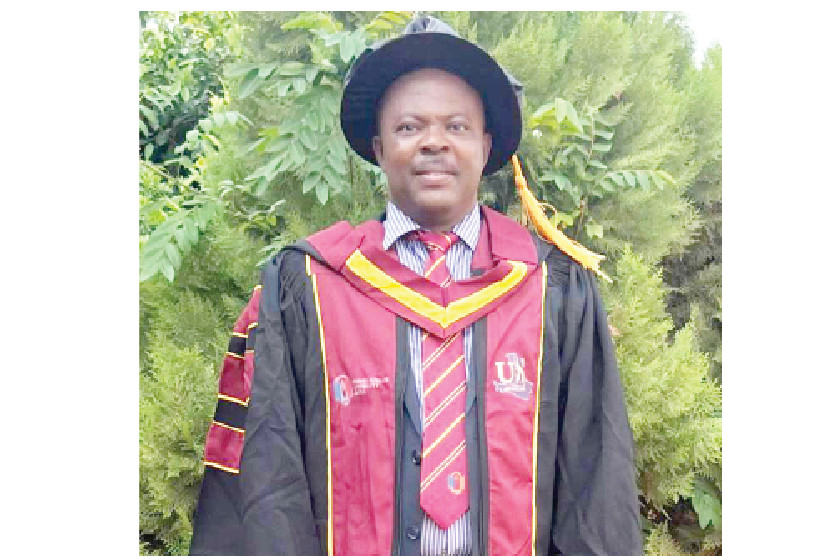
Dr. Valentine Obienyem is a rare academic breed, boasting a clean sweep of First-Class degrees in Philosophy across his Bachelor’s, Master’s, and Doctorate levels. Beyond the ivory tower, he is well-known as the senior media aide to the former governor of Anambra State and the Democratic Congress presidential flag-bearer for the upcoming 2027 general elections, Mr. Peter Obi. In this interview with OKECHUKWU OBETA, the triple first-class scholar shatters the myth of raw intelligence, buttressing that academic excellence requires rigorous discipline. Excerpts:
You have achieved a truly remarkable feat sweeping First-Class honors across your Bachelor’s, Master’s, and PhD in Philosophy, right after a background in Law. Can you specify the universities you attended, share your years of graduation and the secret behind this extraordinary academic run?
Let me start by telling you that I have explored multiple fields of study. My first degree was in Law at the University of Lagos, after which I attended the Nigerian Law School in Abuja. However, I did not graduate with a First Class in Law.
I later returned to school to pursue the discipline I love the most: Philosophy. I always describe it as my first love. It was in Philosophy that I achieved First-Class honors. I pursued this discipline through my Bachelor’s, Master’s, and PhD degrees, earning a First Class at every single level.
In fact, I just successfully defended my PhD thesis in Philosophy on the 20th of last month (May). For context, I earned my Bachelor’s degree in Philosophy in 2018, followed by my Master’s in 2021.
What personal discipline did you cultivate that helped you achieve such outstanding academic excellence?
Well, you have mentioned what helped me. Whether you call it personal discipline, institutional discipline, or community discipline, the keyword is discipline.
For you to make a First Class, you must be disciplined,not just disciplined in your academic life, but disciplined in everything you do.
Could you share some of the specific student lifestyle habits you adopted? How did you balance daily distractions with your studies?
You have to cultivate the discipline of self-control, you do everything in moderation. For instance, in this age of technology, pressing of phone, you do that in moderation, and, you do that when necessary. You imbibe the discipline of attending classes regularly.
You may be intelligent, you may be super intelligent, but, I can bet you that once you don’t attend classes, do your assignments, do everything as at, and, when due, you will see yourself getting a Second Class Lower.
But for you to get a First Class, you must set goals for yourself, you must start from day one, and, say this is what I want to be, this is the grade I want to get. And, once you are convinced within yourself, and, set out to achieve that, there isn’t much to that. You must be focused at all times, you must study seriously, do your assignments, and, pray to God to be with you, and, do with you according to His Will.
Some people hold the view that indulging in social activities affects a student’s chances of achieving academic excellence. What is your take on this?
On the contrary, it does not. It is about having time for everything. If you go to school as a student and you are married to your books only, you will come out a lopsided graduate.
In fact, students are even encouraged to pass through school, and allow the school to pass through them. The school passing through you means that you will partake in all aspects of school.
When I was in the seminary, the motto was ‘Christus in opere, studio et ludo’ (Christ in work, study, and play).
So, it means that you must do everything at its own time. When it is time for you to go and pray, you go and pray. When it comes to time to go and play, you go and play. When it is time for studies, you study hard. That is what makes you a holistic human being.
When you just take one aspect of life, you come out a lopsided person. So, getting a First Class is not about studying, studying, studying, no. You must balance everything you do.
Can a student who is not religious or prayerful still graduate with a First Class degree or achieve top academic excellence?
We have atheists who have made a First Class. So, making a First Class is not God-dependent; otherwise, the people in China or in India, even though they believe in their own God in their own way, would not excel. What I am trying to say is that there are some people who do not even believe in anything, but you see them making a First Class. So, it is not essentially God-dependent.
People who know you closely often describe you as highly successful. In an era where some argue that education is a scam, how much would you say your academic brilliance contributed to your success?
Well, you said that is people’s rating. But I am one man who despises rating people on wealth. I don’t rate people.
If you read my writings, there is one man I like quoting, one ancient philosopher called Democritus. Democritus said, ‘I would rather discover a single demonstration in geometry than win the throne of Persia.’ So, I believe in what Democritus said. So, I would rather make all efforts to become the Democritus of this world than become the richest man in this world.
My concern is: what do you do to add value to the society? And most often, that value doesn’t come by the amount of money we have, but the amount of effort we make to improve the society. So, I don’t believe in counting the amount of money someone has and rating the person based on that.
What exactly do you do now to earn a living, and how much has your academic excellence helped you succeed across these fields?
Well, I describe myself principally as a media consultant. I have a postgraduate degree in journalism. So, I see myself first and foremost as a media practitioner. I am a lawyer, and I do some businesses as well.
So, I earn a little living through all these three areas of expertise.
How much would you say your academic brilliance helps you achieve success in your various professional enterprises?
Let me answer this question by citing an example. I had a friend, and I was in a position to help that friend of mine, but all I needed was his certificate. Eventually, he didn’t attend any university. So, even though I had an opportunity to help him, he was constrained by the level of his academic attainment. So, in whatever we do, education has a major part to play.
In business, when you compare those who are educated with the uneducated, you will see that education enhances the tools with which you do whatever you do. If you are not educated and you possess those tools, they will be at the basic, crude levels. But with education, those tools are sharpened. So, education takes you higher in anything you do.
Like my boss, His Excellency, Mr. Peter Obi, will always say, it (education) is the currency we have to compete in the world. Education opens doors; with education, you have access to anything; it builds self-confidence. So, when you don’t have those things, you have critical drawbacks in success.
People who are familiar with your relationship with Mr. Peter Obi, dating back to his time as governor of Anambra State, often suggest that you brought him into the political limelight. What is your take on this?
Peter Obi is a self-made man. I encountered him after he became governor. When he was in court—the election tribunal pursuing the recovery of his 2003 stolen governorship mandate, I was supporting him, but at that time, I hadn’t met him physically.
I came to meet him after he became governor. In fact, he was the one who called me based on what I did for him, and asked whether I could work with him. So, having become governor before I met him, I think it is wrong to refer to me as the one who brought him to the limelight. He called me, and I joined him, and together everybody tried to do his own part.
And by doing our parts, our levels became elevated. His own level became elevated, and my own level became elevated as well. So, I think it is wrong to say that I’m the one who brought him to the limelight.
Many scholars note that intellectual discipline is often caught rather than taught. How has your own rigorous academic background shaped your philosophy of parenting, and in what ways have you seen your personal habits serve as a blueprint for your children’s development?
I am someone who believes that if we have a family, we should beget children that we should be able to manage. So, I have three kids, two of them are in the university, and one is still in secondary school.
And when they look at me reading at all times, they will tell me, ‘Daddy, we want to read like you.’ They say that when they grow up, they will be better than me. So, I can say that my education has helped my family to grow. Apart from helping me to do better in all aspects that I am doing, it has also been a big encouragement to my family because they always look at their daddy reading. And they say they want to be like their daddy.
For the benefit of the younger generation of students, how would you define your personal reading culture, and how has your relationship with books evolved over the course of your career?
I think I do more writing now than reading. As an undergraduate, the library was my second home. I would always go to the library and read every available tome. When I was doing it, I didn’t know the effect it would have on my life, but it is now that most of the knowledge I use is the residual knowledge I acquired during those periods of intense reading. Right now, I don’t read as much as I write, but I make use of the knowledge I acquired when I was reading.
So, my message to the young ones is that while you are in the university, that’s the opportunity to read. When you grow up and you are thrown into the society, you may not have time to read.
My normal routine is that once I come back from work or anything I am doing, I will go to bed. And if I go to bed, around 2 o’clock (am), I will wake up. If there is anything I need to read, I read it; if there is anything I need to write, I write it. And that has been my routine over the years now
Beyond your academic and professional endeavors, what activities or creative outlets do you engage in to unwind and find personal fulfillment?
Well, I used to play table tennis. But I don’t have enough time now to do so. In fact, writing is what gives me joy. When people call me and say, ‘I read what you wrote,’ it inspires me. That’s what gives me joy.
Given your long-standing intellectual and strategic involvement in His Excellency Mr. Peter Obi’s political journey, do you harbor any personal aspirations for elective office, or is your focus fixed on the broader national assignment?
Let me be frank with you. My political ambition is tied to Mr. Peter Obi’s political ambition. My ambition today is that Peter Obi becomes the President of Nigeria. As for having any political ambition to contest any elective post for now, my answer is no.
We’ve got the edge. Get real-time reports, breaking scoops, and exclusive angles delivered straight to your phone. Don’t settle for stale news. Join LEADERSHIP NEWS on WhatsApp for 24/7 updates →
Join Our WhatsApp Channel