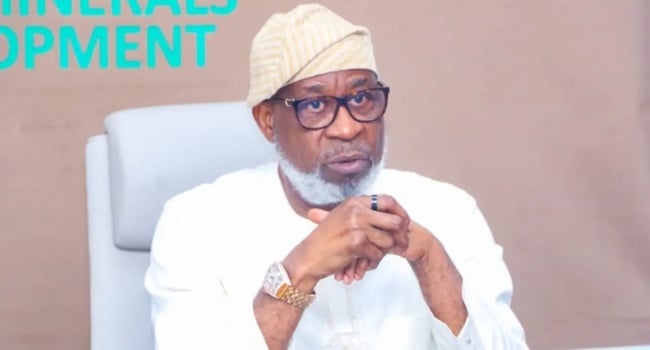
Nigeria’s minister of Solid Minerals Development, Dr Dele Alake, stated that reforms over the past two and a half years have attracted $2.6 billion in foreign direct investment (FDI) to the country’s mining sector.
Speaking at a panel discussion on “Critical Minerals in Africa: Meeting Global Demand” during the Powering Africa Summit in Washington, D.C., Alake attributed the investment gains to strengthened governance, improved regulations, digitisation of licensing, and enhanced ease of doing business.
“Within the last two and a half years, we have successfully de-risked and sanitized the sector, attracting over $2.6 billion in FDI,” Alake stated.
Alake also advocated for the creation of regional industrial hubs to drive Africa’s mining industry and accelerate cross-border industrialisation.
He highlighted that corridors such as the Lagos–Abidjan belt, spanning Nigeria, Benin, Togo, Ghana, and Côte d’Ivoire, or the Walvis Bay Corridor in Southern and Central Africa, could unlock the continent’s mineral potential. “These corridors would catalyse infrastructure development, energy access, local beneficiation, technology transfer, and regional integration,” he said.
“These reforms now guarantee mineral title holders secure tenure, providing the long-term stability required for investment decisions,” Alake said. He added that the government is expanding scientific geological data to aid investors.
Alake also addressed security challenges, noting the deployment of Mining Marshals, which led to the arrest of over 350 suspected illegal miners—including foreign nationals—within one year. More than 150 are currently facing prosecution.
The minister reaffirmed Nigeria’s welcome for investors complying with local laws, citing incentives such as tax waivers on mining equipment and full profit repatriation after royalties and taxes.
“We have de-risked and sanitised the mining environment,” he said.
Calls for Regional Energy Hubs
Alake urged the US and African nations to establish regional energy hubs to accelerate mining industrialisation and secure critical minerals for the global energy transition.
He proposed developing industrial corridors similar to the Lobito Corridor, including the Lagos-Abidjan route spanning Nigeria, Benin, Togo, Ghana, and Côte d’Ivoire, and the Walvis Bay Corridor in Southern and Central Africa.
“Such corridors would drive infrastructure, enhance energy access, and promote regional integration,” Alake stated. He suggested that nuclear power in one West African country could support an entire corridor, enabling local processing, technology transfer, and cross-border industry.“
If three to five such corridors are developed in Africa, we would significantly advance industrialization, creating a win-win for Africa and the West,” he added.
US Perspective and Panel Insights
Also speaking, senior vice president and global head of Origination at the US Export-Import Bank (EXIM), Sarah Whitten, emphasised the need for sustained government commitments beyond political cycles to enable collaborations.
“American banks are ready to support projects, but our role is to catalyse private sector capital,” Whitten said.
She noted institutions ready to finance critical minerals projects directly.
The panel also included Guinea’s Minister of Energy, Hon. Sekou Camara; managing partner at Denham Capital, Carl Tricoli; CEO of ReElement Technologies Africa, Ben Kinkaid; chief strategic Development Officer at TechMet, Heliana Matza; and Partner at McDermott Will & Emery, Jahan Khandokar.Alake credited reforms under President Bola Ahmed Tinubu’s administration for repositioning Nigeria’s mining sector as a driver of economic diversification.
We’ve got the edge. Get real-time reports, breaking scoops, and exclusive angles delivered straight to your phone. Don’t settle for stale news. Join LEADERSHIP NEWS on WhatsApp for 24/7 updates →
Join Our WhatsApp Channel