
For once, let’s start with some good news. In a country where we are constantly bombarded with stories of insecurity, political bickering, and economic hardship, something happened at the Presidential Villa last week that deserves more than a passing headline.
More than N65 billion was mobilised for the National Community Food Bank Programme. That’s not a campaign promise. That’s not a manifesto talking point. That’s real money, from real institutions, committed to a real problem, hunger.
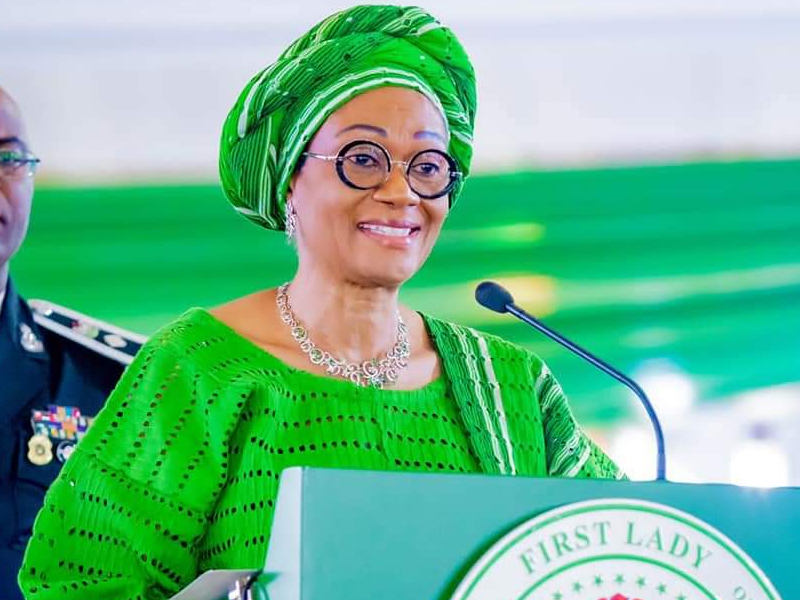
The First Lady, Remi Tinubu, inaugurated the Board of Trustees and fundraising ceremony for the Community Food Bank Trust Fund. And the commitments that followed were substantial. The Aliko Dangote Foundation pledged N20 billion in-kind support over five years. The Nigerian National Petroleum Company Limited committed N10 billion over the same period. The Federal Government, through a Social Action Fund intervention, put in N17 billion. The Nigeria Governors’ Forum matched that with another N17 billion. The Sir Emeka Offor Foundation pledged N500 million. Mrs Tinubu herself donated N500 million from her personal purse. Even anonymous donors described as “friends of Her Excellency” contributed an initial $500,000.
Now, I have been on this page long enough for readers to know I don’t do cheerleading. I don’t carry placards for any government. But when something meaningful is being done, especially on an issue as fundamental as child hunger and malnutrition, it would be intellectually dishonest to look the other way. Credit where credit is due.
Let me put the problem in context. According to the 2023/24 Nigeria Demographic and Health Survey, about four in ten Nigerian children under the age of five are stunted. Four in ten. That means their physical development, their ability to learn, their future productivity all compromised before they even start primary school. UNICEF estimates that Nigeria has the largest number of out-of-school children in the world, and 60 per cent of them are in the north. But malnutrition does not respect geopolitical zones. It is a national crisis, and it has been festering for decades while politicians spent their energy arguing about zoning and restructuring.
This is why the framing by the Coordinating Minister of Health and Social Welfare, Muhammad Ali Pate, is important. He said hunger is not just a food problem ,it is a health problem, a development problem, and a national responsibility. That’s the right language. Because when we reduce hunger to a welfare issue, we make it easy for governments to throw rice at voters during elections and call it intervention. What Pate is saying and what the structure of this programme suggests is that food security should be treated with the same seriousness as national security. And he is right.
What gives this initiative some credibility is the governance architecture around it. The Managing Director of the Bank of Agriculture, Ayodeji Sotinrin, made it clear that no single person can authorise disbursement. A minimum of three to five trustees must co-sign every approval. Contributions are held in a ring-fenced account with independent verification and quarterly reporting. And only food packages not cash will be distributed to beneficiaries. That last point is critical. We have seen too many government programmes where cash meant for the vulnerable ends up in the pockets of middlemen and party loyalists. If they stick to food-only distribution through the NPHCDA network, the chances of diversion are reduced.
Of course, sceptics will say we have heard all this before. And they have a point. Nigeria is littered with the carcasses of well-intentioned programmes that died at the implementation stage. The National Social Investment Programme under the Muhammadu Buhari administration had its own controversies, from ghost beneficiaries to political capture of beneficiary lists. The school feeding programme, while laudable in concept, was plagued by reports of uneven implementation and questionable accounting in several states. We have also seen conditional cash transfer schemes where the cash mysteriously vanishes between Abuja and the last mile. So the burden of proof is squarely on this new initiative to demonstrate that it is different from the graveyard of programmes that came before it.
But here is where I think the sceptics need to pause. The involvement of the private sector at this scale is noteworthy. When Dangote commits N20 billion and NNPC puts in N10 billion, these are not token gestures. These are significant sums from institutions with reputations to protect. The governors matching the federal government naira for naira also introduces a level of shared ownership that previous programmes lacked. Kwara State Governor Abdulrahman AbdulRazaq put it well when he said this is not just a health issue, it is a national issue. If the governors mean what they say, they should ensure the programme reaches every ward in their states, not just the wards that voted for them.
Mrs Tinubu also deserves commendation for putting her money where her mouth is. A personal donation of N500 million is not small change. And more importantly, the programme is structured to go beyond Abuja.
She has called for it to be taken across the six geopolitical zones. The real test will be whether it reaches the communities in Zamfara, Borno, and Sokoto where malnutrition rates are at their worst. It is easy to launch programmes in air-conditioned halls in Abuja. The harder part is getting food packages to a mother in a displaced persons camp in Maiduguri or a rural household in Kebbi.
I recall that Bill Gates, during a visit to Nigeria, advised the Federal Government that the country would do better with strong investments in health and education rather than concentrating on physical infrastructure to the detriment of human capital development. Africa’s richest man, Aliko Dangote, agreed, saying that for Nigeria to compete globally, government must prioritise health and education. This community food bank programme, if well-executed, is a step in that direction. You cannot build a productive workforce on empty stomachs. You cannot expect children to learn when they are malnourished. The foundation of any serious national development agenda is a healthy, well-fed population.
The representative of the Association of Local Governments of Nigeria, Hamisu Mohammed, pledged support and rightly so. Local governments are closest to the people. If this programme is going to work, the local government machinery must be functional.
This food bank programme will test whether our local government system can deliver anything to the people it was created to serve.
Let me also note something that may seem minor but is actually significant. The programme specifically targets children under six. That is deliberate and it is smart. The first 1,000 days of a child’s life from conception to age two are the most critical for brain development and physical growth. Intervening early is not charity, it is investment. A stunted child today becomes an unproductive adult tomorrow. Multiply that by millions and you begin to understand why Nigeria, despite its enormous resources, struggles to compete with countries half its size.
So where do we go from here? The money has been pledged. The governance structure has been set up. The right words have been said. What remains is execution. And that is where most Nigerian programmes go to die. I want to see quarterly reports made public, not buried in some government filing cabinet. I want to see independent audits conducted by reputable firms, not internal reviews that tell us what we want to hear. I want to see the NPHCDA network actually delivering food packages to vulnerable households across all 36 states, not just in a handful of pilot locations in Abuja and Lagos. I want to see the governors who pledged ₦17 billion actually release the funds on schedule, not treat it as another photo opportunity to be quietly forgotten after the cameras leave.
The private sector players also have a responsibility beyond writing cheques. Dangote Foundation, NNPC, and others who have committed funds should demand transparency in how their contributions are used. Corporate social responsibility should not end at the pledge ceremony. Follow the money. Ask for reports. Hold the programme managers accountable. That is what responsible partners do
If this programme delivers on its promise, it will be one of the most meaningful social interventions in recent memory. If it fails, it will join a long list of abandoned initiatives that remind us of our collective failure to take care of our most vulnerable.
The war against hunger is winnable. But it requires more than goodwill and press conferences. It requires sustained funding, transparent governance, and the political will to reach the people who need help the most not the people who shout the loudest. Nigeria has the resources. Nigeria has the institutions. What Nigeria has lacked, historically, is the discipline to see programmes through from launch to last mile. This food bank initiative has a chance to break that pattern. Whether it will or not depends entirely on the men and women entrusted with its implementation.
We’ve got the edge. Get real-time reports, breaking scoops, and exclusive angles delivered straight to your phone. Don’t settle for stale news. Join LEADERSHIP NEWS on WhatsApp for 24/7 updates →
Join Our WhatsApp Channel