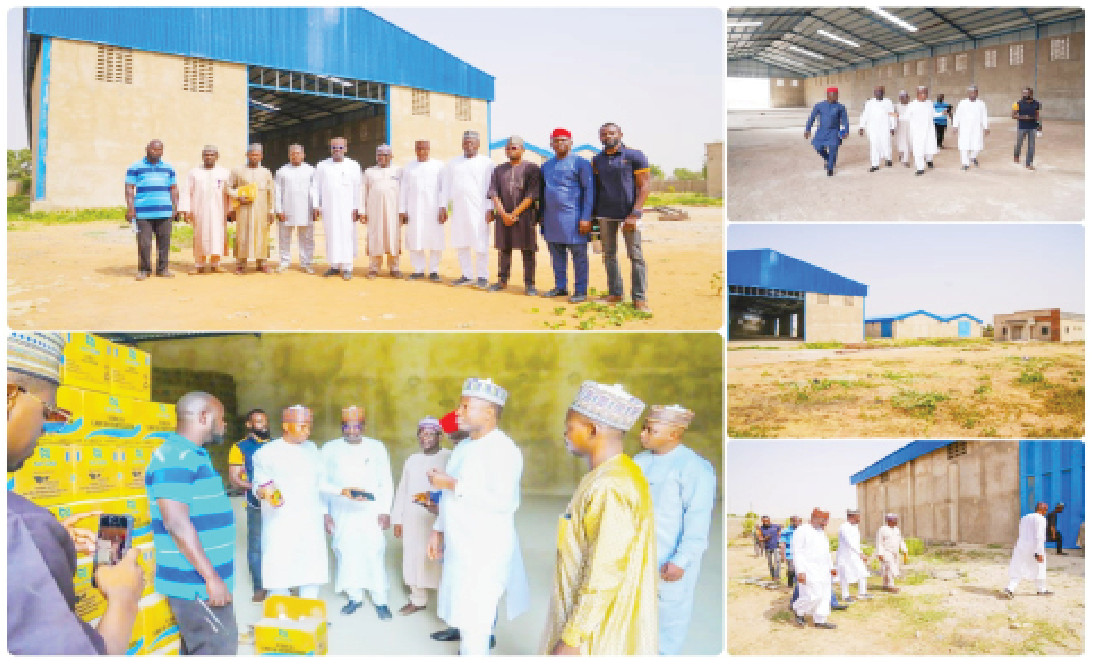
Nigeria’s agriculture ecosystem is about to witness a massive boost and innovation that will transform the sector into one of the most lucrative in the country and make food security a sustainable policy thrust of the President Bola Ahmed Tinubu’s Administration.
Indications to this development emerged during the recent visit of officials of the National Agency for Science and Engineering Infrastructure (NASENI), to its pioneering coal fertilizer and liquid fertilizer plants in Kano State, North-west Nigeria.
The pioneering coal fertilizer project by NASENI and its Nigerian partner, Whitefog Environmental Services Limited, is a bilateral agreement on technology transfer between the Federal Government of Nigeria represented by NASENI and Indonesia represented by PT Saputra Global Harvest for the coal fertilizer production in Nigeria signed in December 2023.
Also, NASENI and Whitefog are in partnership for production of liquid fertilizer in Nigeria. The NASENI-Whitefog projects aims to transform Nigeria’s agricultural landscape in line with President Bola Ahmed Tinubu’s 8-point Agenda on food security, aligning with Sustainable Development Goals 2 (Zero Hunger), 1 (No Poverty), 8 (Decent Work and Economic Growth), and 12 (Responsible Consumption and Production).
Since the emergence of Mr. Khalil Suleiman Halilu as the Executive Vice Chairman and CEO of NASENI, enormous positive changes marked by diverse projects and programmes have been recorded by the Agency in the last two years. The Agency has made investments in agriculture and agro-allied technologies.
Halilu’s introduction of the NASENI coal-based fertilizers (CFs) projects have multiple advantages such as improving soil health, enhancing nutrient-use efficiency when used with mineral fertilizers, and providing economic and strategic benefits such as reduced reliance on imports and job creation.
This brilliant idea from NASENI was crystallized from research and it was discovered that coal fertilizers, which are rich in humic substances and organic carbon, act as soil amendments, improving the soil’s physical, chemical, and biological properties. They can help restore degraded or nutrient-deficient soils prevalent in many parts of Nigeria.
Research also shows that the humic components in coal fertilizers can chelate and stabilize mineral nutrients, which helps to retain nitrogen and other elements in the soil longer and ensures their gradual, slow release. This improves the overall efficiency of nutrient uptake by crops, such as soybeans and cowpeas.
According to the research, by increasing soil organic matter and promoting the formation of soil aggregates, coal and liquid fertilizers enhance the soil’s structure, porosity, and water-holding capacity, making the soil more resilient to drought conditions.
While potentially lower in primary macronutrients (N, P, K) compared to conventional inorganic fertilizers, liquid and coal fertilizers can supply substantial amounts of essential secondary and micronutrients, including calcium, magnesium, manganese, zinc, boron, and iron.
By improving soil fertility and plant growth, liquid and coal-based fertilizers lead to higher crop yields and more reliable harvests, directly supporting Nigeria’s food security goals. Researches in Nigeria have also shown that integrated use of coal-based and NPK fertilizers consistently outperforms sole applications.
It is an established fact that utilizing Nigeria’s extensive domestic coal resources for fertilizer production reduces the nation’s reliance on costly imported fertilizers, saving foreign exchange and stabilizing input costs for farmers.
The project has the capacity to convert low-rank coal, which might otherwise be considered waste, into valuable agricultural inputs, thereby tackling environmental challenges associated with waste disposal. This is particularly of immense benefit to those in low-input farming systems, because effective utilization of locally produced, cost-effective coal-based fertilizers can lower overall production cost.
According to the Acting Coordinating Director, Engineering Infrastructure Directorate, NASENI Headquarters and Coordinator, NASENI-Whitefog project, Engr. Dr. Agava Abdullahi Abdulrasheed, who led a team to inspect construction of the two factories, “the projects will have profound impact on Nigeria’s agricultural sector, ensuring improved soil quality and fertility, increased crop yields and better harvests for farmers,” he said.
“Nigeria’s soil quality has been a major concern for farmers, with traditional NPK fertilizers often failing to provide necessary nutrients for optimal crop yields. The coal fertilizer, an innovative and eco-friendly alternative to traditional fertilizers, with its 26 additional mineral concentrates and activation technology, is poised to address this challenge,” he added.
Chairman, Whitefog Environmental Services Limited, Alhaji Hassan Inuwa Babura, speaking about the coal fertilizer, said “the plant has a permanent site along Wudil Road which and construction has already gone far. We have machineries which are on the way, about to be cleared at the seaport and would be installed. Production will commence by May or June 2026,” he added.
On the liquid fertilizer plant, he said “in the past it was using manual process to produce. But with the partnership and entrance of NASENI, it will use automated equipment which has been procured by the Agency to enhance operation.”
These two fertilizer plants will ensure food security, reduce dependency on current urea fertilizer, and bring the liquid and Coal-based fertilizers faster to the farmers for all round seasonal farming. These projects are coming at a time agriculture in Nigeria, though a major employer, faces significant challenges hindering productivity, including poor infrastructure (bad roads, lack of storage), reliance on crude, traditional tools, limited access to, modern inputs and financing, and severe insecurity.
These, combined with, climate change impacts, land tenure issues, and, high post-harvest losses, stifle growth and food security. Due to NASENI’s efforts and its counterpart funding, the fertilizer plants will achieve technology transfer as several engineers have already been trained abroad on coal production machine installation, operation, repair, and maintenance.
The coal fertilizer plants each will ensure a 5-tonne hourly and 1,040-tonne monthly production capacity. There are enough storage warehouses and administrative facilities in the premises. In the same vein, multimillion naira production machine and activators have been procured from Indonesia.
According to NASENI officials, once operational, the coal and liquid fertilizer plants are expected to have a profound impact on Nigeria’s agricultural sector improving soil quality and fertility, increasing crop yields and better harvests, enhanced food security and reducing reliance on imports, empowering farmers and improving livelihoods and contributing to Nigeria’s agro-industrialization.
As NASENI continues to drive innovation and technological advancement in Nigeria, the coal fertilizer project stands as a shining example of the Agency’s commitment to transforming the country’s agricultural landscape. With its potential to revolutionize farming practices and improve food security, the projects will create 2,000 direct jobs and over 20 million indirect jobs across the agricultural value chain stimulating economic growth and transforming the lives of millions of Nigerians.
As Nigeria works to join the rest of the industrialized societies, a modernized agriculture with massive crop production to support local industries, maximize productivity and ensure agro-allied industries, is inevitable. These two fertilizer plants initiative from NASENI on fertilizer production and food security are indeed, game changers in the agriculture ecosystem.
We’ve got the edge. Get real-time reports, breaking scoops, and exclusive angles delivered straight to your phone. Don’t settle for stale news. Join LEADERSHIP NEWS on WhatsApp for 24/7 updates →
Join Our WhatsApp Channel